


Key Takeaways
- Enterprise app features in 2026 are centered around AI automation, cloud scalability, enterprise security, and real-time decision-making.
- Modern enterprise applications must support API-first integrations, intelligent workflows, and seamless cross-platform collaboration.
- AI-powered features such as predictive analytics, workflow automation, AI copilots, and intelligent search are becoming essential business requirements.
- Cloud-native architecture, microservices, and DevOps practices are critical for enterprise scalability, flexibility, and operational resilience.
- Businesses should prioritize industry-specific enterprise application features to support complex workflows and long-term growth.
- Organizations investing in future-ready enterprise applications are achieving better productivity, operational efficiency, and digital transformation outcomes.
Enterprise applications are no longer just software systems that support business operations. In 2026, they are becoming the digital backbone of modern enterprises, powering automation, collaboration, security, and real-time decision-making across organizations.
Businesses relying on outdated systems are increasingly facing operational inefficiencies, disconnected workflows, scalability limitations, and growing cybersecurity risks. At the same time, organizations adopting AI-powered, cloud-native, and integration-ready enterprise applications are improving productivity, accelerating operations, and strengthening their competitive advantage.
As enterprise technology expectations continue to evolve, businesses now prioritize enterprise application features that support automation, seamless integrations, enterprise security, scalability, and long-term digital transformation.
That is why having a future-ready enterprise app feature checklist for 2026 is no longer optional. In this guide, we will explore the must-have enterprise app features for 2026, including AI and automation capabilities, enterprise security requirements, scalability essentials, and the role of an experienced enterprise mobile app development company in building scalable and future-ready solutions. It also covers industry-specific recommendations and key strategies businesses need to future-proof enterprise applications for long-term growth.
Table of Contents
Why is 2026 the Year the Enterprise App Checklist Changes?
Enterprise software has evolved dramatically over the last few years.
Traditional enterprise applications focused primarily on:
- Data storage
- Workflow management
- Reporting dashboards
- Employee management
- Basic automation
Several major technology shifts are driving this transformation:
1. AI-First Enterprise Operations
Artificial intelligence is now embedded into modern enterprise workflows. Companies are integrating AI copilots, intelligent analytics, predictive automation, and conversational interfaces into their enterprise ecosystems.
2. Cloud-Native Infrastructure
Organizations are rapidly shifting from legacy monolithic systems to scalable cloud-native architectures that support agility, flexibility, and continuous deployment.
As businesses replace legacy infrastructure with cloud-native ecosystems, application modernization solutions are becoming critical for improving scalability, operational agility, and long-term system performance.
3. Cybersecurity & Compliance Pressure
Global data regulations and increasing cyber threats require enterprise applications to include advanced security frameworks from the beginning.
4. Workforce Decentralization
Hybrid work models require enterprise platforms to support secure collaboration, real-time communication, remote accessibility, and cross-device compatibility.
5. API Economy & Connected Systems
Modern businesses rely on interconnected platforms. Enterprise applications must integrate with CRMs, ERPs, payment systems, analytics platforms, communication tools, and third-party APIs.
The result? The enterprise app feature checklist for 2026 looks completely different from what businesses considered sufficient even three years ago.
What Makes an Enterprise App Different in 2026?
Enterprise applications in 2026 are fundamentally different from consumer apps.
While consumer apps primarily focus on user engagement and convenience, enterprise applications are designed to optimize operations, automate processes, improve collaboration, strengthen security, and support large-scale business growth. Modern enterprise application features are increasingly designed around scalability, security, automation, and enterprise collaboration.
Here is a comparison:
| Feature Area | Consumer Apps | Enterprise Apps |
| Users | Individual customers | Teams, departments, organizations |
| Security | Standard login protection | Advanced enterprise-grade security |
| Integrations | Limited | Extensive API ecosystem |
| Scalability | Moderate | High-volume enterprise scalability |
| Workflows | Simple interactions | Complex operational workflows |
| Compliance | Basic | Multi-region compliance standards |
| Data Management | Limited datasets | Large-scale business intelligence |
| Automation | User convenience | Operational efficiency |
| AI Usage | Personalization | Predictive business intelligence |
| Access Controls | Simple roles | Granular permission management |
In 2026, successful enterprise applications are:
- AI-driven
- Integration-first
- Cloud-native
- Security-centric
- Scalable by design
- Analytics-enabled
- Workflow-oriented
- Automation-powered
Businesses that fail to adapt to these expectations risk operational inefficiencies, employee frustration, and long-term technical debt. Businesses increasingly rely on custom software development services to build enterprise applications tailored to complex workflows, industry-specific operations, and scalability requirements.
What Happens When Enterprise Apps Lack Modern Features?
Businesses relying on outdated enterprise applications often face operational inefficiencies, security risks, and scalability limitations that slow growth and reduce productivity.
Common Challenges
- Frequent downtime and slow system performance
- Manual workflows that reduce employee efficiency
- Security vulnerabilities and compliance risks
- Disconnected systems and poor integrations
- Increasing technical debt and maintenance costs
Without modern features like AI automation, cloud scalability, API integrations, and advanced security, enterprise applications can quickly become barriers to innovation and operational agility.
Legacy Enterprise Systems vs Modern Enterprise Applications
Modern enterprise applications are transforming how businesses operate, scale, and innovate. Compared to legacy systems, they offer better scalability, stronger security, seamless integrations, AI-driven automation, and improved operational efficiency.
Here is a comparison table for your convenience.
| Feature Area | Legacy Enterprise Systems | Modern Enterprise Applications |
| Architecture | Monolithic and rigid | Cloud-native and modular |
| Scalability | Limited scalability | Auto-scaling infrastructure |
| Integrations | Difficult and fragmented | API-first seamless integrations |
| Automation | Manual workflows | AI-powered automation |
| Security | Basic security controls | Enterprise-grade security frameworks |
| Deployment | Slow release cycles | CI/CD and rapid deployment |
| Accessibility | Limited device support | Cross-platform accessibility |
| Analytics | Static reporting | Real-time analytics and dashboards |
| Collaboration | Siloed communication | Connected collaborative workflows |
| Maintenance | High technical debt | Flexible and easier modernization |
Must-Have Enterprise App Features Checklist for 2026
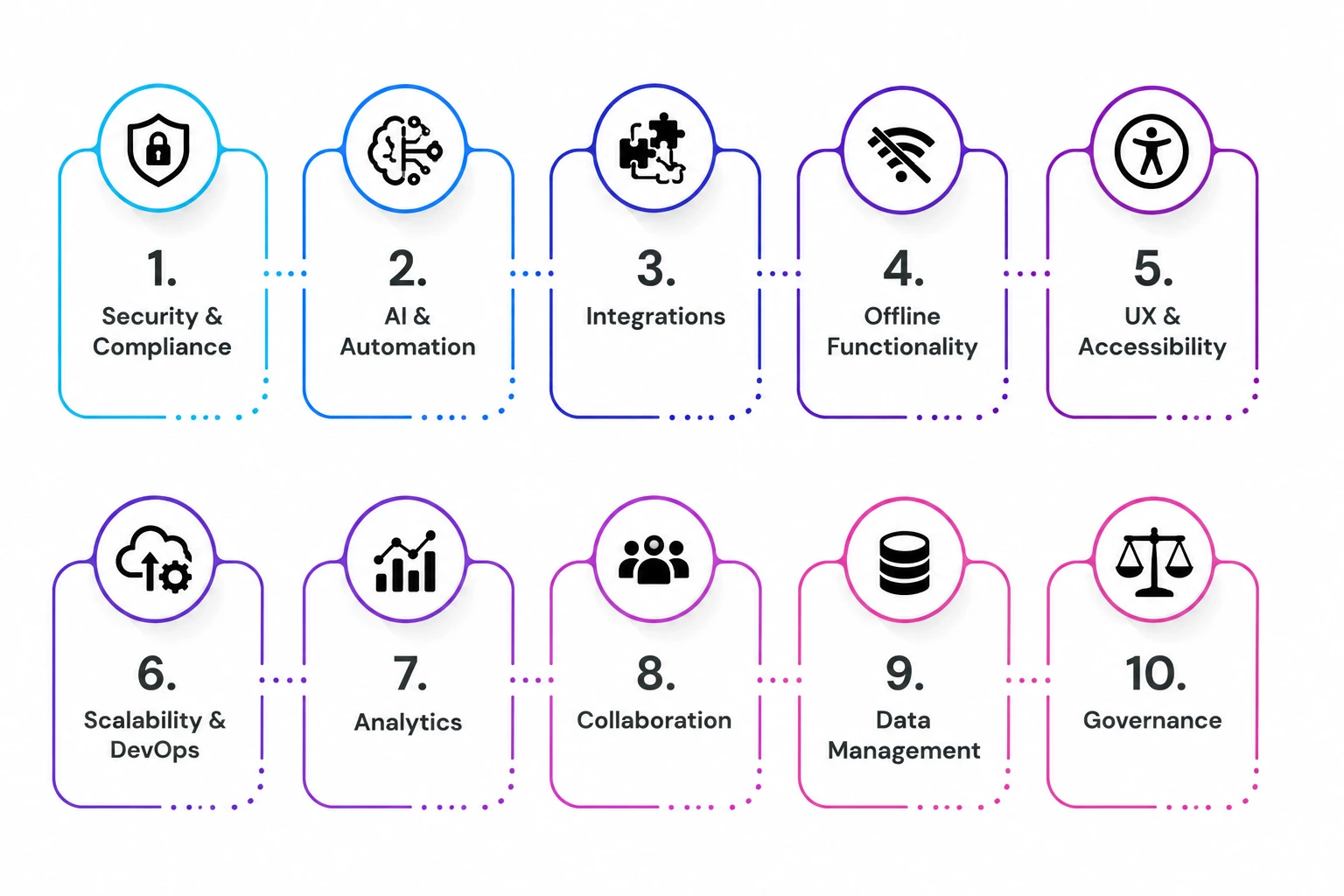
Understanding the key features of enterprise apps helps businesses build scalable and future-ready digital ecosystems:
| Category | Must-Have Features |
| Security & Compliance | Multi-factor authentication, encryption, role-based access, audit logs, compliance tracking |
| AI & Automation | AI copilots, predictive analytics, workflow automation, intelligent search |
| Integrations | API-first architecture, ERP integration, CRM integration, third-party connectors |
| Offline Functionality | Offline sync, local caching, conflict resolution |
| UX & Accessibility | Responsive UI, accessibility compliance, fast performance, multilingual support |
| Scalability & DevOps | Cloud-native architecture, microservices, CI/CD pipelines, monitoring |
| Analytics | Real-time dashboards, data visualization, and custom reporting |
| Collaboration | Team messaging, task assignment, shared workspaces |
| Data Management | Centralized data governance, backups, and recovery systems |
| Governance | Admin controls, policy management, usage tracking |
The sections below explain each category in detail:
1. Security & Compliance Features: The Non-Negotiables
Security is no longer an add-on feature. Enterprise-grade security frameworks are now considered must-have enterprise app features rather than optional additions.
For enterprise applications in 2026, security architecture directly impacts:
- Customer trust
- Legal compliance
- Brand reputation
- Operational continuity
- Business scalability
A single security vulnerability can expose sensitive customer data, disrupt operations, and create massive financial losses. That is why modern enterprise applications must include enterprise-grade security frameworks from the beginning.
Multi-Factor Authentication (MFA)
MFA adds a security layer beyond passwords using:
- OTP verification
- Authentication apps
- Biometric verification
- Hardware security keys
Role-Based Access Control (RBAC)
Enterprise applications must allow businesses to define granular permissions for:
- Admins
- Managers
- Employees
- Vendors
- External stakeholders
This prevents unauthorized access and limits internal security risks.
End-to-End Encryption
Data should remain encrypted:
- At rest
- In transit
- During backups
Encryption standards like AES-256 and TLS protocols are now industry requirements.
Audit Logs & Activity Tracking
Enterprise applications should maintain detailed logs of:
- User activity
- Login attempts
- System changes
- Workflow actions
- Security events
Audit logs improve accountability and support compliance requirements.
Compliance Management
Depending on the industry, enterprise apps may need support for:
- GDPR
- HIPAA
- SOC 2
- ISO 27001
- PCI DSS
- CCPA
Compliance-ready architecture reduces legal risks and accelerates enterprise adoption.
Single Sign-On (SSO)
SSO improves usability and security by allowing employees to access multiple systems using a single authentication layer.
Threat Detection & Monitoring
Modern enterprise applications increasingly use AI-powered monitoring systems to identify:
- Suspicious activity
- Unusual login behavior
- Potential breaches
- Malware threats
- API abuse
2. AI & Intelligent Automation Features: The 2026 Differentiators
AI is becoming the biggest differentiator in enterprise software. Gartner forecasts rapid enterprise expansion in AI adoption, with AI spending increasing by over 40% in 2026 as organizations scale production use cases across automation, analytics, and decision intelligence.
Businesses no longer want software that only stores information. They want systems that can:
- Predict outcomes
- Automate decisions
- Generate insights
- Improve productivity
- Reduce manual workloads
This is why AI-powered enterprise applications are becoming the new standard. Many enterprises now partner with an AI app development company to build intelligent automation systems, AI copilots, predictive analytics tools, and workflow optimization solutions.
AI Copilots & Conversational Interfaces
AI copilots help employees:
- Retrieve information faster
- Generate reports
- Automate documentation
- Summarize workflows
- Analyze business data
- Answer operational queries
Conversational AI interfaces improve productivity significantly across departments.
Predictive Analytics
Modern enterprise apps use machine learning models to forecast:
- Sales trends
- Operational bottlenecks
- Inventory demand
- Customer behavior
- Workforce requirements
- Financial risks
This helps businesses make proactive decisions instead of reactive ones.
Intelligent Workflow Automation
AI-powered workflow systems can automate:
- Approval chains
- Data entry
- Invoice processing
- HR onboarding
- Customer support routing
- Task prioritization
Automation reduces operational costs while improving efficiency.
Intelligent Search Systems
Enterprise knowledge bases are growing rapidly.
AI-powered semantic search helps employees quickly retrieve:
- Documents
- Policies
- Reports
- Customer records
- Internal resources
instead of relying on outdated keyword-based searches.
AI Governance & Responsible AI
One major gap in many enterprise applications is AI governance.
In 2026, enterprise AI systems must include:
- Explainable AI mechanisms
- AI usage monitoring
- Human approval workflows
- Bias detection systems
- AI policy enforcement
- Data governance controls
According to IBM, businesses are increasingly adopting enterprise AI governance frameworks to ensure responsible AI deployment, compliance management, and operational transparency.
3. System Integration & API Architecture Features
Modern enterprises operate using multiple interconnected systems. An enterprise application that cannot integrate smoothly becomes a bottleneck.
That is why API-first architecture is now essential.
Core Integration Features
REST & GraphQL APIs
Enterprise applications should expose flexible APIs that allow:
- Data exchange
- Third-party integrations
- Custom workflows
- Cross-platform connectivity
ERP Integration
Integration with ERP systems helps centralize:
- Financial operations
- Supply chain data
- Procurement workflows
- Inventory management
CRM Integration
CRM connectivity improves:
- Customer visibility
- Sales tracking
- Marketing automation
- Customer support workflows
Third-Party Service Integration
Enterprise apps often integrate with:
- Slack
- Microsoft Teams
- Salesforce
- SAP
- HubSpot
- Stripe
- Power BI
- Tableau
- Google Workspace
- Microsoft 365
Event-Driven Architecture
Modern enterprise systems increasingly rely on event-driven communication to support:
- Real-time updates
- Faster synchronization
- Microservices scalability
- Distributed workflows
Integration Monitoring
Enterprise applications should include monitoring systems that detect:
- Failed API requests
- Delayed syncs
- Data inconsistencies
- Service outages
Many enterprises also adopt DevOps consulting services to improve deployment efficiency, automate testing workflows, and maintain infrastructure reliability at scale.
4. Offline Functionality & Data Synchronisation
Enterprise users often work in environments with inconsistent internet connectivity. Field teams, healthcare workers, logistics staff, sales teams, and manufacturing professionals all require uninterrupted access to enterprise systems.
That makes offline capability a critical enterprise feature.
Local Data Caching
Applications should temporarily store critical data locally so users can continue working offline.
Background Synchronisation
When connectivity returns, the system should automatically synchronize:
- User updates
- Reports
- Task changes
- Inventory records
- Operational logs
Conflict Resolution Systems
Enterprise apps must handle scenarios where:
- Multiple users edit the same data
- Offline changes overlap
- Synchronization conflicts occur
Smart conflict resolution prevents data corruption.
Offline Workflow Support
Businesses should identify mission-critical workflows that must function even without connectivity.
Examples include:
- Delivery confirmations
- Healthcare documentation
- Inspection reports
- Field service updates
- Warehouse operations
5. UX, Accessibility & Performance Features
Enterprise users expect modern and intuitive user experiences. Businesses are also placing greater emphasis on effective UI/UX design services to improve usability, simplify workflows, and support better productivity across enterprise platforms.
Poor UX creates:
- Employee frustration
- Lower adoption rates
- Reduced productivity
- Increased training costs
In 2026, enterprise applications must deliver consumer-grade usability while supporting enterprise complexity.
- Responsive User Interfaces: Enterprise applications should deliver seamless user experiences across desktops, tablets, smartphones, and large enterprise displays to support workforce mobility and operational flexibility.
- Accessibility Compliance: Modern enterprise apps should support accessibility standards such as WCAG compliance, screen readers, keyboard navigation, high-contrast modes, text scaling, and voice assistance to ensure inclusive and user-friendly experiences for all employees.
- Fast Performance: Slow enterprise applications can negatively impact productivity, employee experience, and operational efficiency. Businesses should prioritize fast page loads, optimized caching, and real-time performance monitoring to ensure smooth and reliable enterprise operations.
- Personalised Dashboards: Modern enterprise users want customizable interfaces where they can track KPIs and configure reports.
- Multilingual Support: Global enterprises require multilingual capabilities to support distributed teams.
Businesses working with an enterprise mobile app development company increasingly prioritize responsive interfaces, cross-device compatibility, and seamless workforce mobility to improve enterprise productivity.
6. Scalability, Cloud Architecture & DevOps Features
Enterprise applications must scale efficiently as businesses grow.
Scalability problems can quickly lead to:
- Downtime
- Slow performance
- Increased infrastructure costs
- Operational disruptions
That is why cloud-native architecture and DevOps practices are essential in 2026.
Cloud-Native Infrastructure
Modern enterprise apps increasingly rely on:
- AWS
- Microsoft Azure
- Google Cloud
- Kubernetes
- Docker
Cloud-native systems improve flexibility and scalability.
Microservices Architecture
Microservices allow businesses to:
- Scale modules independently
- Deploy faster updates
- Reduce downtime risks
- Improve resilience
CI/CD Pipelines
Continuous Integration and Continuous Deployment help enterprises:
- Release features faster
- Reduce deployment risks
- Improve software quality
- Accelerate testing workflows
Auto-Scaling Systems
Applications should automatically scale resources based on:
- Traffic spikes
- User demand
- Processing workloads
- Geographic usage patterns
Monitoring & Observability
Modern enterprise systems should include:
- Real-time monitoring
- Error tracking
- Infrastructure analytics
- Performance dashboards
- Incident alerts
Enterprises also increasingly rely on proactive application maintenance services to monitor performance, reduce downtime risks, and maintain long-term operational stability.
Composable Enterprise Architecture
Composable enterprise systems typically combine:
- Microservices
- API-first infrastructure
- Cloud-native deployment
- Event-driven architecture
This checklist helps CTOs, product leaders, and enterprises evaluate key features of enterprise apps before development or modernization.
7. Analytics & Business Intelligence Features
Modern enterprises rely on data-driven decision-making. Enterprise applications in 2026 must provide real-time visibility into operations, customer behavior, and business performance.
Real-Time Dashboards
Enterprise apps should provide dashboards for:
- Operational KPIs
- Sales performance
- Team productivity
- System monitoring
Custom Reporting
Businesses need flexible reporting tools to:
- Generate custom reports
- Track department metrics
- Export analytics
- Automate reporting workflows
Predictive Business Intelligence
AI-powered analytics helps businesses forecast:
- Revenue trends
- Customer behavior
- Demand fluctuations
- Operational risks
Data Visualization
Modern enterprise platforms should support:
- Interactive charts
- KPI tracking
- Trend analysis
- Performance dashboards
8. Collaboration & Workforce Management Features
Enterprise applications must support seamless collaboration across distributed teams and departments.
Team Communication Tools
Modern enterprise apps often include:
- Team messaging
- Shared channels
- Notifications
- Video collaboration
Task & Workflow Management
Enterprise systems should support:
- Task assignment
- Workflow approvals
- Deadline tracking
- Process automation
Shared Workspaces
Collaborative workspaces help teams:
- Share documents
- Track updates
- Collaborate in real time
- Manage project assets
Cross-Department Collaboration
Enterprise applications should enable smooth collaboration between:
- HR
- Finance
- Operations
- Customer support
- Leadership teams
9. Data Management & Governance Features
Enterprise applications manage large volumes of business-critical data, making governance and reliability essential.
Centralized Data Management: Modern enterprise systems should centralize customer data, financial records, operational workflows, and analytics datasets to improve accessibility, consistency, and decision-making.
Backup & Disaster Recovery: Enterprise applications should include automated backups, disaster recovery systems, and restoration workflows to minimize downtime and ensure business continuity.
Data Governance Controls: Businesses increasingly require access policies, compliance auditing, retention management, and data quality monitoring to maintain security and regulatory compliance.
Master Data Synchronization: Enterprise applications should synchronize data across ERP systems, CRM platforms, cloud environments, and third-party integrations to prevent inconsistencies and operational silos.
10. Admin Controls & Governance Features
Enterprise applications require strong governance systems to manage users, workflows, and operational oversight.
- Centralized Admin Panels: Administrators should have centralized control over user permissions, security settings, workflow configurations, and integrations to maintain operational efficiency and system security.
- Policy Management: Enterprise platforms should support security policies, compliance rules, AI governance, and data handling standards to reduce operational and regulatory risks.
- Usage Monitoring & Auditability: Organizations need visibility into user activity, system usage, workflow performance, and security events to improve accountability and operational monitoring.
- Role-Based Governance: Modern enterprise systems should support structured governance models for executives, managers, employees, and external collaborators through granular access controls and permission management.
Features by Industry: What Each Sector Cannot Miss
Different industries require specialized enterprise app features.
Here is a sector-wise breakdown:
| Industry | Critical Enterprise App Features |
| Healthcare | HIPAA compliance, patient records, telemedicine integration, appointment workflows |
| FinTech | Fraud detection, secure transactions, KYC workflows, audit trails |
| Logistics | Real-time tracking, route optimization, offline sync, fleet monitoring |
| Retail | Inventory management, omnichannel integration, and customer analytics |
| Manufacturing | IoT integration, predictive maintenance, production monitoring |
| Education | LMS integration, virtual classrooms, and attendance tracking |
| Real Estate | CRM integration, document management, property analytics |
| HR & Workforce | Employee onboarding, payroll workflows, and attendance automation |
| Travel & Hospitality | Booking systems, loyalty programs, and real-time notifications |
| Enterprise SaaS | Multi-tenancy, API management, subscription billing |
Businesses should never rely on generic enterprise feature lists alone. Industry-specific workflows significantly influence feature prioritization. Businesses offering subscription-based enterprise platforms increasingly depend on SaaS product development services to support multi-tenancy, API integrations, and scalable cloud infrastructure.
Real-World Enterprise App Success Stories By RipenApps
Enterprise app features are already powering large-scale digital platforms across industries. These real-world implementations from RipenApps demonstrate how scalability, AI, and performance-driven architecture translate into measurable business impact.
Hungama: Large-Scale Streaming Platform
We built a high-performance streaming ecosystem for Hungama, designed to support a vast digital content library and high user traffic at scale. The platform delivers access to 30M+ songs and 8,000+ movies, serving millions of users across devices.
Key features:
- AI-based content recommendation system
- Adaptive bitrate streaming for uninterrupted playback
- Scalable architecture for handling high concurrent users
- Cross-device synchronization
This project highlights the importance of AI-driven personalization, scalability, and real-time performance optimization in modern enterprise streaming platforms.
eGurukul: EdTech Learning Platform
eGurukul is a digital learning platform designed to deliver structured medical education content to a large learner base across devices. The platform supports 500K+ learners with scalable and accessible digital learning experiences.
Key features:
- Cloud-based learning management system (LMS)
- Offline access for uninterrupted learning
- Optimized video streaming performance
- Personalized learning experience
This solution demonstrates how enterprise apps in EdTech must focus on accessibility, scalability, and offline-first learning experiences.
Cobone: Digital Deals Marketplace
Cobone is a high-performance digital deals platform built to manage large-scale offers across travel, dining, and retail categories.
Key features:
- Secure payment gateway integration
- Real-time deal and offer management
- High-performance architecture for traffic spikes
- Location-based personalization
This reflects the need for secure, scalable, and API-driven architectures in modern digital commerce platforms.
Common Enterprise App Feature Mistakes in 2026
Many enterprise projects fail because businesses prioritize short-term requirements instead of long-term scalability.
Here are the most common mistakes companies still make:
1. Ignoring AI Readiness
Some businesses still build enterprise apps without AI integration capabilities. This creates expensive modernization costs later.
2. Weak Integration Planning
Enterprise apps that cannot integrate smoothly create operational silos. Disconnected systems reduce productivity and increase manual work.
3. Underestimating Security Requirements
Security cannot be treated as a secondary phase. Enterprise-grade protection must be embedded into the architecture from the beginning.
4. Poor Scalability Planning
Applications built only for current usage often struggle during growth. Scalability planning should include:
- Infrastructure scaling
- Database optimization
- Cloud architecture
- API performance
5. Overcomplicated User Experience
Many enterprise applications become overly complex. Complex interfaces reduce employee adoption and increase training costs.
6. Ignoring Offline Workflows
Field operations frequently require offline capabilities. Ignoring this need can disrupt operational continuity.
7. Lack of Analytics & Reporting
Businesses increasingly depend on data-driven decision-making. Enterprise applications without robust analytics quickly become outdated.
Business Impact of Modern Enterprise App Features
Modern enterprise applications are designed not only to improve operations but also to deliver measurable business value.
AI automation, scalable cloud infrastructure, and integrated enterprise workflows help organizations reduce manual workloads, improve productivity, accelerate execution, and support long-term scalability.
Businesses commonly track the following performance metrics after deployment:
| Enterprise KPI | Business Impact |
| Workflow Automation | Reduced manual effort |
| Employee Productivity | Faster operations |
| System Downtime | Improved continuity |
| Integration Efficiency | Better collaboration |
| AI Automation Coverage | Higher scalability |
Businesses investing in AI-powered, scalable, and integration-ready enterprise applications are increasingly achieving stronger operational efficiency, faster decision-making, and improved long-term digital transformation outcomes. Understanding the enterprise app development in detail also helps organizations build more scalable and future-ready digital ecosystems.
Final Thoughts
Enterprise app features are evolving beyond traditional operational capabilities. In 2026, businesses need AI-powered, cloud-native, scalable, and integration-ready platforms to stay competitive in a fast-changing digital landscape. Modern enterprise applications support intelligent automation, real-time decision-making, seamless connectivity, stronger security, and improved operational efficiency. Organizations investing in future-ready enterprise systems are achieving higher productivity, better scalability, faster execution, and stronger business resilience. Businesses investing in mobile application development services are increasingly focusing on scalable, AI-powered, and integration-ready enterprise ecosystems that support long-term digital transformation and operational efficiency.
At RipenApps, we help businesses build scalable, secure, and AI-driven enterprise applications tailored for modern operational demands and future business growth. From enterprise mobility platforms to intelligent workflow automation systems, our team delivers custom enterprise solutions engineered for scalability, operational efficiency, and long-term digital transformation success.

FAQs
Q1. What are the most important enterprise app features in 2026?
The most important enterprise app features in 2026 include AI automation, cloud-native scalability, enterprise security, API-first integrations, real-time analytics, workflow automation, and offline functionality.
Q2. Why is AI becoming essential in enterprise applications?
AI is essential in enterprise applications because it enables predictive analytics, workflow automation, intelligent decision-making, and improved productivity while reducing manual effort across business operations.
Q3. What security features should enterprise apps include?
Enterprise apps should include multi-factor authentication (MFA), role-based access control (RBAC), encryption, audit logs, single sign-on (SSO), compliance frameworks, and AI-powered threat detection.
Q4. Why is API-first architecture important for enterprise apps?
API-first architecture is important because it enables seamless integration with CRMs, ERPs, third-party tools, and enterprise systems, ensuring flexibility, scalability, and faster digital transformation.
Q5. How do enterprise apps support scalability?
Enterprise apps support scalability through cloud-native architecture, microservices, auto-scaling systems, and DevOps pipelines, enabling them to handle growing user and workload volumes efficiently.
Q6. What industries benefit most from enterprise applications?
Industries such as healthcare, finance, logistics, retail, manufacturing, education, and SaaS benefit most from enterprise applications due to their complex workflows and data-driven operations.
Q7. Why is accessibility important in enterprise software?
Accessibility is important because it ensures usability for all employees, supports compliance with global standards like WCAG, and improves productivity across diverse enterprise teams.
SHARE
WRITTEN BY

Ishan Gupta
CEO & Founder
Ishan Gupta is a seasoned entrepreneur and CEO with extensive 8+ years of experience in business and mobile app development landscape. He believes that the right digital product allows companies to focus on what they do best, while technology handles the rest. With deep exposure to global markets, he understands what makes an app succeed. His approach translates business needs into clear product strategies, ensuring that every feature contributes to measurable ROI.
View All Articles


 India
India USA
USA Australia
 Canada
 UK
UK UAE
UAE