


Key Takeaways
- React Native enables businesses to build iOS and Android apps from a shared codebase, reducing development time and costs.
- Modern React Native apps deliver near-native performance for most business and consumer use cases.
- AI integration, real-time features, and scalable architecture are becoming standard requirements for React Native applications.
- Success depends more on app architecture, state management, and scalability planning than on the framework itself.
- React Native is well-suited for startups, enterprises, marketplaces, fintech, healthcare, and on-demand app development.
- Poor navigation systems, bridge bottlenecks, memory issues, and legacy package debt are common scaling challenges that teams must address early.
- The total cost of React Native app development is influenced by app complexity, integrations, infrastructure, and long-term maintenance requirements.
- Businesses should evaluate React Native against native and PWA approaches based on product goals, performance needs, and budget constraints.
- Modern React Native development increasingly relies on AI-powered experiences, cloud-native infrastructure, and continuous delivery workflows.
- Choosing an experienced React Native app development company helps reduce technical debt, improve scalability, and accelerate time to market.
Building separate iOS and Android applications was once considered the only way to deliver premium mobile experiences. Today, businesses are under pressure to launch faster, control development costs, and scale digital products without doubling engineering efforts. This shift has made cross-platform development a strategic business decision rather than just a technical choice.
For years, cross-platform app development was treated as a compromise. Businesses often assumed they had to choose between faster development speed and high-quality mobile experiences. In 2026, that assumption no longer holds true. React Native has evolved far beyond a simple cost-saving framework and is now powering large-scale, production-grade applications across industries, including fintech, healthcare, eCommerce, logistics, SaaS, and enterprise mobility.
What changed significantly is not just the framework itself, but the surrounding ecosystem. The introduction of React Native’s New Architecture, the growing maturity of Expo, improvements in rendering performance, and deeper native interoperability have made React Native far more capable than earlier generations of cross-platform frameworks. Businesses are now building apps with near-native performance, shared codebases, faster release cycles, and scalable product architectures without sacrificing user experience quality.
At the same time, businesses have become more practical about mobile investments. Most companies no longer want to maintain two completely separate mobile teams unless platform-specific performance genuinely creates measurable business value. React Native enables organizations to validate products more quickly, reduce engineering overhead, and maintain consistent features across both iOS and Android ecosystems simultaneously.
This growing demand has also increased interest in professional React Native app development services, as businesses seek experienced teams that can accelerate development, optimize performance, and build scalable mobile products for long-term growth.
However, experienced product teams also understand that React Native is not a universal solution for every app category. The strongest business outcomes typically arise from understanding where React Native excels, where native architecture still offers advantages, and how to structure applications to prevent scalability and performance bottlenecks later.
Table of Contents
Why Businesses Choose React Native for Mobile App Development in 2026
React Native has become one of the most widely adopted frameworks for modern mobile app development because it aligns closely with how businesses now approach digital product delivery. The growing demand for React Native for mobile app development is driven by the need for faster launches, efficient resource utilization, and scalable product growth. Companies increasingly prioritize faster go-to-market timelines, leaner engineering operations, unified product experiences, and scalable iteration cycles instead of maintaining fragmented mobile ecosystems.
The framework allows businesses to build applications for both iOS and Android using a largely shared codebase, reducing duplicate engineering effort while accelerating feature delivery. For startups, this improves MVP speed. For enterprise organizations, it simplifies long-term product maintenance and release coordination across platforms.
Another major reason React Native continues gaining traction is hiring flexibility. Businesses can scale product teams faster because JavaScript and TypeScript talent pools remain significantly larger than fully specialized native mobile engineering teams in many markets.
Who is Actually Using React Native: Meta, Shopify, Microsoft, Tesla and Beyond
One of the strongest indicators of React Native’s maturity is the type of companies using it in production environments. Major organizations, including Meta, Shopify, Microsoft, and Tesla, have integrated React Native into critical parts of their mobile ecosystems.
These companies are not using React Native simply to reduce development costs. They use it to accelerate feature deployment, maintain platform consistency, improve engineering efficiency, and simplify product iteration cycles across rapidly evolving applications.
At the same time, most large-scale companies do not rely on React Native blindly for every workflow. In practice, businesses often combine React Native with selectively optimized native modules where deeper hardware access or platform-level performance becomes necessary.
What Has Changed in React Native in 2026 That Makes It More Compelling Than Ever
The biggest shift in React Native over the last few years has been architectural maturity. Earlier versions were often criticized for bridge-related performance bottlenecks, inconsistent rendering behavior, and scaling limitations in highly interactive applications.
The New Architecture fundamentally changed that conversation through:
- JSI (JavaScript Interface),
- Fabric Renderer,
- TurboModules,
- and improved native interoperability.
These improvements significantly reduced communication overhead between JavaScript and native layers, resulting in smoother animations, faster rendering, and more stable runtime performance.
Another important change is the maturity of the surrounding ecosystem. Tools like Expo, EAS Update, React Native Reanimated, and modern TypeScript-first workflows have streamlined development operations substantially.
One operational advantage businesses increasingly value is over-the-air update capability. Product teams can now ship bug fixes, UI improvements, and feature adjustments much faster without waiting for lengthy App Store or Play Store review cycles in many scenarios.
What Is React Native and How Does It Work
React Native is an open-source mobile app development framework created by Meta that allows developers to build iOS and Android applications using JavaScript and TypeScript. Instead of creating two completely separate mobile codebases, businesses can share a significant portion of application logic across platforms while still delivering near-native mobile experiences.
What makes React Native different from older hybrid frameworks is that it does not render apps inside a web view. Instead, React Native communicates with native platform components directly, allowing apps to feel much closer to fully native mobile applications in terms of interaction quality and responsiveness.
This balance between development efficiency and user experience quality is one of the primary reasons businesses increasingly choose React Native for scalable product development.
React Native Explained
At its core, React Native combines JavaScript-based business logic with native UI rendering. Developers write application logic using React concepts such as components, state management, hooks, and reusable UI structures, while the framework translates those interactions into native platform elements.
This means a button inside a React Native app is not a simulated web button. It becomes an actual native iOS or Android component rendered by the device itself.
For businesses, this creates an important advantage. Teams can move faster with shared engineering workflows while still delivering mobile experiences that feel platform-native to end users.
How the New Architecture Works
One of the biggest reasons React Native performance has improved dramatically in recent years is the New Architecture. Older versions relied heavily on a communication layer called the Bridge, which often created latency during heavy UI interactions and real-time updates.
The New Architecture introduced JSI (JavaScript Interface), Turbo Modules, and Fabric Renderer to reduce communication overhead between JavaScript and native layers.
In practice, this means smoother animations, faster rendering, lower memory usage, and better responsiveness across complex mobile workflows. Businesses building apps with real-time dashboards, live tracking, AI-powered interactions, or highly interactive UI systems
benefit significantly from these architectural improvements.
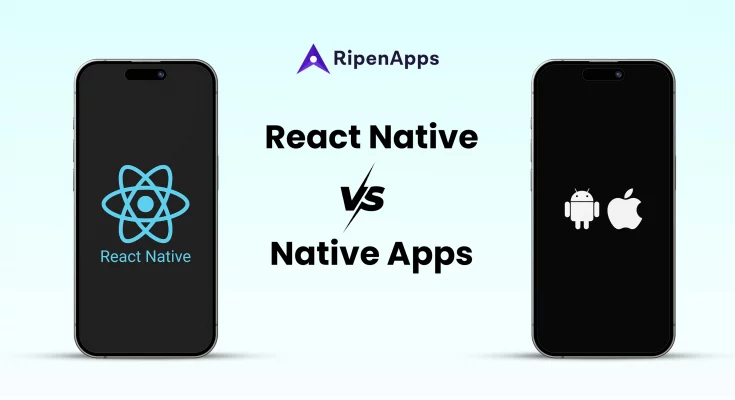
React Native vs Traditional Native Development
Traditional native development involves building separate applications for iOS and Android using platform-specific technologies like Swift for iOS and Kotlin for Android. This approach provides deeper hardware integration, highly optimized performance, and stronger platform-level customization. Native development is often preferred for products involving:
- graphics-intensive rendering,
- advanced AR/VR systems,
- complex animations,
- or highly specialized hardware interactions.
React Native, on the other hand, allows businesses to use a largely shared codebase across both platforms while still delivering near-native user experiences. This significantly reduces development duplication, accelerates release cycles, and simplifies long-term feature management.
For most modern business applications, such as eCommerce, fintech, SaaS, healthcare, and on-demand platforms, React Native provides a strong balance between scalability, performance, and cost efficiency. This is why many businesses partner with a leading custom mobile app development company to evaluate whether React Native or native development aligns better with their product goals and long-term growth strategy.
| Factor | React Native | Traditional Native Development |
| Codebase | Shared across iOS & Android | Separate codebases |
| Development Speed | Faster | Slower |
| Cost Efficiency | Higher | Lower |
| Performance | Near-native | Fully optimized native |
| Maintenance | Easier unified updates | Separate maintenance workflows |
| Best For | Business & scalable apps | High-performance specialized apps |
The Modern React Native Technology Stack Businesses Should Know in 2026
React Native development in 2026 is supported by a highly mature ecosystem that allows businesses to build scalable cross-platform apps with faster release cycles and lower operational complexity. However, long-term app performance depends heavily on choosing the right combination of frameworks, deployment tools, navigation systems, backend architecture, and state management strategies early in the product lifecycle.
1. TypeScript Has Become the Default Choice for Large React Native Apps
Modern React Native applications increasingly rely on TypeScript because large-scale mobile products require stronger code stability and maintainability. As teams scale, TypeScript improves collaboration, reduces runtime bugs, and makes complex app architectures easier to manage efficiently.
2. Expo Simplifies Development and Accelerates Product Launches
Expo has become the preferred starting point for many React Native projects because it reduces native setup complexity and speeds up production workflows. Businesses use Expo extensively for:
- faster MVP launches,
- OTA updates,
- rapid testing,
- and simplified deployment pipelines.
3. Reanimated 3 Improves Mobile Interaction Quality Significantly
React Native Reanimated enables smoother animations and gesture handling by reducing JavaScript thread dependency. This becomes especially important in highly interactive applications where laggy transitions directly affect perceived product quality.
4. Modern State Management Depends on App Scalability Requirements
Redux Toolkit, Zustand, and Jotai are now among the most widely used state management solutions in React Native ecosystems. Enterprise-scale apps generally prefer Redux Toolkit, while lightweight products increasingly use Zustand or Jotai for simpler and more modular state handling.
5. Navigation Architecture Directly Impacts App Scalability
Navigation systems are no longer only about moving between screens. Tools like React Navigation and Expo Router help businesses structure scalable navigation architectures that support deep linking, authentication flows, and large multi-screen ecosystems more efficiently.
6. Backend Integration Is Now Built Around Real-Time Experiences
Modern React Native apps increasingly rely on:
- REST APIs,
- GraphQL,
- Firebase,
- and real-time synchronization systems
Businesses now expect apps to handle live notifications, instant updates, real-time tracking, and cloud-connected workflows without affecting performance consistency.
7. OTA Updates Reduce Release Friction for Businesses
Over-the-air updates through EAS Update allow businesses to push bug fixes, UI improvements, and small feature changes without waiting for lengthy App Store or Play Store approval cycles in many scenarios. This significantly improves product iteration speed and operational flexibility after launch.

Business Applications Where React Native Performs Best in 2026
React Native performs especially well for businesses that need scalable mobile products across both iOS and Android without maintaining completely separate engineering ecosystems. While the framework may not be ideal for every app category, it has become highly effective for most modern business applications involving:
- real-time interactions,
- scalable UI systems,
- API-driven workflows,
- and fast iteration cycles.
The strongest React Native products are usually the ones balancing development efficiency with realistic performance expectations instead of forcing the framework into highly specialized use cases unnecessarily.
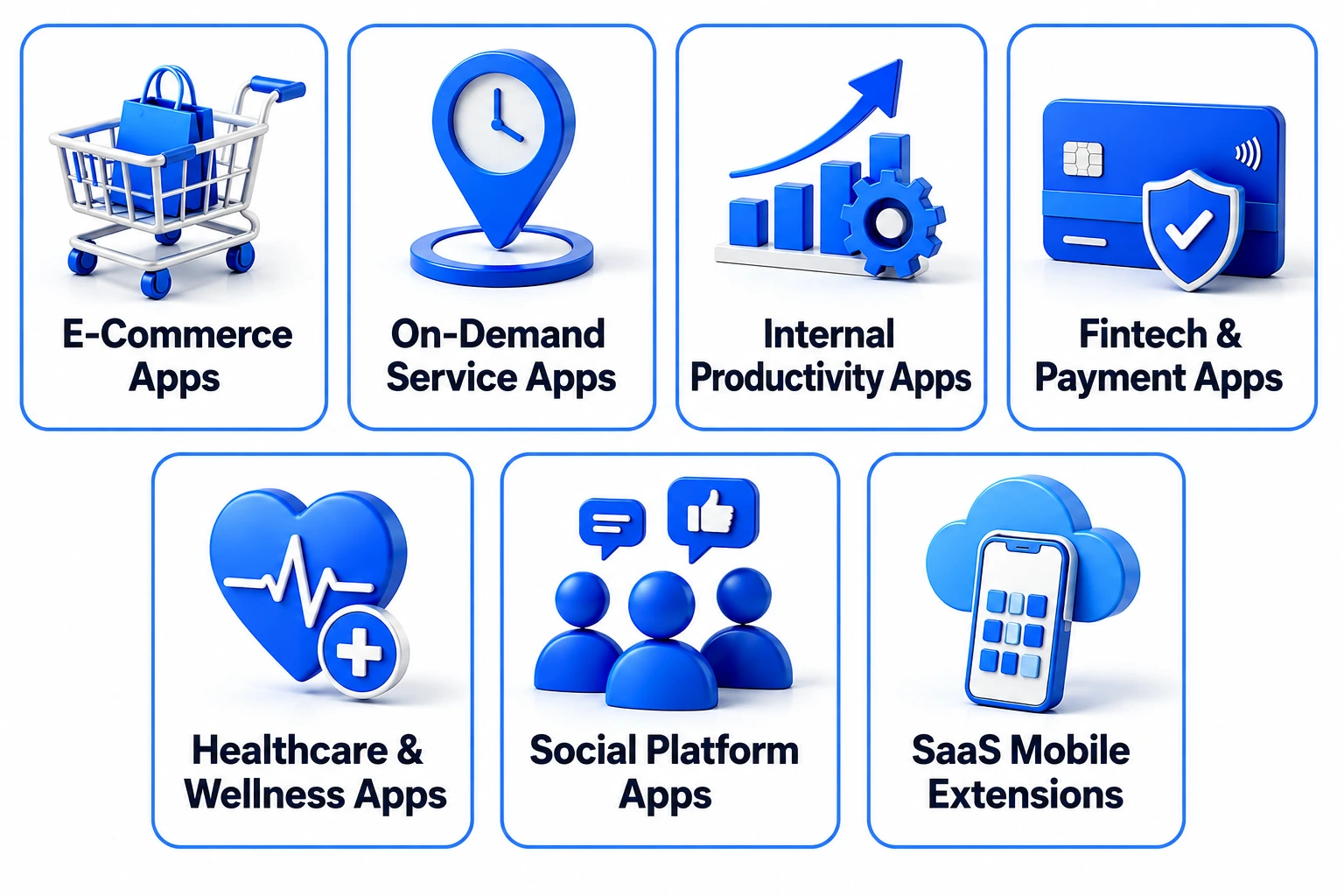
1. Consumer Facing Marketplace and E Commerce Apps
React Native is widely used for eCommerce and marketplace apps because it helps businesses maintain consistent shopping experiences across iOS and Android while accelerating feature releases, promotions, and checkout optimization workflows.
2. On Demand Service Apps: Booking, Delivery and Logistics
Booking, delivery, and logistics apps rely heavily on real-time notifications, live tracking, and seamless customer interactions. React Native supports these workflows efficiently while reducing overall development and maintenance effort.
3. Enterprise and Internal Productivity Apps
Businesses use React Native extensively for internal productivity tools, employee apps, operational dashboards, and workflow management systems because cross-platform deployment simplifies enterprise mobility adoption significantly.
4. Fintech and Payment Apps Built on React Native
React Native is increasingly used for fintech products involving payment workflows, transaction tracking, and financial dashboards. However, these apps require a stronger focus on security architecture and compliance planning from the beginning.
5. Healthcare and Wellness Apps
Healthcare and wellness apps increasingly use React Native for telemedicine, fitness tracking, appointment management, and patient engagement workflows. The framework helps businesses launch multi-platform healthcare solutions faster while maintaining consistent user experiences across devices.
6. Social and Community Platform Apps
Social and community apps rely heavily on messaging, notifications, content sharing, and real-time interactions. React Native allows businesses to build scalable engagement-driven platforms while maintaining unified design and faster feature rollout across iOS and Android.
7. SaaS Mobile Clients Extending Existing Web Products
Many SaaS companies use React Native to extend existing web platforms into mobile ecosystems through dashboards, collaboration tools, and customer portals. This approach helps businesses maintain stronger product consistency without rebuilding core workflows separately for mobile platforms.

How React Native Delivers Real Results Across Industries in 2026
React Native is no longer viewed only as a faster development framework. Businesses across industries now use it to reduce operational complexity, launch products faster, and maintain consistent mobile experiences across platforms without doubling engineering effort. The biggest advantage is not simply code sharing. It is the ability to scale product delivery and iteration cycles more efficiently.
1. Retail and E Commerce: Driving Revenue Across iOS and Android Simultaneously
Modern retail brands use React Native to maintain synchronized shopping experiences across platforms while rolling out promotions, UI updates, and personalized engagement systems much faster. Faster release cycles help businesses respond quickly to changing customer behavior and seasonal demand spikes.
2. Healthcare: HIPAA Compliant Apps That Patients and Clinicians Trust
Healthcare businesses increasingly use React Native to build telemedicine platforms, patient engagement systems, and wellness apps that operate across multiple devices consistently. However, the real challenge is rarely frontend development alone. Most complexity comes from compliance architecture, secure data handling, and healthcare workflow integration.
3. Fintech and Banking: Speed, Security and Cross Platform Consistency
Fintech apps built on React Native benefit from faster development and unified user experiences across devices. At the same time, businesses still invest heavily in:
- encryption,
- secure authentication,
- fraud prevention,
- and compliance systems
Because financial trust depends heavily on reliability and security stability.
4. Logistics and Supply Chain: Real Time Visibility at Lower Build Cost
React Native works especially well for logistics businesses that need live tracking, route monitoring, operational dashboards, and driver communication systems. Many companies prioritize React Native because maintaining two separate mobile codebases significantly increases operational overhead in already infrastructure-heavy industries.
5. Education and EdTech: Adaptive Learning Apps Reaching More Learners
EdTech platforms use React Native to deliver:
- live classes,
- progress tracking,
- AI-assisted learning,
- and engagement-driven educational experiences
Faster iteration cycles are especially important in education because user engagement patterns evolve continuously.
6. Travel and Hospitality: Personalized Booking Experiences on Any Device
Travel apps increasingly rely on React Native to manage:
- booking workflows,
- itinerary systems,
- real-time notifications,
- and personalized recommendations
Consistent cross-platform UX becomes especially important in travel because friction during booking flows directly impacts conversion rates.
React Native Apps That Prove What the Framework Can Do: Real World Success Stories
React Native is no longer limited to startup MVPs or lightweight applications. Some of the world’s most recognized digital platforms now use the framework to manage large-scale mobile experiences involving millions of users, real-time interactions, and continuous feature delivery across iOS and Android ecosystems.
What makes these examples important is not only framework adoption itself, but how businesses strategically use React Native, where cross-platform scalability creates operational advantage without compromising user experience quality significantly.
Shopify: Scaling Faster Across Mobile Commerce Ecosystems
Shopify adopted React Native to accelerate feature deployment across its mobile ecosystem while improving engineering efficiency. Managing separate implementations across platforms was slowing product iteration as commerce experiences became increasingly dynamic.
The company gradually expanded React Native adoption across critical workflows while selectively optimizing native-heavy areas where deeper platform integration was necessary. This hybrid engineering approach helped Shopify improve development velocity without sacrificing performance consistency.
Discord: Managing Real-Time Communication at Massive Scale
Discord uses React Native to support messaging, notifications, live communication, and highly active user engagement workflows across mobile platforms. Apps handling real-time interaction at this scale expose performance bottlenecks quickly if the architecture quality is poor.
Discord’s continued investment in React Native demonstrates how mature architecture planning and selective optimization can support highly interactive ecosystems successfully, even under extremely heavy user activity.
Bloomberg: Delivering Fast Financial Experiences Across Devices
Bloomberg leveraged React Native to improve development efficiency while maintaining responsive financial experiences across iOS and Android. Financial products require stable rendering and real-time updates because user trust depends heavily on speed and reliability.
The platform focused strongly on performance optimization, rendering efficiency, and maintaining consistent financial workflows across multiple mobile ecosystems simultaneously.
RipenApps in Action: React Native Apps We Built That Solved Real Business Problems
At RipenApps, React Native development is approached as a strategic product decision rather than simply a framework preference. The focus remains on helping businesses launch scalable cross-platform products faster while maintaining strong usability, stable performance, and long-term maintainability across iOS and Android ecosystems.
Many businesses initially approach React Native primarily for cost reduction. However, in real production environments, the larger business advantage often comes from faster iteration cycles, simplified maintenance operations, and improved product consistency across devices.
SportsNerve: Building a Dedicated Social Platform for Sports Communities
The Challenge
SportsNerve aimed to create a community-driven sports platform where fans, players, and sports enthusiasts could connect, share opinions, engage in discussions, and follow sports-related activities in real time. The platform needed to support:
- high user engagement,
- real-time social interaction,
- content sharing,
- and scalable community participation
One major challenge was managing engagement-heavy workflows and dynamic social feeds while maintaining smooth navigation and consistent performance across both iOS and Android ecosystems.
What RipenApps Built
RipenApps developed the application using React Native to streamline cross-platform scalability and accelerate product delivery. The app architecture focused on:
- responsive social interaction systems,
- lightweight content rendering,
- scalable backend synchronization,
- and optimized user engagement workflows.
Special attention was given to creating intuitive navigation and real-time interaction consistency to improve community engagement retention.
Business Outcome
The final platform delivered:
- smoother cross-platform social experiences,
- improved community engagement workflows,
- and faster feature scalability
This reduces operational duplication across Android and iOS development ecosystems.
The React Native architecture also enabled quicker product iteration cycles as user engagement and platform activity continued growing.
Mednovate Connect: Streamlining Healthcare Communication and Coordination
The Challenge
Mednovate Connect required a healthcare-focused mobile platform capable of improving communication between healthcare professionals, patients, and operational teams. The application needed to support:
- secure communication workflows,
- appointment coordination,
- real-time updates,
- and scalable healthcare engagement systems.
The challenge was ensuring usability simplicity while maintaining stable performance and scalable backend synchronization for healthcare operations.
What RipenApps Built
RipenApps developed the application using React Native with a focus on:
- secure workflow integration,
- responsive UI architecture,
- scalable communication systems,
- and optimized data synchronization.
The platform was structured carefully to simplify healthcare coordination while maintaining cross-platform consistency.
Business Outcome
The application achieved:
- improved communication efficiency,
- smoother healthcare coordination workflows,
- and faster operational scalability
Thus, reducing development and maintenance complexity across mobile platforms.
Vedic: Building a Digital Wellness and Astrology Experience at Scale
The Challenge
Vedic aimed to create a digital platform combining wellness guidance, astrology-based experiences, and personalized user interactions within a highly content-driven mobile environment. The platform needed to support:
- personalized recommendations,
- content-heavy workflows,
- real-time consultations,
- and scalable engagement systems
That too, without creating UI clutter or performance instability.
What RipenApps Built
RipenApps used React Native to create a scalable cross-platform architecture focused on:
- lightweight content rendering,
- smooth user navigation,
- optimized interaction flows,
- and scalable backend synchronization.
The product was structured carefully to maintain usability consistency while handling growing user engagement and content expansion efficiently.
Business Outcome
The final application delivered:
- improved cross-platform user engagement,
- faster feature rollout capability,
- and smoother content interaction experiences.
React Native also helped reduce maintenance complexity while supporting long-term scalability across both Android and iOS ecosystems.
The React Native App Development Process From Business Brief to App Store Launch
Building a successful React Native app involves much more than writing cross-platform code. Businesses now focus heavily on product strategy, scalable architecture, user experience consistency, testing stability, and post-launch iteration planning from the very beginning. Strong React Native projects usually succeed because product, engineering, and business goals stay aligned throughout development.
Stage 1 — Discovery, Scope Definition and Business Requirements
The development process begins with understanding business goals, user problems, operational workflows, and scalability expectations. This stage helps define feature priorities, technical feasibility, and MVP scope before development starts, reducing unnecessary feature expansion later.
Stage 2 — Market Research, Competitor Analysis and User Persona Mapping
Businesses analyze competitors, user expectations, and market gaps to understand how the app should position itself across platforms. This stage also helps teams identify retention drivers, monetization opportunities, and usability expectations specific to the target audience.
Stage 3 — UI UX Design Tailored to Both iOS and Android Design Languages
React Native apps share code across platforms, but user expectations still differ between iOS and Android ecosystems. Strong design systems balance cross-platform consistency while respecting native interaction patterns, navigation behavior, and platform-specific usability standards. Well-structured React Native components also help teams maintain design consistency, accelerate development, and deliver a seamless user experience across both platforms.
Stage 4 — React Native Development, Architecture Setup and Module Configuration
This stage focuses on frontend development, backend integration, navigation architecture, API configuration, and reusable component systems. Early architectural decisions strongly influence long-term scalability, performance quality, and maintainability as the product grows.
Stage 5 — Integration: APIs, Third Party Services and Native Modules
Modern React Native apps often integrate:
- payment gateways,
- analytics systems,
- AI services,
- notifications,
- and real-time APIs.
Apps requiring deeper hardware access may also use selectively optimized native modules for stronger performance and platform compatibility.
Stage 6 — Quality Assurance Testing Across Real Devices, OS Versions and Screen Sizes
Testing React Native apps involves much more than checking basic functionality. Teams validate UI responsiveness, device compatibility, rendering consistency, performance stability, and real-world interaction quality across multiple screen sizes and operating system versions.
Stage 7 — App Store and Google Play Submission: What Businesses Must Prepare
Before launch, businesses must prepare app store assets, privacy disclosures, compliance documentation, subscription configurations, and platform-specific policies. Many delays occur because submission planning is treated as a final task instead of part of the product workflow earlier.
Stage 8 — Post Launch Monitoring, OTA Updates and Continuous Improvement
Successful React Native products evolve continuously after launch through:
- analytics monitoring,
- OTA updates,
- performance optimization,
- and user behavior analysis.
The ability to deploy certain updates faster without full store review cycles gives React Native teams stronger operational flexibility after release.
React Native Performance Optimization in 2026
Performance has become one of the biggest success factors for modern React Native applications. Users now expect apps to open instantly, scroll smoothly, and respond without lag across every device. Even a small delay in loading, animations, or screen transitions affects retention, engagement, and app ratings. This is why businesses in 2026 are treating performance optimization as a core part of React Native app development instead of a post-launch fix.
Modern React Native optimization focuses on improving startup speed, reducing frame drops, preventing memory leaks, and eliminating JS thread bottlenecks that slow down app interactions. Developers are also optimizing animations, rendering cycles, and background processes to deliver smoother cross-platform experiences.
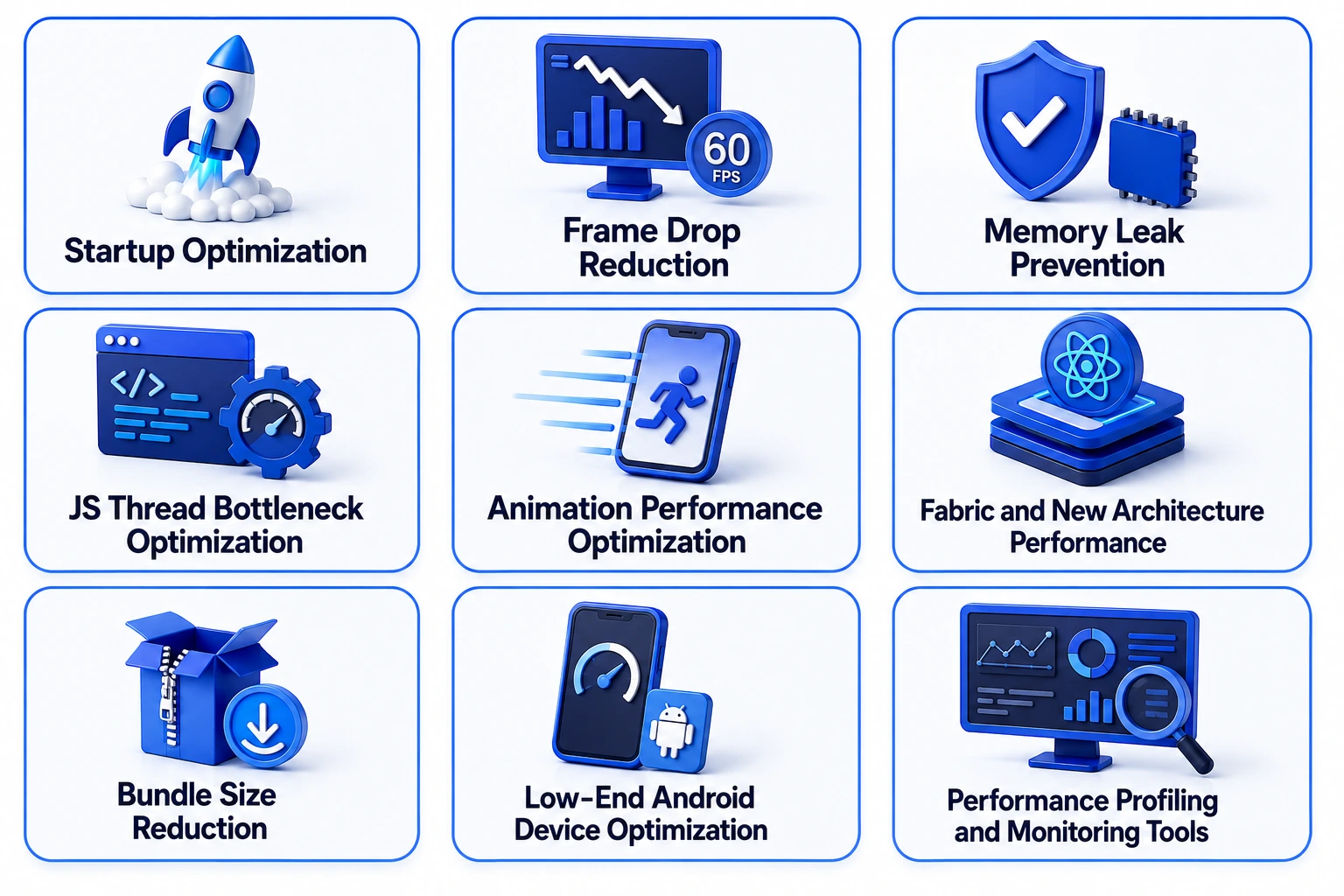
Key Areas of React Native Performance Optimization
- Startup Optimization
Reducing app launch time improves first impressions and user retention. Developers now use lightweight assets, code splitting, lazy loading, and optimized APIs to make React Native apps load faster on both Android and iOS devices. - Frame Drop Reduction
Laggy scrolling and delayed gestures create poor user experiences. Performance-focused React Native apps optimize rendering pipelines and minimize unnecessary re-renders to maintain smooth 60 FPS interactions. - Memory Leak Prevention
Unmanaged memory usage often causes crashes and slowdowns in large-scale applications. Developers regularly monitor background processes, API calls, and component lifecycles to maintain long-term app stability. - JS Thread Bottleneck Optimization
Heavy JavaScript operations block UI responsiveness. Modern React Native development reduces thread overload through efficient state management, native modules, and asynchronous processing techniques. - Animation Performance Optimization
Smooth animations improve engagement and navigation flow. Developers now rely on native-driven animations, React Native Reanimated, and Gesture Handler libraries to create fluid user interactions without performance drops. - Fabric and New Architecture Performance
React Native’s Fabric architecture improves rendering efficiency and UI responsiveness. Businesses adopting the new architecture achieve better performance consistency, faster rendering, and improved scalability. - Bundle Size Reduction
Large app bundles increase installation time and storage usage. Optimized asset management, dependency cleanup, and modular coding help reduce overall application size. - Low-End Android Device Optimization
Businesses targeting large user bases must optimize apps for budget smartphones and slower network conditions. Efficient rendering, lightweight assets, and reduced background processing improve accessibility across emerging markets. - Performance Profiling and Monitoring Tools
Tools like Flipper, Hermes Profiler, and React DevTools help developers identify rendering issues, memory consumption, and performance bottlenecks before they impact end users.
Businesses that prioritize React Native performance optimization early often achieve better retention, smoother user experiences, and lower maintenance costs as their applications scale.
React Native Performance in 2026: What the New Architecture Actually Delivers
React Native performance has improved significantly over the last few years, especially after the introduction of the New Architecture and advancements in the React Native new version releases. Earlier versions often struggled with bridge latency, rendering delays, and inconsistent responsiveness during highly interactive workflows. In 2026, the framework is far more capable of supporting production-grade mobile experiences at scale.
At the same time, businesses should understand that React Native performance still depends heavily on architecture quality, rendering optimization, and engineering decisions rather than framework choice alone.
1. How JSI Eliminated the Old Bridge Bottleneck
Older React Native versions relied on a communication layer called the Bridge, which slowed interactions between JavaScript and native components during heavy UI updates. JSI (JavaScript Interface) reduced this dependency significantly by enabling faster direct communication between layers, improving responsiveness and reducing rendering lag.
2. Fabric Renderer and What Synchronous UI Updates Mean for User Experience
Fabric Renderer introduced a more modern rendering system that improves UI synchronization and interaction smoothness. This becomes especially noticeable in gesture-heavy interfaces, dynamic animations, and real-time interaction workflows where delayed rendering negatively affects user experience quality.
3. Hermes Engine: Faster Cold Starts and Lower Memory Footprint on Real Devices
Hermes improves app startup performance and reduces memory consumption on mobile devices. Faster cold starts are especially important for businesses because users often abandon apps quickly when loading experiences feel slow or unstable.
4. Performance Benchmarks Businesses Should Use to Evaluate Any React Native Project
Businesses should evaluate React Native performance based on:
- startup speed,
- frame consistency,
- rendering smoothness,
- memory usage,
- and real-device responsiveness
In many production apps, poor architecture decisions create larger performance issues than the framework itself.
5. Where React Native Performance Still Has Limits and How Experienced Teams Work Around Them
React Native still faces limitations in highly graphics-intensive applications, advanced gaming environments, and extremely hardware-dependent workflows. Experienced teams usually address these challenges through:
- selective native module optimization,
- rendering optimization,
- background processing improvements,
And hybrid architecture planning instead of forcing React Native into every performance-critical scenario unnecessarily.
Adding AI and Machine Learning to React Native Apps in 2026
AI integration has become one of the biggest priorities in modern React Native app development. Businesses are no longer adding AI only for experimentation. They are using it to improve personalization, automate workflows, optimize engagement, and create smarter user experiences directly inside mobile applications.
The growing adoption of machine learning in React Native app development is enabling businesses to build features such as recommendation engines, predictive analytics, intelligent search, fraud detection, and personalized user journeys without maintaining separate codebases for different platforms.
At the same time, experienced teams understand that adding AI features introduces new operational challenges involving:
- inference cost,
- latency management,
- prompt reliability,
- model monitoring,
- and data privacy.
The strongest AI-powered apps are usually the ones solving focused business problems instead of forcing AI into every workflow unnecessarily.
On Device AI in React Native: TensorFlow Lite and ONNX Runtime Integration
React Native apps are increasingly using on-device AI for:
- image recognition,
- voice processing,
- predictive recommendations,
- and offline intelligence workflows.
Frameworks like TensorFlow Lite and ONNX Runtime help businesses reduce cloud dependency while improving response speed and privacy protection.
Cloud AI APIs in React Native Apps: OpenAI, Anthropic Claude and Google Gemini
Many businesses integrate cloud AI services such as OpenAI, Anthropic, and Google Gemini models to add conversational AI, summarization, recommendation systems, and intelligent automation into mobile apps quickly.
However, one issue businesses often underestimate is token cost growth. As AI usage scales, operational cost can increase much faster than traditional backend infrastructure if prompt optimization and usage control are not managed carefully.
Personalisation Engines, Recommendation Systems and Predictive Features in React Native
The growing adoption of Artificial Intelligence with React Native is helping businesses deliver smarter, more personalized mobile experiences. React Native apps increasingly use AI to analyze user behavior, engagement patterns, and interaction history to deliver more relevant experiences dynamically. Retail apps personalize product discovery, streaming apps optimize content suggestions, and fintech platforms surface spending insights based on behavioral patterns.
In production environments, recommendation quality depends far more on data quality and behavioral signals than on the sophistication of the AI model itself.
Conversational AI and Chatbot Integration: Making React Native Apps Talk Back
Conversational AI is becoming a standard layer inside customer-facing mobile products. Businesses now integrate AI chat systems for:
- customer support,
- onboarding,
- shopping assistance,
- and workflow automation
To reduce friction and improve engagement speed.
However, businesses also face challenges around hallucination handling, response reliability, and maintaining conversational consistency during complex user interactions.
How AI Development Tools Are Accelerating React Native Build Cycles
AI-assisted development tools are helping React Native teams improve coding speed, debugging workflows, testing efficiency, and documentation generation. Tools like:
- GitHub Copilot,
- Cursor,
- AI-assisted testing systems,
- Automated code analysis is reducing repetitive engineering overhead significantly.
Still, experienced teams avoid over-relying on AI-generated code without architectural review because scalability and maintainability issues often appear later in production environments.
Read Also: How to Develop AI based App with React Native? Facial Landmark Detection Example
React Native vs Other Frameworks: An Honest Business Comparison
Framework comparison discussions often become overly opinionated. In practice, the right choice depends less on ecosystem popularity and more on business goals, scalability expectations, team structure, and product complexity. Most businesses do not fail because they chose the “wrong†framework. They struggle because architecture decisions were made without understanding long-term operational tradeoffs.
React Native vs Flutter: Which One Actually Fits Your Business Situation
The React Native vs Flutter debate continues to be one of the most common discussions in cross-platform app development. Both frameworks offer strong capabilities, but the right choice depends on your business goals, technical requirements, and long-term product strategy.
Flutter delivers highly controlled UI rendering and strong visual consistency, while React Native benefits from a larger ecosystem, JavaScript talent availability, and stronger integration flexibility with existing web workflows.
Businesses often prefer React Native when faster hiring, web ecosystem alignment, and long-term scalability matter more than highly customized UI rendering systems.
React Native vs Native iOS and Android: When the Extra Cost of Native Is Worth It
The discussion around React Native vs Native apps often comes down to performance requirements, development speed, and long-term maintenance costs.
Native development still performs better in:
- graphics-intensive apps,
- advanced AR/VR experiences,
- gaming environments,
- and hardware-heavy workflows.
However, for most business applications, React Native delivers sufficient performance while reducing development duplication significantly.
Many companies now use hybrid approaches where React Native powers core workflows while performance-critical modules are optimized natively.
React Native vs Kotlin Multiplatform: The Rising Alternative Businesses Should Know About
Kotlin Multiplatform is gaining attention because it allows businesses to share backend logic across platforms while maintaining native UI layers. This approach appeals to teams wanting stronger native control without completely duplicating business logic.
However, React Native still maintains advantages in:
- ecosystem maturity,
- community size,
- third-party tooling,
- and faster frontend iteration cycles.
React Native vs Ionic and Xamarin: Why the Legacy Alternatives Have Lost Ground
Older cross-platform solutions like Ionic and Xamarin lost momentum as businesses demanded stronger performance, smoother UX, and more scalable developer ecosystems.
React Native gained wider adoption because it offered a stronger balance between development efficiency and user experience quality without feeling overly hybrid or web-dependent.
The Decision Framework That Cuts Through Framework Debate for Good
Businesses choosing a framework should evaluate:
- product complexity,
- performance expectations,
- release speed,
- team expertise,
- scalability plans,
And maintenance overhead instead of following ecosystem trends blindly.
In many cases, React Native becomes the strongest option when businesses prioritize faster product delivery, unified development operations, and scalable cross-platform growth without maintaining separate mobile engineering ecosystems.
How Much Does React Native App Development Cost in 2026
React Native app development cost in 2026 depends far more on product complexity than the framework itself. Many businesses assume cross-platform development automatically means “cheap development,†but real production costs are influenced by:
- feature depth,
- backend infrastructure,
- AI integration,
- third-party services,
- security requirements,
- and scalability expectations.
A simple MVP and a large-scale fintech or AI-powered platform built with React Native operate under completely different engineering realities.
What Drives the Cost of a React Native App More Than Anything Else
The biggest cost drivers are usually:
- app complexity,
- real-time functionality,
- backend architecture,
- AI features,
- and third-party integrations.
Features like live tracking, payment systems, video streaming, and AI-powered personalization increase both development and infrastructure complexity significantly.
One operational challenge businesses often underestimate is the post-launch scaling cost. As user traffic grows, cloud infrastructure, API usage, analytics systems, and AI inference expenses often rise faster than expected.
React Native App Development Cost Breakdown by Complexity Level
| App Complexity | Estimated Cost Range | Typical Features |
| Basic MVP App | $15,000 – $35,000 | Authentication, dashboards, simple APIs |
| Mid-Level Business App | $35,000 – $80,000 | Payments, real-time features, notifications |
| Advanced Scalable Platform | $80,000 – $180,000+ | AI systems, live tracking, and advanced integrations |
| Enterprise or AI-Heavy Ecosystem | $180,000+ | Large infrastructure, automation, complex workflows |
The final React Native app development cost also depends heavily on design complexity, compliance requirements, and scalability planning from the beginning.
How React Native Saves Budget Compared to Building Two Separate Native Apps
React Native reduces duplication across:
- frontend development,
- testing workflows,
- release management,
- and long-term maintenance operations.
This often lowers overall development investment compared to maintaining separate iOS and Android engineering teams. Businesses can also reduce ongoing application maintenance services costs by managing a shared codebase across both platforms.
However, experienced businesses understand that cost savings should not come at the expense of product quality. Poor architecture decisions made only to reduce short-term budget often create larger scaling and maintenance costs later.

React Native App Security: What Businesses Building Cross Platform Apps Must Know
Security has become a major priority in React Native development because modern mobile apps now handle sensitive customer data, financial transactions, healthcare records, and real-time user activity continuously. Many businesses focus heavily on frontend delivery speed while underestimating API security, token management, and backend vulnerabilities. In practice, most production-level security risks emerge from poor implementation decisions rather than the framework itself.
1. Why React Native Apps Need Active Security Measures Beyond What the Framework Provides
React Native provides the development foundation, but businesses still need strong security architecture around authentication systems, encrypted communication, backend validation, and secure API handling. The framework alone does not automatically protect apps from reverse engineering, insecure storage, session hijacking, or exposed backend vulnerabilities.
2. Secure Authentication, Biometrics and Token Storage in React Native
Modern React Native apps increasingly use biometric authentication, OAuth systems, multi-factor verification, and encrypted token storage to improve account protection. One issue many businesses overlook is insecure local data storage. Experienced teams usually rely on platform-secure storage layers and carefully managed session workflows to reduce unauthorized access risks.
3. GDPR, CCPA and Data Privacy Compliance in React Native Apps
Businesses handling customer data across regions must comply with regulations such as GDPR, CCPA, HIPAA, and industry-specific privacy standards. Compliance is no longer only a legal requirement. Poor data handling practices now directly affect customer trust, platform reputation, and long-term business scalability.
4. Security Testing Practices Every React Native App Must Go Through Before Launch
Production-grade React Native apps typically undergo:
- penetration testing,
- API vulnerability testing,
- authentication validation,
- device-level security checks,
- and real-device behavioral testing before launch.
Many businesses underestimate how frequently security risks emerge through third-party SDKs and external integrations rather than the core app itself. Strong testing workflows help identify these issues before they become operational threats.
Common React Native Development Challenges and How Strong Teams Solve Them
React Native has matured significantly, but building scalable cross-platform apps still comes with operational and architectural challenges. Most long-term issues do not appear during early MVP development. They emerge later when apps scale, user activity increases, and product complexity expands across platforms.
Experienced teams usually focus less on “Can React Native handle this?†and more on “How should the architecture be planned to handle this efficiently over time?â€
Performance Optimization Across Complex Workflows
As React Native apps scale, maintaining smooth rendering, fast interactions, and stable memory usage becomes more challenging. This is where React Native optimization becomes critical for sustaining app performance and delivering a seamless user experience. Real-time dashboards, live tracking systems, animations, and engagement-heavy interfaces often expose architectural weaknesses quickly if optimization is ignored during the early stages of development.
Managing Third Party Dependencies and Library Stability
React Native ecosystems evolve rapidly, which creates dependency management issues over time. Businesses often face compatibility problems when external libraries fail to support newer React Native versions or operating system updates consistently, affecting long-term product stability.
Maintaining Consistent UI Behavior Across Platforms
Although React Native enables shared development across iOS and Android, both platforms still behave differently in navigation patterns, gestures, typography, and interaction systems. Strong product teams usually balance cross-platform consistency with platform-specific usability adjustments to maintain natural user experiences.
Scaling Real-Time Features Without Creating Instability
Applications involving live tracking, messaging, notifications, or collaborative workflows often face synchronization and rendering challenges as user activity grows. Scalable API architecture, efficient caching, and optimized event handling become critical for maintaining stable real-time experiences.
Controlling Technical Debt During Rapid Product Expansion
One of the biggest long-term challenges in React Native projects is uncontrolled technical debt caused by aggressive feature expansion. Businesses focused only on launch speed often postpone architectural improvements until scalability, maintenance, and performance issues begin affecting product stability.
React Native Trends Reshaping Cross Platform App Development in 2026
React Native is evolving far beyond its original purpose as a faster cross-platform framework. In 2026, the ecosystem is shifting toward AI-native experiences, scalable architecture systems, and deeper platform integration. Businesses are no longer evaluating React Native only for development speed. They are evaluating how efficiently it supports long-term product scalability and operational flexibility.
New Architecture Is Now the Default
The New Architecture has become the standard foundation for modern React Native development. Features like JSI, Fabric Renderer, and TurboModules significantly improve rendering speed, responsiveness, and native interoperability, making React Native far more capable for production-scale applications.
Expo as the Standard Starting Point
Expo has evolved into the preferred starting point for many React Native projects because it simplifies setup, deployment, OTA updates, and development workflows. Businesses increasingly use Expo to accelerate product launches and reduce operational complexity during early scaling stages.
React Native on Desktop and Web
React Native is gradually expanding beyond mobile ecosystems into desktop and web experiences. Businesses building unified digital products increasingly explore shared architecture strategies where mobile, desktop, and web applications operate within more connected development ecosystems.
AI Native React Native Apps
AI integration is rapidly becoming a standard layer inside React Native applications. Businesses are embedding conversational AI, recommendation systems, predictive analytics, and workflow automation directly into mobile products to improve personalization and operational efficiency.
React Server Components Coming to React Native
React Server Components are expected to influence future React Native architecture by improving rendering efficiency and reducing unnecessary client-side processing. This shift may help businesses manage larger applications more efficiently while improving performance across complex mobile workflows.
Micro Frontend Architecture in Large-Scale React Native Apps
Large-scale React Native products increasingly use modular frontend architecture to simplify team collaboration and feature scalability. Micro frontend approaches help businesses manage complex applications more efficiently by allowing independent teams to develop and scale product modules separately.
How to Choose the Right React Native Development Company for Your Business
Choosing a React Native development company is no longer only about finding developers who know the framework. Businesses now need partners who understand product scalability, architecture planning, performance optimization, and long-term operational growth. Many projects fail not because React Native is weak, but because the development approach focuses only on launch speed without planning for future scale.
Strong React Native app development companies usually think beyond code delivery. They evaluate business goals, user behavior, infrastructure scalability, and long-term product evolution before development even begins.
What a Strong React Native Portfolio Tells You and What It Hides
A polished portfolio may show visually impressive apps, but businesses should evaluate deeper factors such as:
- scalability complexity,
- real-time feature handling,
- performance quality,
- architecture maturity,
- and post-launch product evolution.
Many agencies showcase successful UI projects without discussing operational challenges they solved during production scaling. Experienced React Native partners usually speak openly about tradeoffs, optimization decisions, and real deployment bottlenecks instead of presenting development as frictionless.
What Makes RipenApps a React Native Development Partner Built for Long-Term Business Success
At RipenApps, React Native development is approached as a long-term product strategy rather than simply a faster way to launch cross-platform apps. Our focus goes beyond code delivery into areas that directly impact business scalability, including architecture planning, performance optimization, API scalability, and post-launch product evolution. We help businesses build React Native applications that remain stable and maintainable as user activity, feature complexity, and operational demands grow over time.
What differentiates RipenApps is the combination of product thinking and engineering execution. Our teams work closely with startups, enterprises, and scaling businesses across industries such as fintech, healthcare, logistics, SaaS, AI, and eCommerce to build apps that balance speed, usability, and long-term scalability. Instead of forcing one-size-fits-all development approaches, we align technology decisions with actual business goals, operational realities, and future growth expectations from the beginning.
Wrapping Up
React Native has evolved into one of the most practical and scalable mobile app development frameworks for modern businesses in 2026. From faster cross-platform development and reduced operational overhead to AI integration and real-time mobile experiences, the framework now supports far more than simple MVP launches. Businesses increasingly choose React Native because it helps balance development speed, product scalability, and consistent user experiences across iOS and Android ecosystems without maintaining completely separate engineering operations.
At the same time, successful React Native products are rarely built through framework choice alone. Long-term success depends on architecture planning, performance optimization, security implementation, scalability strategy, and continuous post-launch improvement. As part of comprehensive mobile application development services, the RipenApps team helps businesses build React Native applications designed for long-term success. The focus extends beyond launch to support sustainable growth, evolving user expectations, and digital scalability in competitive markets
FAQs
Q1. What is React Native and how does it work for businesses?
React Native is a cross-platform mobile app development framework created by Meta that allows businesses to build iOS and Android apps using a shared codebase. It helps companies reduce development duplication, accelerate product launches, and maintain consistent experiences across platforms.
Q2. Is React Native still worth using in 2026?
Yes. React Native has evolved significantly with the New Architecture, improved rendering systems, and stronger ecosystem maturity. Many businesses continue choosing React Native because it balances development speed, scalability, and near-native performance effectively for most modern applications.
Q3. How much does React Native app development cost?
React Native app development cost depends on factors such as:
- app complexity,
- AI integration,
- backend infrastructure,
- real-time features,
- and scalability requirements.
Basic MVP apps may start around $15,000–$35,000, while enterprise-grade platforms can exceed $150,000 depending on complexity.
Q4. How long does it take to build a React Native app?
Development timelines vary based on feature scope and architecture complexity. A simple MVP may take 2–4 months, while advanced apps involving AI systems, live tracking, fintech workflows, or large backend ecosystems often require 6–12 months or longer.
Q5. What is the difference between React Native and Flutter?
Flutter uses its own rendering engine for UI consistency, while React Native relies more on native platform components. Businesses often prefer React Native for stronger JavaScript ecosystem support and easier integration with existing web development workflows.
Q6. What is the React Native New Architecture?
The New Architecture includes technologies such as:
- JSI,
- Fabric Renderer,
- and TurboModules.
These improvements reduce rendering bottlenecks, improve responsiveness, and strengthen communication between JavaScript and native layers significantly.
Q7. Can React Native apps match native app performance?
For most business applications, React Native delivers near-native performance successfully. However, highly graphics-intensive apps, advanced gaming systems, or deeply hardware-dependent workflows may still benefit more from fully native development approaches.
Q8. Is React Native good for enterprise app development?
Yes. Many enterprises use React Native for:
- employee productivity apps,
- operational dashboards,
- customer platforms,
- and internal workflow systems.
The framework helps organizations maintain faster release cycles and unified cross-platform experiences efficiently.
Q9. What is Expo and do I need it for React Native development?
Expo is a development platform that simplifies React Native setup, deployment, testing, and OTA updates. Many businesses use Expo to accelerate product launches, although highly specialized apps may later require custom native workflows.
Q10. How do I choose the right React Native development company?
Businesses should evaluate:
- technical expertise,
- architectural planning ability,
- scalability experience,
- real-world portfolio quality,
- and post-launch support capabilities.
Strong React Native partners usually discuss operational challenges, performance tradeoffs, and long-term product scalability openly instead of focusing only on visual delivery.

SHARE
WRITTEN BY

Prankur Haldiya
Chief Technical Officer
A tech innovator and engineering leader, Prankur Haldiya drives RipenApps’ product development strategy and oversees cutting-edge solutions in mobility, AI, and cloud ecosystems. He is passionate about building high-performance teams and helping brands launch secure, scalable, and user-centric digital products.
View All Articles





 India
India USA
USA Australia
 Canada
 UK
UK UAE
UAE