


Key Takeaways
- iOS app development helps businesses reach high-value users with strong engagement and spending potential.
- Swift and SwiftUI continue to drive faster, more scalable, and future-ready iOS app development.
- Modern iOS apps increasingly integrate AI, real-time data, and personalized user experiences.
- Security, privacy, and performance remain key advantages of the Apple ecosystem.
- The success of an iOS app depends heavily on architecture, UX design, scalability, and long-term maintenance.
- Development costs vary based on app complexity, integrations, backend infrastructure, and advanced features.
- Partnering with an experienced iOS app development company helps businesses reduce risk and accelerate product success.
The iPhone is no longer just a smartphone in the customer journey. For modern businesses, it has become a high-conversion digital touchpoint where users shop, invest, learn, book services, manage finances, consume content, and interact with brands daily. In 2026, businesses are not building iOS apps only for visibility. They are building them to increase retention, strengthen customer loyalty, and create scalable revenue ecosystems.
What makes iOS especially valuable is the quality of engagement inside the Apple ecosystem. Apple users expect fast, intuitive, and deeply personalized experiences. They are more likely to subscribe, spend consistently, and remain loyal to apps that deliver premium usability. This creates a major competitive advantage for businesses investing in high-performance iOS products instead of generic mobile experiences.
At the same time, iOS app development has changed dramatically over the past few years. AI-powered experiences, on-device intelligence, spatial computing, advanced privacy controls, and ecosystem-wide continuity are redefining how modern apps are designed and engineered. Businesses are now expected to deliver seamless experiences across iPhone, iPad, Apple Watch, Mac, and even immersive environments like Apple Vision Pro. This shift has made product architecture and long-term scalability more important than ever before.
Businesses that succeed in the Apple ecosystem today are not necessarily the ones launching the most features. They are the ones building intelligent, frictionless, and ecosystem-native experiences that users continue engaging with over time. This is exactly why businesses are increasingly investing in professional iOS application development services to build future-ready products that perform well beyond the launch stage.
Table of Contents
Why iOS App Development Still Dominates Business Strategy in 2026
Despite the rise of cross-platform frameworks, iOS continues to dominate business mobile strategy for brands targeting premium users and long-term digital growth. Businesses increasingly prioritize iOS because Apple users show higher purchasing behavior, stronger subscription retention, and better engagement quality compared to broader mobile ecosystems.
Another major reason is ecosystem stability. Compared to fragmented device environments, iOS allows businesses to maintain stronger performance consistency, smoother UI experiences, and more predictable optimization workflows. This reduces operational complexity as products scale.
The Scale of the Apple Ecosystem Today
The Apple ecosystem in 2026 extends far beyond the iPhone. Businesses now build interconnected experiences across:
- iPhone
- iPad
- Apple Watch
- Mac
- Apple TV
- Vision Pro
- CarPlay
This ecosystem-level integration creates a major competitive advantage for businesses investing in native iOS app development.
A customer may begin a workflow on iPhone, continue it through Apple Watch notifications, review analytics on iPad, and interact with immersive experiences through Vision Pro. Apple’s ecosystem continuity allows businesses to create connected user journeys instead of isolated app interactions.
This matters because customer retention increasingly depends on ecosystem stickiness rather than standalone app functionality.
Businesses building inside the Apple ecosystem also benefit from:
- Higher average revenue per user (ARPU)
- Better subscription conversion rates
- Faster adoption of premium features
- Stronger consumer trust in privacy
- More stable hardware optimization environments
One operational advantage businesses often underestimate is hardware consistency. Compared to broader Android fragmentation, iOS development environments remain significantly more controlled. This reduces testing complexity, UI inconsistencies, and device-level unpredictability during production deployment.
That does not mean iOS development is easier. It means engineering teams can spend more time optimizing product quality instead of constantly resolving hardware variability issues.
What Has Changed in iOS Development in 2026 That Businesses Must Know
One of the biggest shifts in iOS development is Apple’s growing focus on AI, privacy-first architecture, and spatial computing. Businesses are now expected to deliver intelligent experiences while maintaining strong on-device privacy protections. This is pushing development teams toward hybrid AI architectures where sensitive processing increasingly happens locally instead of entirely through cloud systems.
SwiftUI adoption has also accelerated significantly, although many large-scale apps still rely on hybrid UIKit and SwiftUI environments. At the same time, businesses are evaluating spatial computing opportunities through Apple Vision Pro, especially in industries like healthcare, retail, and real estate, where immersive visualization creates practical business value.
What is iOS App Development and How Does It Actually Work
Most businesses understand iOS app development at a surface level. They know it involves building applications for iPhones and iPads using Apple technologies. But production-grade iOS app development is far more than writing code for Apple devices.
Modern iOS development combines:
- Native engineering
- UI architecture
- backend infrastructure
- cloud synchronization
- AI integration
- security engineering
- App Store compliance
- performance optimization
- analytics systems
- and ecosystem continuity
An iOS app today functions as a connected digital system rather than a standalone mobile interface.
What makes this increasingly important is that user expectations inside the Apple ecosystem are significantly higher than average mobile standards. Users expect apps to feel fast, polished, intuitive, battery-efficient, secure, and deeply integrated with device capabilities by default.
Poorly optimized iOS apps rarely survive long-term retention cycles regardless of marketing investment.
iOS App Development Defined — Beyond the Basic Explanation
At a technical level, iOS app development refers to building applications for Apple operating systems using technologies such as Swift, SwiftUI, UIKit, and Xcode. But from a business perspective, native iOS development is really about creating premium ecosystem-driven experiences optimized for Apple users.
Native iOS apps gain direct access to Apple ecosystem capabilities such as Face ID, Siri, Apple Pay, Core ML, HealthKit, and Apple Watch integration. These capabilities allow businesses to build highly optimized experiences that feel deeply connected to Apple devices instead of behaving like generic mobile software.
Native iOS vs Cross-Platform Development
Businesses building mobile apps in 2026 often face one major decision early in the product journey: should they invest in native iOS development or choose a cross-platform framework for faster deployment? The answer depends heavily on product goals, scalability expectations, performance requirements, and long-term business strategy.
Native iOS apps are built specifically for the Apple ecosystem using technologies like Swift and SwiftUI. This allows businesses to achieve stronger performance optimization, smoother animations, deeper hardware integration, and better ecosystem consistency across iPhone, iPad, Apple Watch, and other Apple devices. In contrast, cross-platform frameworks like Flutter and React Native focus on code reusability across multiple platforms, helping businesses reduce initial development effort and accelerate MVP launches.
The difference becomes more noticeable as applications grow in complexity. Native iOS apps generally perform better in scenarios involving:
- AI-powered workflows,
- real-time synchronization,
- advanced gesture interactions,
- heavy animations,
- and ecosystem-level integrations.
Cross-platform apps work efficiently for simpler business applications and early-stage products, but scaling highly interactive or performance-intensive experiences often requires additional optimization later.
Another important distinction is long-term maintainability. Native iOS development provides stronger alignment with Apple’s ecosystem updates, security standards, and performance expectations. Cross-platform development reduces early cost and launch timelines, but businesses sometimes face technical limitations as feature complexity increases over time.
Read Also: Native vs Cross-Platform App Development: Which is Best For Your Mobile App Project?
What Makes an iOS App Truly Native and Why It Matters for Your Business
AÂ native iOS app is not simply written in Swift. It behaves according to Apple ecosystem expectations. This includes:
- smooth gesture interactions,
- fluid animations,
- optimized dark mode support,
- strong accessibility handling,
- seamless offline behavior,
- and efficient battery usage.
Apple users are highly sensitive to product quality inconsistencies. Small UX friction points, such as animation lag, broken navigation behavior, or poor haptic feedback, can negatively affect retention much faster than many businesses expect.
This is one reason premium brands continue investing heavily in native iOS app development instead of relying entirely on generalized mobile frameworks. Over time, native architecture usually provides stronger:
- performance stability,
- ecosystem scalability,
- maintainability,
- and long-term user experience consistency.
The iOS App Development Tech Stack Every Business Should Understand
The iOS development ecosystem has evolved significantly in recent years. Businesses are no longer choosing technologies only for app functionality. The modern iOS tech stack now directly impacts scalability, AI integration, performance optimization, ecosystem compatibility, and long-term maintainability. Selecting the right architecture early helps businesses avoid expensive rewrites, release instability, and scaling bottlenecks later.
Swift 6: The Language Powering Every Modern iOS App in 2026
Swift 6 continues to dominate modern iOS app development because of its performance efficiency, safety improvements, and advanced concurrency support. Businesses building scalable iOS apps increasingly prefer Swift for handling real-time processing, AI workflows, and smooth user experiences across Apple devices.
SwiftUI vs UIKit: Which One Should Your App Be Built With
SwiftUI has become the preferred framework for building modern Apple ecosystem interfaces quickly and efficiently. However, UIKit still powers many enterprise-grade applications that require deeper customization and mature architecture stability. In practice, many scalable iOS apps now operate through hybrid SwiftUI and UIKit environments.
Xcode 26 and the iOS 26 SDK: What Businesses Need to Know
Xcode 26 and the latest iOS SDK focus heavily on AI integration, performance profiling, and ecosystem-wide optimization. Apple’s development environment is also becoming stricter around privacy, energy efficiency, and App Store compliance, making architecture decisions more important from the early development stage itself.
Core ML and Apple Intelligence: Building AI Directly Into Your iOS App
Core ML allows businesses to integrate AI capabilities such as personalization, predictive analytics, image recognition, and intelligent automation directly into iOS applications. With Apple increasingly prioritizing on-device AI, businesses now focus more on balancing intelligence, privacy, and performance together.
ARKit and RealityKit: When Augmented Reality Makes Business Sense
ARKit and RealityKit are helping businesses create immersive experiences across retail, healthcare, real estate, and training ecosystems. However, AR delivers meaningful ROI only when it solves practical interaction problems instead of functioning as a purely experimental feature.
SwiftData and Core Data: Managing App Data the Right Way
Modern iOS apps depend heavily on efficient data architecture for personalization, offline synchronization, AI workflows, and scalability. SwiftData simplifies data handling for newer SwiftUI applications, while Core Data continues supporting large-scale enterprise systems requiring more mature persistence management.
Read Also: Top 10 iOS App Development Tools That Every App Owner Needs To Boost User Engagement
Essential Apple Frameworks Every iOS App Should Leverage
Modern iOS apps increasingly rely on Apple’s ecosystem frameworks to improve functionality, engagement, and performance consistency.
Some of the most widely used frameworks in scalable iOS applications include:
- HealthKit for healthcare and fitness ecosystems,
- CloudKit for Apple ecosystem synchronization,
- SiriKit for voice interactions,
- Vision Framework for computer vision,
- WidgetKit for home screen engagement,
- ActivityKit for Live Activities,
- and StoreKit for subscriptions and in-app purchases.
These frameworks allow businesses to create ecosystem-native experiences instead of building disconnected mobile interfaces.
One important operational advantage is ecosystem trust. Apple users generally engage more confidently with apps that integrate naturally with device capabilities because these experiences feel more secure, intuitive, and platform-consistent.
Types of iOS Apps Businesses Are Building in 2026
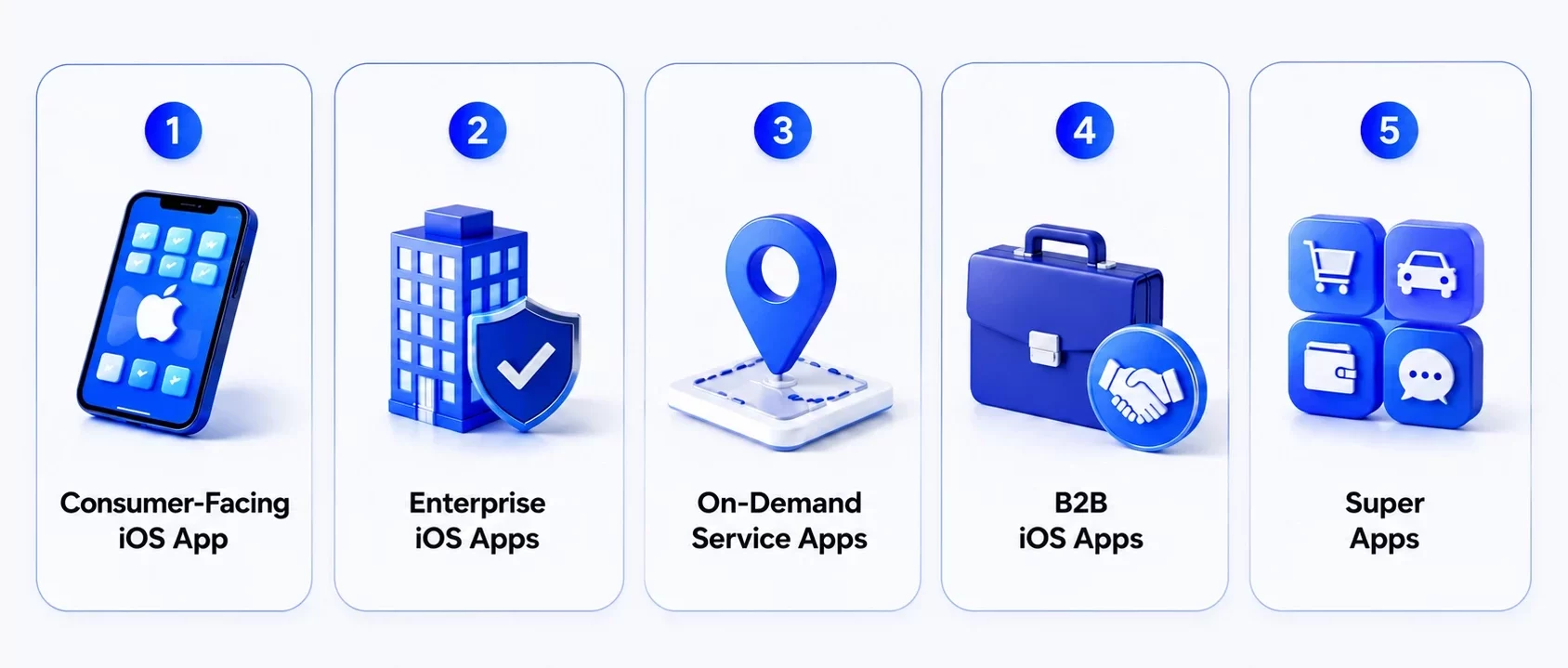
Businesses are no longer building iOS apps only for digital presence. In 2026, iOS applications are being used to automate operations, improve customer retention, drive recurring revenue, and deliver AI-powered user experiences. The focus has shifted from “having an app†to building ecosystem-driven products that create measurable business impact.
The type of iOS app a business builds usually depends on:
- customer behavior,
- monetization strategy,
- operational complexity,
- and long-term scalability goals.
1. Consumer-Facing iOS Apps: Reaching Millions on the App Store
Consumer apps continue dominating the App Store ecosystem across categories like retail, fitness, social networking, entertainment, and productivity. Businesses focus heavily on personalization, subscription models, and engagement-driven experiences to improve retention and monetization.
What separates successful consumer apps today is not feature quantity. It is user experience quality, onboarding simplicity, and ecosystem-level engagement across Apple devices.
2. Enterprise iOS Apps: Transforming Internal Business Operations
Enterprise iOS apps are helping organizations streamline internal workflows, employee collaboration, field operations, and real-time reporting. Industries such as healthcare, logistics, finance, and manufacturing increasingly rely on enterprise mobility to improve operational efficiency.
One major advantage of enterprise iOS ecosystems is stronger security consistency and device management compared to fragmented environments.
3. On-Demand Service Apps: Speed, Convenience and Retention
On-demand iOS apps continue expanding across industries like food delivery, mobility, healthcare, beauty, and home services. Businesses are increasingly integrating:
- AI-based recommendations,
- real-time tracking,
- dynamic pricing,
- and intelligent notifications
to improve customer experience and operational efficiency.
Retention has become the biggest competitive differentiator in this segment, rather than simple service availability.
4. B2B iOS Apps: Streamlining Business-to-Business Workflows
B2B iOS applications are evolving rapidly beyond basic dashboards and CRM access. Modern B2B apps now support:
- workflow automation,
- AI-powered analytics,
- document collaboration,
- sales enablement,
- and real-time operational visibility.
Businesses increasingly prioritize clean UX in B2B apps because enterprise users now expect consumer-grade digital experiences even inside operational tools.
5. Super Apps: One iOS App That Does Everything
Super apps are gaining momentum as businesses attempt to consolidate multiple services into unified ecosystems. These apps combine functionalities such as payments, shopping, messaging, bookings, subscriptions, and customer support inside a single platform.
However, scaling super apps introduces significant architectural complexity. Poorly planned ecosystems often struggle with performance degradation, bloated interfaces, and difficult maintenance cycles as services continue expanding.
How iOS App Development Delivers Real Business Results Across Industries
iOS apps are no longer industry-specific digital tools. Businesses across healthcare, fintech, retail, education, logistics, and real estate now use iOS applications to improve customer engagement, automate workflows, and create scalable digital ecosystems. The biggest shift is that mobile apps are increasingly becoming operational infrastructure instead of secondary business channels.
What makes iOS especially valuable across industries is the combination of:
- strong security standards,
- premium user behavior,
- ecosystem consistency,
- and high-performance native experiences.
Healthcare businesses are using iOS apps for:
- telemedicine,
- remote patient monitoring,
- appointment management,
- wearable integrations,
- and AI-assisted diagnostics.
Apple’s privacy-focused ecosystem and HealthKit integrations make iOS especially suitable for healthcare environments where security and compliance directly impact trust and scalability.
1. Fintech and Banking Apps: Security, Speed and Trust on iOS
Fintech platforms rely heavily on iOS for secure authentication, real-time transactions, investment management, and AI-powered fraud detection. Features like Face ID, encrypted payment systems, and biometric security help businesses build stronger customer trust.
One major advantage of native iOS fintech apps is smoother performance consistency during high-frequency financial interactions, where latency directly affects user experience.
2. Retail and E-Commerce Apps: Turning iPhones Into Revenue Channels
Retail brands increasingly use iOS apps to create personalized shopping experiences through:
- AI recommendations,
- visual search,
- loyalty ecosystems,
- AR-based product previews,
- and one-click payment flows.
What many businesses realize later is that retention and repeat purchases often contribute more revenue than raw app downloads.
3. Education and E-Learning Apps: Personalized Learning at Scale
Education platforms are increasingly using iOS apps to deliver adaptive learning experiences, interactive assessments, and AI-powered progress tracking. Personalized learning systems help students engage with customized content instead of following static educational workflows.
iPad ecosystems also continue driving growth in digital classrooms and institutional learning environments because of their strong accessibility and performance capabilities.
4. Logistics and Supply Chain Apps: Real Time Visibility and Control
Logistics businesses use iOS apps for:
- fleet management,
- route optimization,
- inventory visibility,
- warehouse coordination,
- and live delivery tracking.
Real-time operational visibility has become critical because customers increasingly expect faster delivery updates and accurate shipment transparency across supply chain ecosystems.
5. Travel and Hospitality Apps: Personalization That Drives Loyalty
Travel apps now rely heavily on AI-driven personalization to improve bookings, itineraries, pricing recommendations, and customer retention. Businesses increasingly integrate real-time assistance, multilingual support, and contextual travel recommendations directly into mobile experiences.
Customer loyalty in hospitality ecosystems is now influenced heavily by convenience, personalization quality, and seamless digital interactions across devices.
6. Real Estate Apps: Closing Deals Faster with Smarter iOS Tools
Real estate businesses use iOS apps for:
- virtual property tours,
- AR-based visualization,
- lead management,
- document signing,
- and AI-powered property recommendations.
Mobile-first buyer behavior is changing how real estate transactions happen, especially as customers increasingly expect instant property access, faster communication, and immersive digital experiences before physical site visits.

The iOS App Development Process From Business Idea to App Store Launch
Successful iOS apps are rarely built through coding alone. High-performing products usually emerge from structured planning, strong architecture decisions, user-focused design, and continuous optimization after launch. Businesses that skip strategies to build iOS app development often face expensive redesigns, App Store rejection issues, or scalability problems later.
One of the biggest misconceptions around iOS app development is assuming launch is the finish line. In reality, long-term product growth depends heavily on post-launch iteration, analytics, and ecosystem adaptability.
Stage 1 — Discovery and Business Requirements Mapping
The development process begins with identifying the actual business problem the app needs to solve. This stage focuses on:
- business goals,
- target users,
- monetization strategy,
- feature priorities,
- and long-term scalability expectations.
Many businesses rush into UI design too early without validating operational requirements first. This usually creates product direction issues later during scaling.
Stage 2 — Market Research, Competitor Analysis and User Persona Definition
Understanding the competitive landscape helps businesses identify market gaps, user expectations, and feature opportunities before development begins. This stage also includes defining user personas based on behavioral patterns, pain points, and engagement goals.
The most successful iOS apps rarely compete only through features. They compete through better usability, retention, and ecosystem-level experience quality.
Stage 3 — Information Architecture and Product Scope Finalization
This stage focuses on organizing workflows, navigation systems, feature hierarchy, and overall app structure. Clear information architecture helps reduce user friction and improve long-term scalability.
Scope control becomes especially important here. Many businesses overload early product versions with excessive features, which often increases development cost and slows release cycles unnecessarily.
Stage 4 — UI UX Design Built Around Apple Human Interface Guidelines
Apple users expect highly polished interfaces that feel intuitive and ecosystem-consistent. This stage focuses on:
- wireframes,
- visual design,
- interaction flows,
- accessibility,
- and responsive UI behavior.
Apps ignoring Apple Human Interface Guidelines often feel unfamiliar to users and may struggle during App Store review evaluations.
Stage 5 — iOS App Development and Architecture Setup
Once designs are finalized, development teams begin frontend engineering, backend integration, API setup, database architecture, and ecosystem-level functionality implementation.
Architecture decisions made during this stage heavily influence:
- app performance,
- maintainability,
- AI integration capability
- and long-term scalability.
Poor architectural planning may work temporarily during the MVP stage, but it usually creates operational bottlenecks later.
Stage 6 — Quality Assurance Testing Across Real Devices and iOS Versions
Testing is no longer limited to identifying broken screens or crashes. Modern iOS QA focuses on:
- performance consistency,
- battery optimization,
- accessibility compliance,
- security testing,
- and multi-device ecosystem behavior.
One challenge businesses often underestimate is testing across different network conditions, background states, and real-world usage scenarios instead of only ideal environments.
Stage 7 — App Store Submission and Apple Review Process
Apple’s review process has become increasingly strict around:
- privacy permissions,
- payment systems,
- data transparency,
- and content moderation.
Many businesses still treat App Store submission as a final administrative step. In reality, approval readiness should influence architecture and compliance planning much earlier during development itself.
Stage 8 — Post Launch Monitoring, Updates, and Continuous Improvement
Launch is only the beginning of the product lifecycle. Businesses must continuously monitor:
- user behavior,
- crash analytics,
- retention patterns,
- App Store feedback
- and infrastructure performance.
The most scalable iOS apps evolve continuously based on real-world usage data instead of relying only on assumptions made during early product planning.
iOS App Design Principles That Separate Great Apps
Great iOS apps rarely succeed because of feature quantity alone. In most cases, users stay because the app feels intuitive, fast, visually polished, and deeply aligned with Apple ecosystem expectations. Design quality directly impacts retention, subscription conversion, engagement time, and even App Store ratings.
What many businesses underestimate is that poor UX decisions create operational problems later. Confusing navigation, inconsistent interactions, or overloaded interfaces increase churn much faster than most feature limitations.
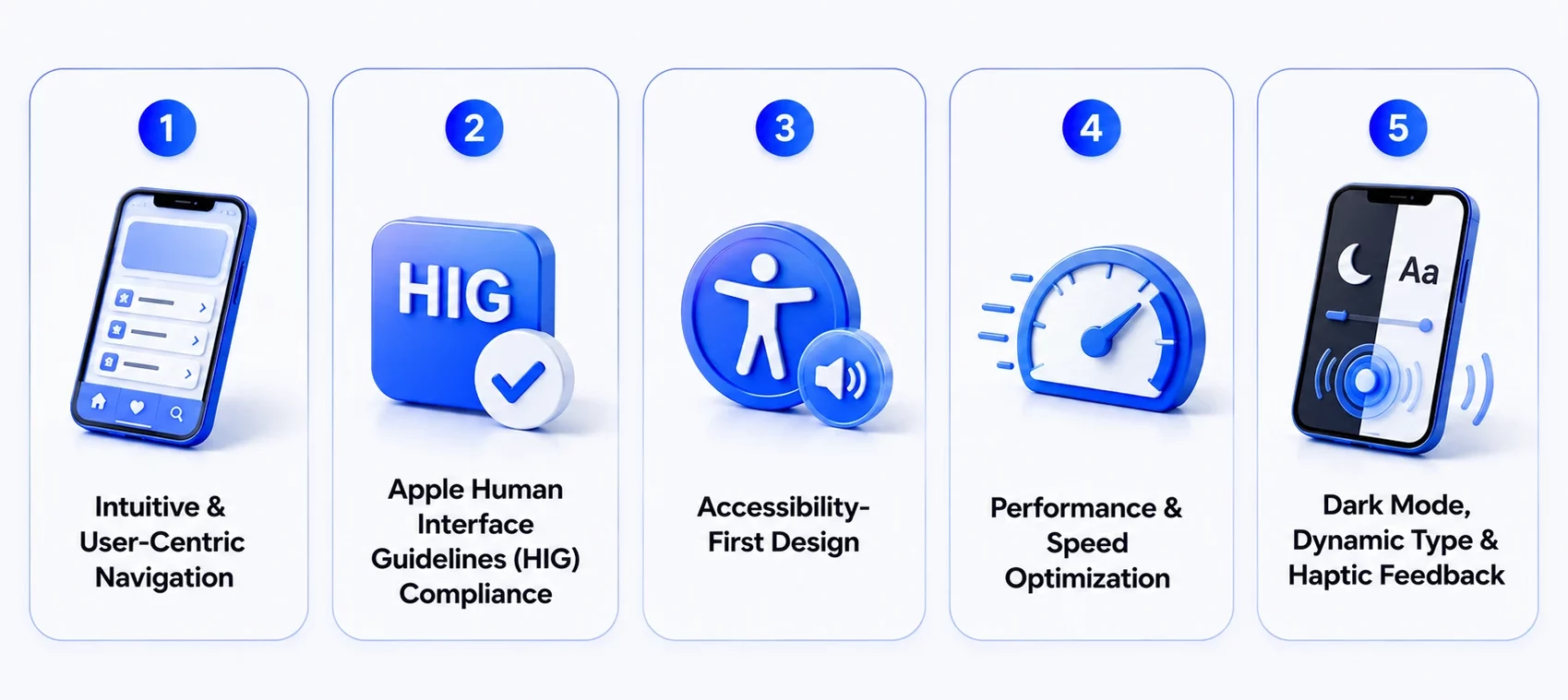
1. Apple Human Interface Guidelines — Why Following Them Is Non-Negotiable
Apple’s Human Interface Guidelines exist to maintain consistency across the ecosystem. Apps that follow these patterns feel more natural because users already understand how interactions should behave.
Ignoring Apple design standards often creates friction around:
- navigation behavior,
- gestures,
- typography,
- spacing,
- and accessibility.
This is one reason many visually attractive apps still struggle with retention. They look modern but fail to behave like true iOS experiences.
2. Accessibility in iOS Apps — Building for Every User from Day One
Accessibility is no longer an optional enhancement layer. Apple increasingly expects apps to support:
- voice interaction,
- dynamic text sizing,
- screen readers,
- contrast optimization,
- and motion sensitivity settings.
Businesses that prioritize accessibility early usually avoid expensive redesign efforts later. More importantly, accessible apps generally deliver better usability for all users, not only users with disabilities.
3. Performance First Design — Speed as a Core Feature, Not an Afterthought
Users inside the Apple ecosystem are highly sensitive to performance issues. Delayed animations, slow loading states, and laggy transitions immediately reduce perceived app quality.
Modern iOS app design now focuses heavily on:
- lightweight interfaces,
- smooth rendering,
- optimized media handling,
- and low-friction interactions.
In practice, performance itself has become part of user experience design rather than a purely engineering concern.
4. How Dark Mode, Dynamic Type and Haptics Create a Premium Feel
Premium iOS experiences are often shaped by small interaction details rather than large visual elements alone. Features like Dark Mode, Dynamic Type, and haptic feedback help apps feel more natural inside the Apple ecosystem because they align with existing device behavior and user expectations.
Dark Mode is no longer only a visual preference feature. Users now expect apps to adapt seamlessly across lighting conditions without affecting readability or interface consistency. Similarly, Dynamic Type improves accessibility and usability by automatically adjusting text according to user settings, creating a more comfortable reading experience across devices.
Haptic feedback adds another layer of interaction quality by making actions feel more responsive and tactile. Subtle vibration responses during gestures, confirmations, or transitions improve perceived responsiveness and make interfaces feel significantly more polished. These ecosystem-native details often influence user perception more than businesses initially expect.
Integrating AI and Machine Learning Into Your iOS App in 2026
AI integration is rapidly becoming a standard expectation in modern iOS apps rather than a premium differentiator. Businesses are increasingly using AI to improve personalization, automate workflows, strengthen customer engagement, and create smarter mobile experiences that adapt dynamically to user behavior.
What makes iOS especially important for AI-driven applications is Apple’s growing focus on on-device intelligence and privacy-first AI architecture. Businesses now have opportunities to build intelligent experiences without relying entirely on cloud-based processing.
On Device AI with Core ML — Intelligence Without Compromising Privacy
Core ML allows businesses to integrate machine learning capabilities directly into iOS apps while keeping sensitive data processing on-device. This approach improves response speed, reduces dependency on constant internet connectivity, and strengthens privacy protection.
On-device AI is becoming especially valuable in healthcare, fintech, fitness,and productivity applications where user trust and data security directly impact product adoption.
However, businesses also need to balance AI functionality with battery efficiency, model optimization, and hardware limitations during production deployment.
Building Personalization Engines Into iOS Apps Using Create ML
Modern iOS apps increasingly rely on personalization systems to improve retention and user engagement. Businesses use AI models to analyze browsing behavior, app interactions, purchase activity, and engagement patterns in order to deliver customized experiences dynamically.
Create ML helps development teams train lightweight machine learning models optimized specifically for Apple ecosystems. This enables businesses to build recommendation systems, predictive experiences, and intelligent content delivery workflows without requiring extremely large AI infrastructure initially.
NLP and Voice Interfaces Through SiriKit and the Speech Framework
Voice interactions are becoming more common as users increasingly prefer hands-free and conversational experiences. SiriKit and Apple’s Speech Framework allow businesses to integrate:
- voice commands,
- speech recognition,
- conversational workflows,
- and intelligent voice-based assistance
directly into iOS applications.
In practice, voice interfaces perform best when they reduce friction in repetitive or task-heavy workflows rather than functioning as novelty features.
Computer Vision in iOS Apps — ARKit, Vision Framework and Real World Use Cases
Computer vision is helping businesses create smarter visual experiences across various ecosystems, including retail, healthcare, logistics, and education. iOS apps now use Vision Framework and ARKit for:
- facial recognition,
- object detection,
- document scanning,
- visual search,
- and AR-based interactions.
Retail brands, for instance, increasingly allow users to search products through images instead of text-based queries. Similarly, healthcare apps use computer vision for medical imaging support and patient monitoring workflows. The strongest AI implementations typically solve practical interaction problems rather than adding unnecessary visual complexity.
How Much Does iOS App Development Cost in 2026
One of the most common questions businesses ask before starting development is how much an iOS app actually costs. The answer depends heavily on app complexity, feature requirements, AI integration depth, backend infrastructure, design quality, and long-term scalability expectations.
What many businesses underestimate is that development cost is not only influenced by the number of screens or features. Architecture quality, ecosystem integrations, security requirements, and post-launch scalability planning often influence budget far more than businesses initially expect.
Apps optimized only for lower upfront cost frequently create expensive maintenance and performance issues later.
What Actually Drives the Cost of Building an iOS App
Several factors directly influence iOS app development cost in 2026, including:
- app complexity,
- UI/UX customization,
- AI integration,
- backend infrastructure,
- API dependencies,
- security requirements,
- and third-party ecosystem integrations.
Development timelines also increase significantly for apps requiring:
- real-time synchronization,
- AI-powered workflows,
- payment systems,
- AR functionality,
- or enterprise-grade scalability.
One major operational cost businesses often overlook is post-launch infrastructure growth. As user activity scales, cloud usage, AI inference costs, analytics systems, and maintenance workloads increase continuously.
iOS App Development Cost Breakdown by App Complexity
Basic iOS applications with limited features and simple workflows usually require lower investment and shorter development cycles. Mid-level apps involving custom UI, APIs, subscriptions, and backend systems generally require larger budgets and more testing effort.
Highly advanced applications involving AI integration, enterprise infrastructure, AR experiences, real-time processing, or multi-device ecosystem support can increase development complexity significantly.
In practice, businesses focused on long-term scalability usually prioritize phased product development instead of attempting full-scale feature deployment initially.
How to Get Maximum Value From Your iOS Development Budget
Businesses achieve stronger ROI when they focus first on solving core user problems instead of aggressively expanding feature lists during early development stages. Prioritizing MVP validation helps reduce unnecessary development spending and accelerates market testing.
One common mistake businesses make is overinvesting in visual complexity before validating user engagement and retention patterns. In many cases, strong architecture, smooth performance, and ecosystem-native usability create far more long-term value than excessive feature expansion during the launch stage itself.

Getting Your iOS App Through the App Store — What Businesses Must Know
Launching an iOS app is not only a technical milestone. Businesses must also align with Apple’s ecosystem policies, privacy expectations, and review standards before reaching users through the App Store. Many apps face delays or rejection, not because of poor functionality, but because compliance and submission planning were treated as final-stage tasks instead of early product considerations.
Apple’s review process has become significantly stricter around:
- user privacy,
- subscription transparency,
- payment handling,
- AI-generated content
- and permission usage.
Apple App Store Review Guidelines That Determine Approval or Rejection
Apple evaluates apps across usability, privacy compliance, security, content moderation, and overall user experience quality. Apps requesting unnecessary permissions, using misleading subscription flows, or providing unstable experiences often face rejection during review.
One challenge businesses frequently underestimate is policy interpretation. Two apps with similar functionality may receive different review outcomes depending on implementation quality, transparency, and ecosystem alignment.
App Store Optimization Strategies That Drive Organic Downloads
App Store Optimization (ASO) directly impacts visibility, discoverability, and download growth. Businesses increasingly optimize:
- app titles,
- descriptions,
- screenshots,
- keywords,
- ratings,
- and preview videos
to improve ranking inside competitive App Store categories.
However, downloads alone no longer define success. Retention rate, user reviews, subscription performance, and engagement quality increasingly influence long-term App Store growth.
Monetization Models That Work on iOS — Subscriptions, IAP, and Freemium
Subscription ecosystems continue dominating iOS monetization because Apple users generally show stronger recurring payment behavior. Businesses increasingly combine:
- freemium access,
- in-app purchases,
- premium subscriptions,
- and usage-based unlocks
to improve long-term revenue generation.
The strongest monetization models usually create ongoing user value instead of aggressively pushing early conversions. Poorly structured paywalls often reduce retention faster than businesses expect.
iOS App Security and Privacy — Building What Apple Users Expect
Apple users have some of the highest privacy expectations across the mobile ecosystem. Businesses building apps must treat iOS app security and data protection as core product architecture decisions instead of secondary compliance tasks.
Poor privacy practices no longer create only legal risk. They directly affect:
- customer trust,
- App Store approval,
- user retention,
- and long-term brand perception.
Why iOS Users Have the Highest Privacy Expectations of Any Platform
Apple has positioned privacy as a major ecosystem differentiator for years. Features like App Tracking Transparency, on-device processing, and permission transparency have significantly increased user awareness around data collection practices.
As a result, users now expect businesses to explain clearly:
- What data is collected?
- Why is it needed,
- and how is it protected?
Apps that appear invasive or overly aggressive with permissions often experience weaker onboarding conversion and trust issues.
Compliance Requirements for iOS Apps in Regulated Industries
Industries such as healthcare, fintech, insurance, and enterprise services must comply with strict regulations around data security and user privacy. Businesses increasingly integrate compliance frameworks such as:
- HIPAA,
- GDPR,
- PCI-DSS,
- and SOC 2
directly into development planning.
Ignoring compliance early usually creates expensive architectural changes later, especially for apps handling sensitive financial or healthcare information.
Security Testing Practices That Catch Vulnerabilities Before Apple Does
Modern iOS security testing goes far beyond identifying crashes or broken APIs. Businesses now perform:
- penetration testing,
- authentication validation,
- encryption verification,
- session security checks,
- and vulnerability assessments
before App Store submission.
One growing challenge is securing AI-powered workflows and third-party integrations, especially as apps increasingly process personalized and behavioral user data in real time.
Trends Redefining iOS App Development for Businesses in 2026
The iOS ecosystem is evolving rapidly as Apple expands deeper into AI, spatial computing, ecosystem intelligence, and connected device experiences. Among the most influential iOS app development trends, businesses are moving beyond building standalone smartphone applications and focusing on creating intelligent digital ecosystems. Modern iOS products are increasingly designed to operate seamlessly across multiple Apple devices while delivering personalized, privacy-focused, and highly connected user experiences.
1. Apple Intelligence and On-Device AI as the New Standard
Apple is aggressively pushing on-device AI capabilities across its ecosystem. Businesses are increasingly integrating AI-powered personalization, predictive workflows, and intelligent automation directly into iOS apps without relying entirely on cloud infrastructure. This shift improves privacy, reduces latency, and creates faster user experiences.
2. Spatial Computing — Designing iOS Apps That Extend Into Apple Vision Pro
Spatial computing is changing how businesses think about digital interaction experiences. Industries such as healthcare, retail, real estate, and training are already exploring immersive workflows through Apple Vision Pro and extended reality ecosystems. However, businesses creating real value are focusing on practical usability instead of purely experimental experiences.
3. Swift 6 Concurrency and What Faster Safer Code Means for Your Product
Swift 6 introduces stronger concurrency handling, allowing iOS apps to process real-time operations more efficiently without affecting UI responsiveness. This becomes increasingly important for apps handling AI workflows, live synchronization, streaming systems, and background processing simultaneously.
4. Wearable Integration — Building iOS Apps That Talk to Apple Watch
Businesses are increasingly expanding app experiences beyond smartphones through Apple Watch integration. Fitness, healthcare, productivity, and logistics apps now use wearable connectivity for real-time notifications, health monitoring, activity tracking, and contextual user engagement across devices.
5. 5G and Its Real Impact on What iOS Apps Can Now Deliver
5G is enabling faster real-time interactions across streaming, gaming, AI processing, AR experiences, and cloud-connected mobile workflows. However, the biggest business impact is not raw speed alone. Faster connectivity is helping businesses create more responsive and data-intensive experiences without increasing user friction.
6. Agentic AI in iOS Apps — When Your App Acts on Behalf of Your Users
Agentic AI is becoming one of the biggest shifts in modern mobile experiences. Instead of only responding to commands, AI systems are increasingly capable of managing multi-step workflows automatically. Businesses are exploring agentic AI for scheduling, booking management, customer support automation, and personalized productivity experiences inside iOS ecosystems.
Real iOS Apps That Show What Great Development Looks Like
The best iOS apps do more than provide functionality. They create seamless user experiences, solve operational challenges efficiently, and scale consistently across millions of users. Businesses studying successful iOS products often realize that strong execution, ecosystem alignment, and long-term product thinking matter far more than simply adding more features.
Another important observation is that successful apps continuously evolve. The companies leading the App Store ecosystem rarely treat launch as the final milestone. Instead, they optimize performance, retention, personalization, and monetization continuously through user behavior analysis and product iteration.
1. Airbnb — How Native iOS Powers a Global Marketplace
Airbnb has built one of the strongest marketplace experiences inside the Apple ecosystem through highly optimized native iOS interactions. The platform handles:
- real-time booking workflows,
- secure payments,
- dynamic search systems,
- location intelligence,
- and personalized recommendations
at a massive scale.
One of Airbnb’s biggest strengths is interface simplicity despite operational complexity. The app minimizes friction across browsing, reservations, communication, and payments, helping improve conversion and customer retention globally.
2. Duolingo — Adaptive iOS Learning That Retains Millions of Users
Duolingo demonstrates how AI-powered personalization and behavioral design can significantly improve user retention. The app continuously adapts lessons, reminders, and engagement flows based on learning behavior and user progress.
Its success is not only about gamification. The platform combines:
- adaptive learning,
- clean iOS-native interactions,
- streak psychology,
- and lightweight UX
to maintain long-term engagement across millions of users worldwide.
3. Robinhood — Security, Speed, and Trust Built on Native iOS
Robinhood transformed retail investing by simplifying complex financial workflows into highly accessible mobile experiences. The app relies heavily on native iOS performance optimization to support:
- real-time stock tracking,
- instant trade execution,
- biometric authentication,
- and secure transaction processing.
In fintech ecosystems, even small interface delays can negatively affect trust. Robinhood’s success highlights how performance consistency and usability directly influence financial product adoption.
4. Calm — How Premium iOS Design Became a Core Business Asset
Calm built its brand around experience quality rather than feature overload. The app uses:
- minimalist design,
- subtle animations,
- immersive audio,
- and ecosystem-native interactions
to create emotionally engaging user experiences.
Calm demonstrates that premium design itself can become a competitive advantage when user engagement depends heavily on comfort, consistency, and emotional connection.
RipenApps in Action: iOS Apps We Built That Solved Real Business Problems
At RipenApps, iOS app development is approached as a business growth solution rather than only a technical delivery process. Most businesses come with feature ideas, but during product discovery, the real challenge often turns out to be low retention, operational inefficiency, fragmented user journeys, or scalability limitations.
The focus across projects remains on building stable, scalable, and user-centric iOS experiences that continue performing beyond the launch stage.
1. Examarly — Building a Scalable EdTech iOS Ecosystem for Competitive Exam Preparation
Examarly was built to improve how students prepare for competitive exams through structured digital learning experiences. The challenge was not only delivering educational content. The platform needed to maintain engagement consistency for students preparing through long study cycles.
The app required:
- live classes,
- test series,
- performance analytics,
- progress tracking,
- and personalized learning workflows
inside a smooth and scalable mobile experience.
RipenApps focused heavily on:
- lightweight UI architecture,
- optimized video delivery,
- simplified navigation,
- and scalable backend integration
to support growing student activity without affecting performance.
After deployment, the platform experienced strong user adoption and improved engagement consistency among learners preparing for high-pressure examinations. The scalable iOS architecture also allowed the platform to expand features gradually without major performance instability.
2. Mednovate Connect — Simplifying Telemedicine Through a Secure iOS Experience
Mednovate Connect was designed to streamline telehealth and medication management workflows through a user-friendly mobile ecosystem. The biggest challenge was simplifying healthcare interactions while maintaining privacy, usability, and operational efficiency.
The platform required:
- secure consultations,
- medication management,
- appointment coordination,
- patient communication,
- and healthcare workflow accessibility
inside a single mobile interface.
RipenApps prioritized:
- intuitive onboarding,
- HIPAA-aware architecture,
- smooth patient-doctor workflows,
- and simplified interaction patterns
to reduce friction for users with varying levels of digital familiarity.
The result was a more accessible telemedicine experience that improved healthcare coordination while maintaining a clean and scalable iOS environment.
3. Cobone — Scaling a High-Traffic E-Commerce and Deals Platform
Cobone required an iOS experience capable of handling large-scale user traffic, personalized offers, and real-time deal discovery without compromising app responsiveness.
One of the major challenges was maintaining smooth browsing and checkout performance despite constantly changing inventory and promotional campaigns. Platforms operating in high-frequency commerce environments often struggle with engagement drops when navigation becomes cluttered or slow.
RipenApps optimized the platform around:
- faster product discovery,
- clean offer presentation,
- responsive UI behavior,
- and scalable backend synchronization.
The improved shopping experience helped strengthen customer engagement and allowed the platform to manage large promotional traffic more efficiently across the iOS ecosystem.

Common Challenges in iOS App Development and How Experienced Teams Solve Them
Building a successful iOS application involves more than writing code. Businesses often face technical, design, security, and scalability challenges throughout the development lifecycle. Experienced teams identify these iOS app development challenges early and implement proven strategies to prevent delays, performance issues, and costly rework.
1. Ensuring Compatibility Across Apple Devices
Apple users access applications through different iPhone models, iPads, screen sizes, and iOS versions. Maintaining a consistent user experience across all devices can become complex.
Experienced teams use adaptive UI design, extensive device testing, and Apple’s development guidelines to ensure seamless performance across the Apple ecosystem.
2. Meeting Apple’s Strict App Store Guidelines
Many applications face delays or rejection because they fail to comply with Apple’s review policies, privacy requirements, or user experience standards.
Seasoned developers follow App Store compliance requirements from the beginning, conduct pre-submission audits, and address potential issues before the review process starts.
3. Balancing Security with User Experience
Modern iOS applications handle sensitive customer information, payment data, and personal details. Weak security practices can create compliance risks and damage customer trust.
Experienced teams implement secure authentication, data encryption, biometric verification, and privacy-first architectures without creating friction in the user journey.
4. Building Applications That Scale with Business Growth
An application that performs well during launch may struggle when user traffic, data volume, and feature requirements increase.
Skilled development teams design scalable backend architectures, optimize APIs, and build flexible systems that support future growth without requiring major redevelopment.
5. Managing Performance and Battery Efficiency
Users quickly abandon applications that load slowly, consume excessive battery power, or experience crashes and lag.
Experienced iOS developers continuously monitor performance, optimize memory usage, reduce unnecessary background processes, and conduct rigorous testing to deliver a fast and reliable experience.
6. Integrating Third-Party Services and Emerging Technologies
Businesses often require integrations with payment gateways, CRM platforms, analytics tools, AI capabilities, and cloud services. Poor integration planning can lead to security vulnerabilities and performance bottlenecks.
Experienced teams follow structured integration frameworks, use secure APIs, and conduct comprehensive testing to ensure all connected systems work reliably and efficiently.
By addressing these challenges proactively, businesses can reduce development risks, accelerate time-to-market, and build high-performing iOS applications that deliver long-term value.
How to Choose the Right iOS App Development Company for Your Business
Choosing the right iOS app development company directly impacts product quality, scalability, time-to-market, and long-term business growth. Many businesses evaluate development partners mainly on pricing or delivery timelines, but the bigger differentiator is usually product thinking and technical execution quality.
A development company may build an app successfully for the launch stage, but still struggle with:
- scaling architecture,
- retention optimization,
- AI integration,
- App Store compliance,
- or long-term maintenance.
This is why businesses should evaluate development capability beyond portfolio visuals alone.
What an iOS Development Portfolio Should Actually Tell You
A strong iOS portfolio should demonstrate more than attractive interfaces. Businesses should look for evidence of:
- scalability,
- ecosystem understanding,
- performance optimization,
- industry-specific expertise,
- and real operational problem solving.
The best development partners usually explain:
- Why certain architecture decisions were made,
- What business challenges existed?
- how user experience problems were solved,
- and what measurable outcomes were achieved after launch.
Another important factor is long-term product evolution. Companies experienced in scalable iOS app development often showcase how apps improved over time instead of presenting launch screenshots only.
Why RipenApps Builds iOS Apps That Perform Beyond Launch
At RipenApps, iOS app development is approached with a long-term product mindset instead of focusing only on launch delivery. As a company delivering advanced mobile app development services, the team works closely with businesses to build scalable, performance-driven iOS applications that align with real user behavior, operational workflows, and future growth goals. From product strategy and UI/UX design to native iOS engineering and post-launch optimization, every stage is planned around creating stable and business-focused digital experiences.
RipenApps helps businesses across industries build iOS apps optimized for:
- scalability and long-term maintainability,
- native Apple ecosystem performance,
- AI-powered user experiences,
- App Store compliance and security,
- high user retention and engagement,
- and continuous product improvement after launch.
Instead of overloading products with unnecessary features during the early stage, the focus remains on solving core business challenges, optimizing critical user journeys, and building flexible architectures that support future expansion without creating heavy technical debt.
Final Thoughts
iOS app development in 2026 is no longer only about building mobile applications. Businesses are using the Apple ecosystem to create intelligent, scalable, and highly personalized digital experiences that improve customer engagement, operational efficiency, and long-term revenue growth. From AI integration and spatial computing to privacy-first architecture and ecosystem-native design, modern iOS development is evolving rapidly.
The businesses achieving long-term success are the ones focusing on product quality, performance consistency, and scalable architecture instead of chasing feature-heavy launches. Building a successful iOS app now requires a balance of user-centric design, technical expertise, security planning, and continuous optimization after deployment.
RipenApps team helps businesses build high-performance iOS applications that go beyond launch and deliver measurable business outcomes through scalable architecture, intuitive user experiences, and future-ready mobile innovation.

FAQ’s
Q1. What is iOS app development?
iOS app development refers to building applications for Apple devices such as iPhone, iPad, Apple Watch, and other Apple ecosystem platforms using technologies like Swift, SwiftUI, UIKit, and Xcode.
Q2. How much does it cost to build an iOS app in 2026?
The cost depends on app complexity, UI requirements, backend infrastructure, AI integration, third-party APIs, and scalability needs. Simple apps require lower investment, while enterprise-grade or AI-powered applications significantly increase development complexity and cost.
Q3. How long does iOS app development take?
Development timelines vary based on project scope and feature requirements. Basic MVPs may take a few months, while highly scalable or AI-integrated applications often require longer planning, testing, and optimization cycles.
Q4. Should I build an iOS app or use a cross-platform framework?
The decision depends on business goals, budget, scalability expectations, and performance requirements. Native iOS development generally provides stronger ecosystem optimization, while cross-platform frameworks help accelerate MVP launches and reduce initial development effort.
Q5. What programming language is used for iOS app development?
Swift is currently the primary programming language used for modern iOS app development. Many legacy applications also continue using Objective-C alongside newer Swift-based systems.
Q6. What is the difference between SwiftUI and UIKit?
SwiftUI is Apple’s modern declarative UI framework focused on faster interface development and ecosystem-wide consistency. UIKit is the older but highly mature framework that still powers many enterprise-grade and highly customized applications.
Q7. How do I get my app approved on the Apple App Store?
Businesses must comply with Apple’s App Store Review Guidelines related to privacy, security, payment systems, content moderation, and user experience quality. Proper compliance planning during development helps reduce approval delays and rejection risks.
Q8. Can I add AI features to an iOS app?
Yes. Businesses increasingly integrate AI features such as personalization, recommendation systems, voice interaction, predictive analytics, and computer vision using technologies like Core ML, Create ML, and cloud AI APIs.
Q9. What is the best iOS app development company for businesses?
The best development company depends on business goals, industry expertise, technical capability, and scalability requirements. Businesses should evaluate portfolios based on real business outcomes, architecture quality, and long-term product support rather than pricing alone.
Q10. How do I maintain and update my iOS app after launch?
Post-launch maintenance includes:
- performance monitoring,
- security updates,
- iOS version compatibility,
- bug fixing,
- analytics optimization,
and feature improvements
based on evolving user behavior and business requirements.

SHARE
WRITTEN BY

Ishan Gupta
CEO & Founder
Ishan Gupta is a seasoned entrepreneur and CEO with extensive 8+ years of experience in business and mobile app development landscape. He believes that the right digital product allows companies to focus on what they do best, while technology handles the rest. With deep exposure to global markets, he understands what makes an app succeed. His approach translates business needs into clear product strategies, ensuring that every feature contributes to measurable ROI.
View All Articles



 India
India USA
USA Australia
 Canada
 UK
UK UAE
UAE