


Key Takeaways
- Rapid prototyping is a learning process, not a design exercise.
- User feedback matters more than visual perfection.
- Prototype testing should begin as early as possible.
- Validation failures are often caused by incorrect assumptions rather than poor execution.
- The most successful products treat prototyping as an ongoing process, not a one-time activity.
Building a product without testing assumptions is one of the fastest ways to waste time, budget, and development effort. This is why prototyping has become an essential part of modern product development. Instead of investing months building a complete solution, businesses create early versions of their product to validate ideas, gather user feedback, and reduce uncertainty before development begins.
However, prototyping is often misunderstood. Many teams assume that creating a prototype automatically reduces risk. In reality, poor execution can create new problems. We’ve seen startups spend weeks building polished prototypes that never get tested with users. We’ve also seen businesses move into development without validating the core problem their product was supposed to solve.
The purpose of a prototype is not to impress stakeholders. The purpose is to learn quickly, validate assumptions, and make informed product decisions. When teams lose sight of that objective, validation becomes less effective, and development teams often end up building solutions based on assumptions rather than evidence.
This guide examines the most common mistakes businesses make during prototyping, the reasons behind these errors, and practical ways to avoid them. Whether you are validating a startup idea, refining a product concept, or availing professional rapid prototyping services, understanding these challenges can help you improve decision-making and reduce costly mistakes before moving into full-scale development. So, let’s get started :
Table of Contents
Why Rapid Prototyping Matters in Modern Product Development
The modern product development process moves much faster than it did a decade ago. Customer expectations change rapidly, markets evolve quickly, and competition can emerge almost overnight.
This is why businesses increasingly rely on rapid prototyping to validate product ideas before committing significant development resources.
A structured prototype helps teams:
- Test assumptions early
- Identify usability issues
- Gather customer feedback
- Reduce development risks
- Improve stakeholder alignment
When used correctly, rapid prototyping becomes one of the most effective risk-reduction tools available during product development.
Many businesses leveraging expert product discovery services begin prototyping before writing extensive requirements documents because real user feedback often reveals insights that planning sessions cannot.
The Most Common Rapid Prototyping Mistakes That Lead to Product Failure 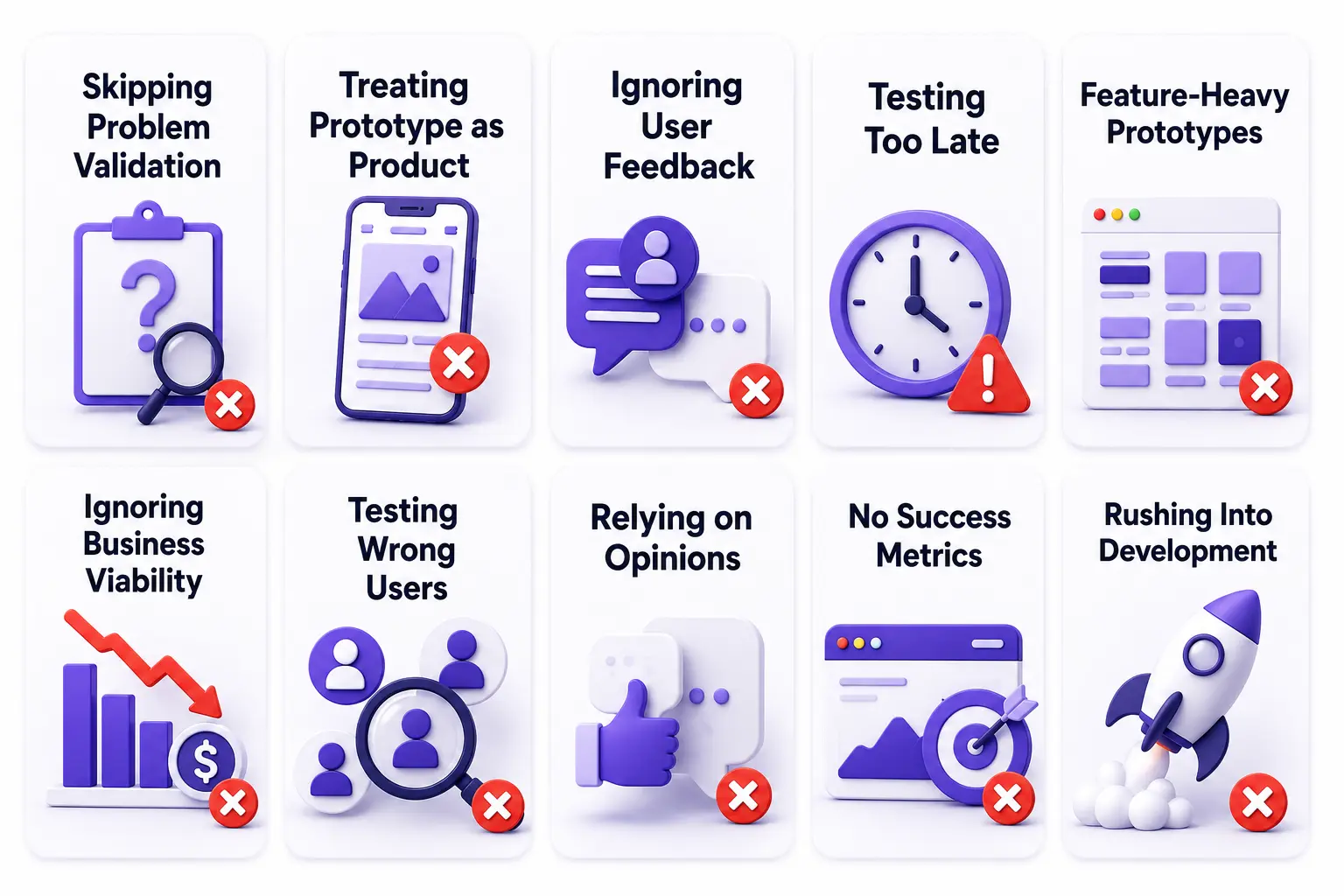
Rapid prototyping is designed to reduce uncertainty, accelerate learning, and improve product decisions before development begins. However, many businesses fail to realize that a poorly executed prototype can create as much risk as skipping validation altogether. Small mistakes made during prototyping often lead to incorrect assumptions, wasted development budgets, delayed launches, and products that struggle to gain market traction. Understanding these common rapid prototyping mistakes helps teams build a stronger validation process and move into development with greater confidence.
Mistake 1: Building a Prototype Before Understanding the Problem
One of the most expensive mistakes teams make is jumping directly into solution design without fully understanding the problem they are solving.
A prototype should validate a problem-solution fit. However, many organizations begin designing screens, workflows, and features before confirming whether the target audience actually experiences the problem.
This often leads to attractive prototypes that generate little market interest. Effective product designing starts with understanding user needs and business challenges before moving into interface and feature decisions.
Before starting the prototype development phase, businesses should clearly define:
- User pain points
- Business objectives
- Target audience
- Success criteria
Strong prototypes begin with a strong problem definition.
Mistake 2: Treating Prototypes Like Finished Products
Many teams spend excessive time polishing details that have little impact on validation outcomes.
The goal of rapid prototyping is learning, not perfection. When teams focus heavily on animations, visual effects, and advanced interactions, they often delay the feedback process unnecessarily.
A prototype only needs enough functionality to answer critical business questions. The most effective prototypes are often surprisingly simple, as their primary purpose is to validate assumptions, test user behavior, and gather meaningful feedback, rather than impress stakeholders.
This principle is central to both Rapid Prototyping for Product Development and lean product methodologies, where speed of learning is prioritized over design perfection.
Mistake 3: Skipping User Feedback During Prototype Testing
One of the most common prototype testing mistakes is collecting feedback only from internal stakeholders. Internal teams already understand the product concept. Actual users do not. Without external validation, businesses often mistake internal agreement for market demand.
Effective prototype testing involves observing how real users interact with the prototype rather than simply asking whether they like it.
Users frequently behave differently from how they predict. This is why observation often provides more valuable insights than direct feedback alone.
Mistake 4: Testing Too Late in the Product Validation Process
Some teams delay validation until the prototype becomes highly detailed.
This creates unnecessary risk. The earlier the feedback enters the product validation process, the easier it becomes to make changes.
Late-stage adjustments are significantly more expensive than early corrections.
Businesses following a structured product discovery process typically validate assumptions continuously throughout the project rather than waiting until the prototype feels complete. Rapid feedback cycles are what make rapid prototyping effective.
Mistake 5: Building Too Many Features Into the Prototype
Another costly prototyping mistake is trying to validate everything at once. Many teams attempt to include every possible feature in their prototype. The result is often confusion.
Users struggle to understand the product’s primary value proposition because the experience becomes cluttered with unnecessary functionality.
A prototype should focus on testing the most critical assumptions first. MVP app development services often use this validation-first approach to help businesses test ideas, gather user feedback, and reduce product development risks before scaling.
Less complexity often leads to better learning outcomes.
Mistake 6: Ignoring Business Viability During Validation
Many teams validate usability without validating business viability. A product that users enjoy does not automatically become a successful business.
The validation process should answer questions such as:
- Will customers pay for this solution?
- Does the solution reduce a meaningful pain point?
- Is the business model sustainable?
- Can the product scale efficiently?
Some of the most significant product validation mistakes occur when teams focus entirely on user experience while overlooking business fundamentals.
Successful validation combines customer desirability, technical feasibility, and commercial viability.
Mistake 7: Using the Wrong Users for Prototype Testing
Feedback quality depends heavily on participant quality. Testing with friends, colleagues, or unrelated audiences often produces misleading results.
The goal is not to collect positive feedback. The goal is to collect relevant feedback. Businesses should recruit participants who closely resemble their intended users.
This improves the accuracy of insights and reduces validation bias. Many startups investing in reliable product prototyping services discover that selecting the right test audience is often more important than prototype fidelity itself.
Mistake 8: Confusing Opinions With Data
Product teams frequently receive conflicting feedback. One user requests additional features. Another recommends removing them. This creates confusion when decisions rely solely on opinions. Strong validation combines qualitative feedback with behavioral data.
Instead of asking users what they want, observe:
- Where they hesitate
- Where they become confused
- Which actions do they complete
- Which workflows do they abandon
Behavior often reveals more than interviews. This is one of the most overlooked rapid prototyping best practices.
Mistake 9: Failing to Define Success Metrics
Many teams begin prototyping without defining what success actually looks like. As a result, feedback becomes difficult to interpret.
Before testing begins, establish clear validation metrics such as:
- Task completion rates
- User engagement
- Conversion intent
- Feature adoption
- User satisfaction
Without measurable goals, teams risk making subjective decisions that weaken the overall product design process.
Mistake 10: Moving Into Development Too Quickly
Perhaps the most expensive mistake is treating positive prototype feedback as permission to begin full-scale development immediately. Validation should reduce uncertainty, not eliminate it.
Before development begins, businesses should confirm:
- Problem validation
- User demand
- Technical feasibility
- Business viability
- Scalability considerations
Skipping these evaluations creates significant downstream risks.
Many startups eventually rebuild products because they moved too quickly from prototype to development. This is one reason experienced teams often recommend a structured transition from prototyping into the broader product development life cycle.
Common Rapid Prototyping Challenges Businesses Face
Even experienced teams encounter challenges during validation. Some of the most common include:
1. Stakeholder Misalignment
Different stakeholders often have different expectations regarding product direction.
2. Limited User Access
Finding qualified users for testing can be difficult.
3. Validation Bias
Teams sometimes seek feedback that confirms existing beliefs rather than challenging assumptions.
4. Time Constraints
Businesses frequently rush validation due to competitive pressure.
5. Resource Limitations
Startups often operate under budget and staffing constraints.
These rapid prototyping challenges are common, but they become manageable when teams prioritize learning over speed.

How to Avoid Prototyping Mistakes and Improve Validation Outcomes
Avoiding prototyping mistakes begins with adopting the right mindset. Rapid prototyping should function as a structured learning process rather than a design milestone.
Successful teams focus on:
- Problem validation before solution design
- Early and continuous testing
- Measurable success criteria
- User behavior over opinions
- Incremental learning cycles
Organizations working with a trusted digital product development company often achieve stronger validation outcomes because experienced product teams help identify risks before development begins.
Likewise, businesses exploring Startup App Ideas frequently use prototyping to determine which concepts deserve investment and which should be discarded early.
The goal is not building prototypes faster. The goal is to make better product decisions faster.
The Role of Rapid Prototyping in Startup Success
For startups, prototyping can significantly reduce risk during the earliest stages of product development. Most startup failures occur because products are built before market demand is validated.
Instead of spending months developing a complete application, founders can test assumptions quickly and gather meaningful feedback before making larger investments.
Many successful startups also partner with the best app developers for startups to create validation-focused prototypes that help attract investors, refine business models, and improve product-market fit.
This early validation process helps teams make informed product decisions, reduce development waste, and build solutions that better align with real market needs.
Real-World Lessons From Successful Product Teams
One of the most widely cited rapid prototyping examples comes from Airbnb. Before becoming a global platform, the founders used simple prototypes and landing pages to validate whether people would actually pay to stay in someone else’s home. Instead of investing heavily in technology from day one, they focused on testing assumptions, gathering user feedback, and refining the experience based on real-world behavior. This validation-first approach helped them identify what users valued most before scaling the product.
The lesson is clear. Successful product teams do not treat prototyping as a one-time phase that ends before development begins. They use prototypes throughout the product lifecycle to test new features, validate workflows, and reduce uncertainty before making larger investments. Even after launch, leading companies continue experimenting and collecting feedback to improve user experiences and business outcomes.
Teams leveraging the best product engineering services often follow a similar approach by validating major product enhancements before implementation. This reduces development waste, improves delivery confidence, and helps prioritize features based on user demand rather than assumptions.
Whether the goal is launching a startup product, scaling a SaaS platform, or modernizing an enterprise solution, continuous prototyping remains one of the most effective ways to make smarter product decisions and avoid costly development mistakes.

Wrapping Up
Rapid prototyping has become one of the most effective ways to reduce risk during modern product development. It enables businesses to validate ideas, gather meaningful user feedback, test assumptions, and make informed decisions before investing heavily in development. However, the success of rapid prototyping in product development depends on execution. Poor testing practices, unclear objectives, and invalidated assumptions often lead to costly mistakes that become far more expensive to fix later in the product journey.
The most successful product teams view prototyping as a continuous learning process rather than a design milestone. By focusing on user behavior, measurable insights, and ongoing validation, businesses can improve product-market fit and reduce development risk significantly. Whether you are building a startup product, enterprise platform, or digital solution, effective product designing and structured validation create a stronger foundation for success. At RipenApps, we help businesses transform ideas into market-ready products through strategic prototyping, validation, and product development approaches that minimize risk and maximize business value.
FAQs
1. What is rapid prototyping in product development?
Rapid prototyping in product development is the process of quickly creating an early version of a product to test ideas, validate assumptions, and gather user feedback before investing in full-scale development. It helps businesses reduce risk and make better product decisions early.
2. What are the most common rapid prototyping mistakes?
Some of the most common rapid prototyping mistakes include skipping user research, testing with the wrong audience, adding too many features, delaying prototype testing, focusing on design perfection, and moving into development without proper validation.
3. Why is prototype testing important?
Prototype testing helps identify usability issues, validate product assumptions, and understand how real users interact with a product concept. Early testing reduces development waste and improves the chances of building a product that meets market needs.
4. How can startups avoid costly prototyping mistakes?
Startups can avoid costly prototyping mistakes by validating the problem before building solutions, testing with target users, defining clear success metrics, and focusing on learning rather than creating highly polished prototypes. Early feedback often prevents expensive product pivots later.
5. What is the difference between a prototype and an MVP?
A prototype is used to validate ideas and gather feedback before development. An MVP (Minimum Viable Product) is a functional version of the product released to real users to validate market demand. Prototypes test assumptions, while MVPs test real-world usage and business viability.
6. How long does the rapid prototyping process take?
The rapid prototyping process can take anywhere from a few days to several weeks, depending on product complexity, validation goals, and testing requirements. Most businesses aim to create and test prototypes as quickly as possible to accelerate learning.
7. What are the key benefits of rapid prototyping?
The major benefits of rapid prototyping include faster product validation, reduced development risk, lower costs, improved stakeholder alignment, better user experience insights, and more informed product development decisions before significant resources are invested.
8. When should businesses move from prototyping to development?
Businesses should move into development only after validating the core problem, confirming user demand, gathering sufficient feedback, and establishing technical and business feasibility. Transitioning too early is one of the most common causes of product development failures.

SHARE
WRITTEN BY

Ishan Gupta
CEO & Founder
Ishan Gupta is a seasoned entrepreneur and CEO with extensive 8+ years of experience in business and mobile app development landscape. He believes that the right digital product allows companies to focus on what they do best, while technology handles the rest. With deep exposure to global markets, he understands what makes an app succeed. His approach translates business needs into clear product strategies, ensuring that every feature contributes to measurable ROI.
View All Articles





 India
India USA
USA Australia
 Canada
 UK
UK UAE
UAE