

Suppose an AI-driven financial advisor is critically analysing your spending habits and investment goals and giving personalised advice. What about reputed companies using AI-powered hiring platforms to screen candidates, reduce hiring time, and improve employee retention? All these AI app ideas are not futuristic, but a reality that’s shaping the present.
Around 80% of businesses will witness a significant investment in AI technologies by the end of 2026, which indicates a seismic shift towards data-driven decision-making and customer personalisation. The technological landscape is transformed by AI integration into our everyday life applications. From predictive analytics in retail to AI-driven diagnostics in healthcare, popular AI apps are paving the way for innovative solutions.
For instance, SigFig is one of the popular robo-advisors that leverage AI technology to effectively manage portfolios based on individual goals. It helps users with automated rebalancing, personalised financial insights, low-cost investment management, etc. Similarly, Zebra Medical Vision utilises AI algorithms to analyse medical imaging, guiding medical professionals to make quicker and more accurate diagnoses.
Such real-life examples of AI apps showcase that organisations that harness AI effectively are expected to increase their cash flow and streamline their operations. Thus, as entrepreneurs look forward to opportunities, they can leverage the full potential of emerging technologies.
In this blog, you will discover the top 15 innovative app ideas that every entrepreneur should know. These innovative concepts not only reflect emerging trends but are the future of how we work, live, and interact with technology. So, stay tuned till the end to embark on a journey into the future of AI.
Key Takeaways
- AI-powered apps are creating massive opportunities for entrepreneurs to build intelligent, scalable, and highly personalised digital products.
- Industries like fintech, healthcare, retail, productivity, and logistics are rapidly adopting AI-driven mobile applications.
- AI technologies such as machine learning, generative AI, and predictive analytics are transforming modern app capabilities.
- Successful AI startups focus on solving real problems, validating ideas, and building scalable AI-powered solutions.
- Building AI apps in 2026 offers strong revenue potential, faster innovation, and significant competitive advantages.
Table of Contents
Why Today’s Users are More Excited for AI-Powered Apps?
In today’s tech-driven age, the demand for AI-powered apps is booming at a rapid speed. The market size of Artificial Intelligence in mobile apps is projected to reach around USD 354.09 billion by the year 2034. The high surge is fueled by the AI’s abilities to automate several daily tasks, offer hyper-personalised options, streamline business operations, and help in making better decisions across various sectors.
Additionally, the rise of generative AI and intelligent AI assistants is transforming mobile apps into smart, proactive digital companions. Today, mobile users are more excited about AI-based apps because the emerging technologies are bringing convenience and intelligence in almost every field.
With the rise of large language models (LLMs), AI copilots, and real-time data processing integration, modern apps are becoming more intuitive and context-aware than ever before. Many businesses are also investing in application modernization solutions to upgrade their existing systems and support these advanced AI capabilities. The AI capabilities are constantly growing as more and more users are using apps that offer efficient and smarter solutions tailored to their specific needs.
Here, we have mentioned some key reasons:
- Personalisation at Scale: With the help of AI algorithms, users can analyse huge sets of data to provide personalised content as per their needs. AI algorithms can also give recommendations according to an individual’s history and preferences. Modern AI apps now leverage machine learning and generative AI to deliver hyper-personalised experiences, from tailored shopping suggestions to personalised financial insights and health recommendations.
- Automates Several Repetitive Tasks: AI-driven mobile apps automate several day-to-day tasks such as scheduling, customer support, etc. Therefore, users can reduce their workload, save time, and boost their productivity in the long run. Advanced AI automation tools and intelligent agents are now capable of managing workflows, summarising information, generating content, and handling routine tasks with minimal human intervention.
- Seamless Human-like Interactions: Another reason that users are more excited about the latest AI applications is due to AI chatbots and virtual assistants. The main reason is that they provide real-time insights, which improve customer support and boost user engagement. With advancements in natural language processing (NLP) and conversational AI, users can now interact with apps through voice, chat, and multimodal interfaces, making digital experiences more natural and interactive.
- Predictive Analytics: Users can make more data-driven decisions as AI-driven apps provide predictive insights for health tracking, managing finance, e-commerce, and more, assisting them in making better choices. By analysing historical data and behavioural patterns, AI-powered apps can forecast trends, anticipate user needs, and deliver proactive recommendations in real time. Businesses often rely on predictive analytics consulting to implement these capabilities effectively and ensure accurate, scalable insights.Â
Why Entrepreneurs Should Build AI Apps in 2026?
Building an AI-powered app is a foundational shift in 2026 that enables startups to have a unique chance of building intelligent applications that deliver highly personalised user experiences. Artificial intelligence is no longer a future concept; instead, it is a powerful business opportunity that entrepreneurs can leverage today.
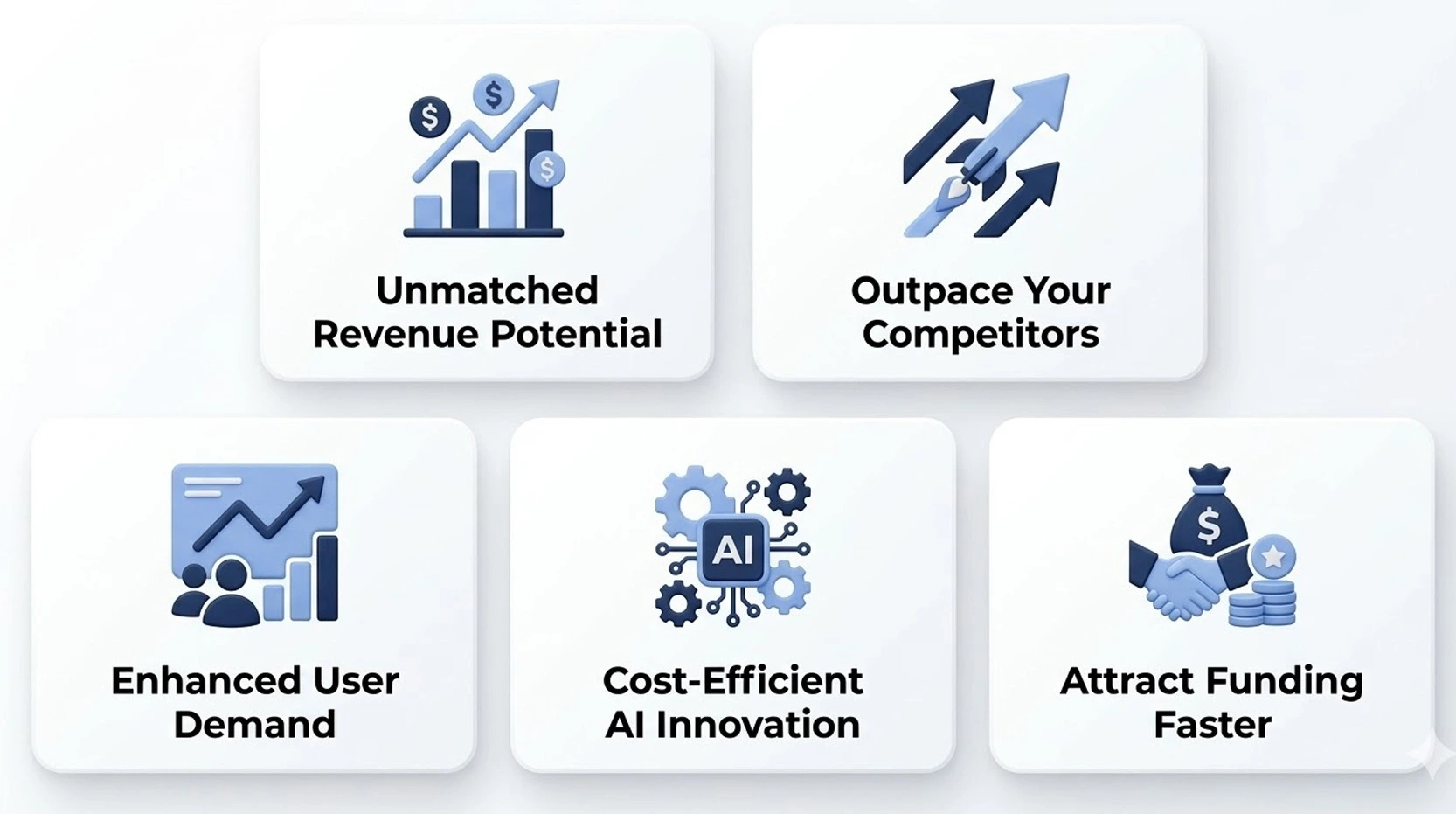
This rapid shift means end-user expectations have changed permanently, and people now expect apps to be intelligent, personalised, and predictive. Now, look at the 5 reasons why you should invest in AI app development now:
1. Unmatched Revenue Potential
The AI market opportunity has never been seen in this unprecedented form, with the AI app sector projected to reach $156.9 billion in revenue by 2030. Meanwhile, Gartner’s Jan 2026 forecast report puts total worldwide AI spending at $2.52 trillion this year, which means a 44% increase overall.
For startup founders, this translates to an expanding pool of paying users, enterprise buyers, and investors actively seeking well-executed AI products. Entering this market today means growing alongside it, rather than trying to catch up once it matures and competition intensifies further.
2. Outpace Your Competitors
Building with AI is no longer a luxury reserved for large tech companies. Business leaders leveraging AI-powered solutions are seeing a 40% boost in operational efficiency and a 25% increase in revenue generation, helping them pull ahead of competitors who are still relying on traditional approaches.
For entrepreneurs, this edge compounds over time. An AI-powered app learns, improves, and personalises at a scale that no manual process can match. Once users experience that level of intelligence and convenience, switching back to a non-AI alternative becomes almost unthinkable.
3. Enhanced User Demand
Almost 700 million people have used AI apps in the first half of 2025 alone. This is not a niche audience; it is mainstream adoption happening at a global scale across age groups and industries. Users are actively seeking apps that save them time, help them make better decisions, and feel tailor-made for their needs.
Entrepreneurs who build around this demand, whether in health, finance, education, or retail, are entering markets with proven appetite and strong retention potential, since personalised AI experiences naturally keep users coming back.
4. Cost-Efficient AI Innovation
Another key reason is how accessible AI development has become. With the rise of low-code and no-code platforms and powerful APIs from companies like OpenAI and Google, developers can now integrate sophisticated AI features without needing an entire data science team. This dramatically lowers the barrier to entry for entrepreneurs and early-stage startups.
What once required millions in infrastructure and talent can now be prototyped and validated for a fraction of the cost, making it realistic for founders at any stage to launch competitive, AI-driven products quickly.
5. Attract Funding Faster
Capital is flowing into AI at historic levels, making it one of the best-funded spaces for new entrepreneurs. Bessemer Venture Partners reports AI is now the highest-valued category in their Cloud 100 at $176 billion, with AI companies reaching the $100 million revenue milestone in 5.7 years versus the 7.5-year average.
This means AI startups are scaling faster and attracting funding more efficiently than almost any other category. For entrepreneurs with a strong idea and a clear use case, the funding environment in 2026 is as favourable as it has ever been for building and scaling an AI-first product.
15 Best AI App Ideas to Launch in 2026
Launching an AI-powered app can help you enter one of the fastest-growing technology markets today. From fintech and healthcare to productivity and retail, AI is enabling entrepreneurs to build smarter, data-driven applications.
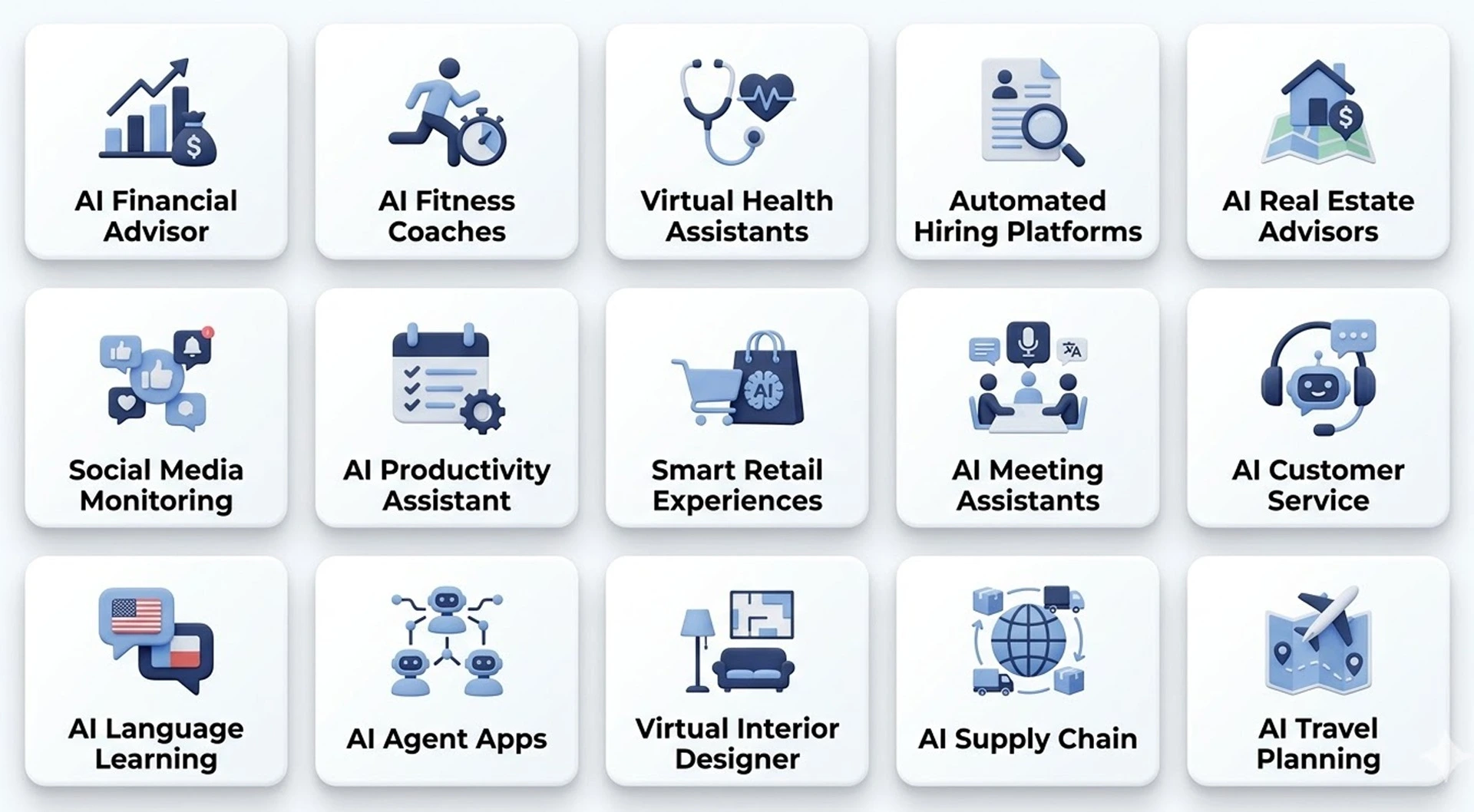
Here are 15 AI app ideas you can explore in 2026 to build innovative solutions and capture emerging market opportunities.
1. AI Financial Advisor: The Future of Personal Finance
One of the most game-changing and best AI app ideas is the AI Financial Advisor. The impact of AI in the Fintech Industry and this AI financial advisor app idea redefines the way individuals manage their personal finances and investments. AI-driven financial advisors will manage your wealth and offer real-time and data-driven insights, so you can make informed decisions.
The global market of generative AI in financial services is expected to reach around USD 17.88 billion by 2035, with a CAGR of 24.81% from 2026 to 2035. Several factors, such as automated investment management, improved financial forecasting, and enhanced customer experiences, are driving this growth. Thus, making AI financial advisors one of the most crucial tools for modern investors and digital banking platforms.
Popular Examples of AI financial advisors: Betterment, Wealthfront, Cleo AI, Plum, Acorns
2. AI-Fueled Fitness and Nutrition Coaches: Wellness Guidance for Tomorrow
When it comes to the fitness industry, the focus is more on hyper-personalisation. With the help of AI-driven apps, you can easily personalise your workout schedule or plans and monitor your progress in real-time. Apart from this, you can also make necessary adjustments to your diet based on your health goals and preferences.
If you are an entrepreneur looking to excel in the wellness era, you should come up with such app ideas with AI and take advantage of this booming opportunity. Surely, your investment in fitness-tracking app development will give you a higher return.
Popular examples of AI apps for fitness and nutrition coaches:Â MyFitnessPal, Fitbod, Noom, Freeletics, Future
3. AI-Powered Virtual Health Assistants: Your Digital Partner for Better Health
In the healthcare sector, patients are looking forward to personalised treatment and care. AI-based virtual health assistants have completely redefined the way people manage their health status. Entrepreneurs looking for ideas for AI apps should invest in such apps so that their users can easily monitor their health data in real-time. Medical professionals are advancing patient-centred healthcare by leveraging AI in healthcare app development.
Apart from this, such apps can suggest preventive measures and also give emergency alerts to medical professionals. However, you need to hire app developers to incorporate such advanced features into your app.
Popular Examples of AI-powered virtual health assistants: Ada Health, HealthTap, Buoy Health, Mediktor
4. Automated Hiring Platforms: Find the Right Talent, Faster
The recruitment process can be significantly streamlined with the help of AI-powered and data-driven hiring platforms. These applications can analyse resumes, screen candidates, and even assist in the initial stages of interviews using machine learning algorithms and intelligent candidate-matching systems. By analysing historical hiring data, skills, and behavioural indicators, AI can help organisations identify the most suitable candidates more efficiently.
If you are an entrepreneur searching for business ideas for apps, then you can also invest in availing mobile application development services to develop automated hiring platforms. So that you can easily transform the hiring process and help companies to save time, effort, and valuable resources.
Popular examples of AI automated hiring platforms: HireVue, Paradox AI, Zoho Recruit, iCIMS Talent Cloud
5. AI-Powered Real Estate Advisors: Guide For Future-Proof Investments
With technical advancements in AI-driven apps, you can make smarter decisions for real estate investments. AI in real estate advisor platforms helps you to analyse market trends, predict fluctuations in property value, and allows users to find the best deals.
The market size of the AI-powered real estate market is rapidly growing and will be valued at around USD 41.5 billion by 2033. According to industry reports, it is growing at a CAGR of 30.5% from 2024 to 2033. One of the major reasons for growth is AI’s ability to process huge amounts of data effectively. Thus, AI-powered real estate advisors help investors to make more informed decisions. You can also build similar apps to transform how users buy, sell, or rent properties.
One of the famous examples of an AI-powered real estate advisor app: Zillow’s AI Zestimate, which uses ML to provide an estimation of property value based on trends, market scenarios, and historical data.
Read More: How Much Does It Cost to Develop a Real Estate App Like Zillow?
6. AI Social Media Monitoring Tools: Monitor, Analyse, and Engage Smarter
If you are in the social media management field, then staying ahead of your competitors can be challenging. It demands constant monitoring of emerging trends and keeping track of engagement. When you invest in an AI in social media app in 2026, you can easily schedule posts, analyse your competitors, keep track of sentiments, and also suggest viral content ideas as per your users’ preferences.
By investing in AI-driven social media applications in 2026, businesses can automate content scheduling, analyse competitor strategies, monitor brand mentions, and generate data-driven content recommendations based on audience behaviour. These intelligent tools help marketers optimise their campaigns, improve engagement, and make more informed decisions about their social media strategies.
Popular examples of AI social media monitoring tools: Hootsuite Insights, Brandwatch, AgoraPulse, Sprout Social AI
7. AI Personal Productivity Assistant: Smarter Work Management
Professionals and businesses are constantly looking for smarter ways to manage tasks and improve productivity. AI-powered personal productivity assistants help users organise schedules, prioritise tasks, and streamline daily workflows with the help of intelligent automation. These applications can analyse work patterns, suggest task priorities, and provide reminders to ensure better time management.
By leveraging technologies such as machine learning and generative AI, these apps can also summarise documents, generate meeting notes, automate routine tasks, and assist users in managing emails or project updates more efficiently. For entrepreneurs, developing AI-powered productivity assistants presents a strong opportunity to build tools that enhance workplace efficiency and simplify complex workflows for modern professionals.
Popular examples of AI personal productivity assistants: Motion AI, Notion AI, Reclaim AI, Sunsama
8. Smart Retail Experiences: Shop Smarter, Experience Better
One of the most exciting AI app ideas for 2026 was offering smart retail experiences. As the retail industry is evolving continuously, so are the customer expectations. Nowadays, customers can enjoy personalised shopping experiences, which is transforming the retail landscape. Retailers can do real-time inventory tracking and predictive customer insights to accelerate their businesses. So, if you are an entrepreneur, you can also revolutionize eCommerce with AI-powered virtual stores.
Some popular examples of smart retail experiences: Sephora Virtual Artist, Amazon Go, Vue.ai, Walmart’s Intelligent Retail Lab (IRL)
9. AI Meeting Assistants: Automating Collaboration
As remote and hybrid work environments continue to grow, managing meetings efficiently has become a major challenge for teams and organisations. AI-powered meeting assistants are designed to simplify collaboration by automatically recording conversations, transcribing discussions, and generating concise meeting summaries. These intelligent tools help teams focus more on productive discussions rather than manual note-taking.
By leveraging technologies such as natural language processing (NLP) and machine learning, AI meeting assistants can identify key discussion points, extract action items, and organise follow-up tasks automatically. This allows businesses to improve communication, enhance productivity, and ensure that important information from meetings is never missed.
Popular examples of AI meeting assistants: Otter AI, Fireflies AI, Avoma, Fathom AI
10. AI-Enhanced Customer Service Platforms: Elevate Customer Satisfaction with Smart Support
Nowadays, businesses are looking forward to offering exceptional customer experiences. Therefore, they can make the best use of AI-driven customer service platforms to stay ahead of their competitors. Entrepreneurs can create apps that can offer 24/7 support to their users, work on predictive problem-solving, and also offer personalised customer interactions. All of these can be powered by the latest technologies, such as Artificial Intelligence, Machine Learning, etc.
Popular examples of AI-driven customer service platforms: Zendesk Answer Bot, Freshdesk, Intercom, Ada AI
11. AI-Based Language Learning Apps: Your Virtual Tutor for Global Communication
If you plan to invest in AI for learning languages, this can be one of the great AI-based app ideas. This can help you attract millions of targeted audiences and can give you a chance to increase your revenue.
By using an AI-powered language learning app, you can easily analyze user’s performance and enhance their overall experience. Moreover, by making the best use of such apps, several users are improving their communication skills and learning multiple languages.
A popular example of an AI-based language learning app: the Duolingo application
Read More: How AI Transforming E-learning Landscape?
12. AI Agent-Based Apps: Autonomous Digital Assistants
AI agent-based applications are emerging as one of the most transformative innovations in modern software development. Unlike traditional AI tools that respond to simple inputs, AI agents are designed to perform complex tasks autonomously by analysing data, making decisions, and interacting with multiple systems. These intelligent digital assistants can manage workflows, conduct research, automate repetitive tasks, and even coordinate between different applications to complete multi-step operations.
For entrepreneurs, building AI agent-based apps presents a powerful opportunity to create next-generation digital products that enhance productivity and automate business processes. By leveraging technologies such as large language models (LLMs), machine learning, and intelligent automation, these applications can significantly improve efficiency while reducing manual effort across various industries.
Popular examples of AI agent-based platforms: AutoGPT, AgentGPT, Devin AI, Adept AI, OpenAI Operator
13. AI-Based Virtual Interior Designer: Effortless Design, Infinite Possibilities
Another increasing demand is for AI-based virtual interior designer platforms. It helps several users to creatively design and plan their living spaces using technologies such as AR/VR. With such apps, your users can easily create and visualise 3D floor plans, generate realistic 360-degree views of the space, and much more. Therefore, it is worth it to leverage AI in mobile app development and to build an engaging virtual interior design platform for your users.
Some successful AI-based virtual interior designer apps: Roomle, Planner 5D, Roomstyler 3D Home Planner, DecorMatters
14. AI-Powered Apps for Supply Chain Operations: Future-Proof Your Business with Smart Tech
When it comes to logistics, supply chain optimisation is one of the major pillars of all logistics workflows. With an AI-driven supply chain operations app, employees can get solutions to their issues in real time. The app can provide valuable insights to users about the organisation profile, sales, inventory stock, etc which will allow them to make prompt decisions. So, this can also be one of the best AI mobile app ideas to help industries streamline their operations.
For instance, Logistimo is one of the most popular apps that helps entrepreneurs to efficiently manage their logistics and supply chain processes.
Read More: Role of Technology in Supply Chain: How Technology is Revolutionizing the Logistics Industry
15. Travel Planning AI-Driven App: Your Next Adventure, Optimised by AI
Planning a trip can be exciting, but organising itineraries, managing budgets, and discovering the best destinations can quickly become overwhelming. AI-powered travel planning apps simplify this process by analysing user preferences, travel history, and real-time data to generate personalised travel recommendations.
These intelligent applications can automatically create travel itineraries, recommend attractions, suggest optimal routes, and track travel expenses. By leveraging technologies such as machine learning, predictive analytics, and generative AI, these platforms can provide travellers with customised experiences tailored to their interests, budgets, and schedules. For entrepreneurs, AI-driven travel planning apps present a strong opportunity to transform the travel industry by offering smarter and more convenient digital travel assistants.
Some popular examples of travel planning AI-driven apps: TripIt, Hopper, Kayak, Skyscanner, Mindtrip AI
How to Choose the Right AI App Idea for Your Startup
Choosing the right AI app idea is one of the most important steps for entrepreneurs planning to build a successful AI-powered product. While the market offers numerous opportunities, selecting an idea that aligns with real user needs, technological feasibility, and market demand can significantly increase the chances of success. To identify the most promising AI app idea for your startup, consider the following key factors:
1. Solve a Real-World Problem
Focus on identifying practical problems where AI technologies such as automation, predictive analytics, or intelligent decision-making can create measurable value for users or businesses.
2. Conduct Market Research
Analyse industry trends, study competitors, and evaluate existing solutions to understand gaps in the market where an AI-powered application can offer better efficiency or innovation.
3. Validate the Idea with Potential Users
Before investing heavily in development, gather feedback from your target audience through surveys, prototypes, or MVP testing to ensure that your app idea meets real user needs.
4. Evaluate Data Availability
AI applications rely heavily on data. Ensure that sufficient and reliable datasets are available to train machine learning models and deliver accurate insights or predictions.
5. Assess Scalability and Technology Integration
Choose an idea that can scale with user growth and can integrate advanced technologies such as machine learning, generative AI, natural language processing, and AI agents.
By combining strong market demand with innovative AI technologies, startups can develop powerful applications that deliver long-term value and sustainable business growth.
The Ultimate Cost of Developing an AI-Powered Mobile App
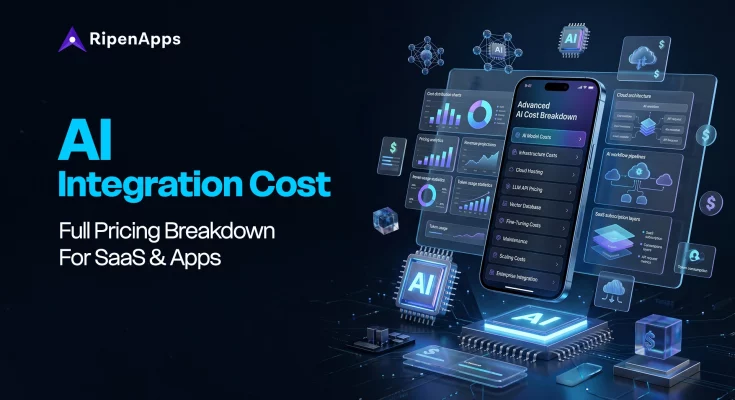
The cost of developing an AI-powered mobile app can vary depending on several factors, including the complexity of features, the type of AI model integration, data processing requirements, and the expertise of the development team.
Compared to traditional apps, AI-powered applications often require additional resources for training machine learning models, managing data pipelines, and integrating intelligent automation capabilities. As a result, the development cost may vary significantly based on the scope and functionality of the application.
Here is an estimated cost breakdown based on the complexity of AI app development:
| AI App Type                  | Estimated Development Cost               | Key Features Included                               |
| Basic AI App (MVP) | $40,000 to $80,000 | Basic AI features, chatbot integration, simple automation, and limited datasets |
| Mid-Level AI App | $80,000 to $180,000 | Predictive analytics, personalised recommendations, API integrations, and scalable architecture |
| Advanced AI App | $180,000 to $250,000+ | Generative AI capabilities, large datasets, real-time analytics, and advanced automation |
| Enterprise AI Platform | $250,000+ | Custom AI models, deep learning systems, complex integrations, and enterprise-level scalability |
Partnering with an experienced AI app development company can help businesses identify the right technology stack, optimise development costs, and build scalable AI-driven applications tailored to their business goals.
Wrapping Up
AI is redefining how businesses build digital products and how users interact with modern applications. From personalised financial advisors to AI-powered productivity tools and intelligent virtual assistants, AI apps are reshaping industries and unlocking new possibilities for innovation. For entrepreneurs, this presents a significant opportunity to build scalable, data-driven applications that solve real-world problems while delivering smarter and more personalised user experiences.
However, turning an AI app idea into a successful product requires the right strategy, technology stack, and expertise. As a leading AI app development company, RipenApps helps businesses develop innovative AI-powered applications tailored to their unique goals. Whether you’re looking to build a smart app or launch a next-generation AI product, our team can help you bring your vision to life and stay ahead in the evolving digital landscape.
FAQ
Q1. What is the future of AI in 2026 and beyond?
By 2026, AI will drive advancements in various industries such as healthcare, finance, education, and logistics. It will help in making smarter and more autonomous decision-making. Also, it helps in predictive analysis and automates several tasks. Therefore, transforming how businesses and individuals operate.
Q2. What are the key AI trends in 2026?
The AI trend in 2026 will focus on advancements in natural language processing (NLP), autonomous systems, personalised AI experiences, and AI-powered decision-making. Key AI trends include AI in healthcare, autonomous vehicles, and hyper-personalised consumer apps, driving innovation across multiple sectors.
Q3. What is the future of AI in business?
With the help of AI, businesses can enhance their operational efficiency, automate repetitive workflows, personalise customer experiences, and optimise decision-making processes. AI-powered analytics and automation tools allow companies to make faster, data-driven decisions, which leads to better productivity and long-term innovation.
Q4. How Much Does It Cost To Build an AI Mobile App?
The cost to build an AI-powered mobile app depends on various factors such as the app’s complexity, features, AI model integration, and the development team’s expertise. However, the average cost typically ranges from $40,000 to $180,000 for a standard AI-powered application. More advanced AI platforms with complex machine learning models, real-time analytics, or generative AI features can exceed $200,000.
Q5. What industries benefit the most from AI-powered mobile apps?
Several industries are rapidly adopting AI-powered applications to improve efficiency and deliver smarter services. Healthcare, fintech, retail, logistics, education, and travel are among the sectors benefiting the most. AI apps help businesses automate processes, analyse large datasets, personalise user experiences, and improve decision-making, making them highly valuable across multiple industries.
Q6. How long does it take to develop an AI-powered mobile app?
The development timeline for an AI-powered mobile app depends on the complexity of the features and the type of AI integration required. A basic AI MVP may take around 3–4 months to develop, while more advanced AI applications with machine learning models, data training, and integrations can take 6–9 months or longer.

SHARE
WRITTEN BY

Prankur Haldiya
Chief Technical Officer
A tech innovator and engineering leader, Prankur Haldiya drives RipenApps’ product development strategy and oversees cutting-edge solutions in mobility, AI, and cloud ecosystems. He is passionate about building high-performance teams and helping brands launch secure, scalable, and user-centric digital products.
View All Articles



 India
India USA
USA Australia
 Canada
 UK
UK UAE
UAE