

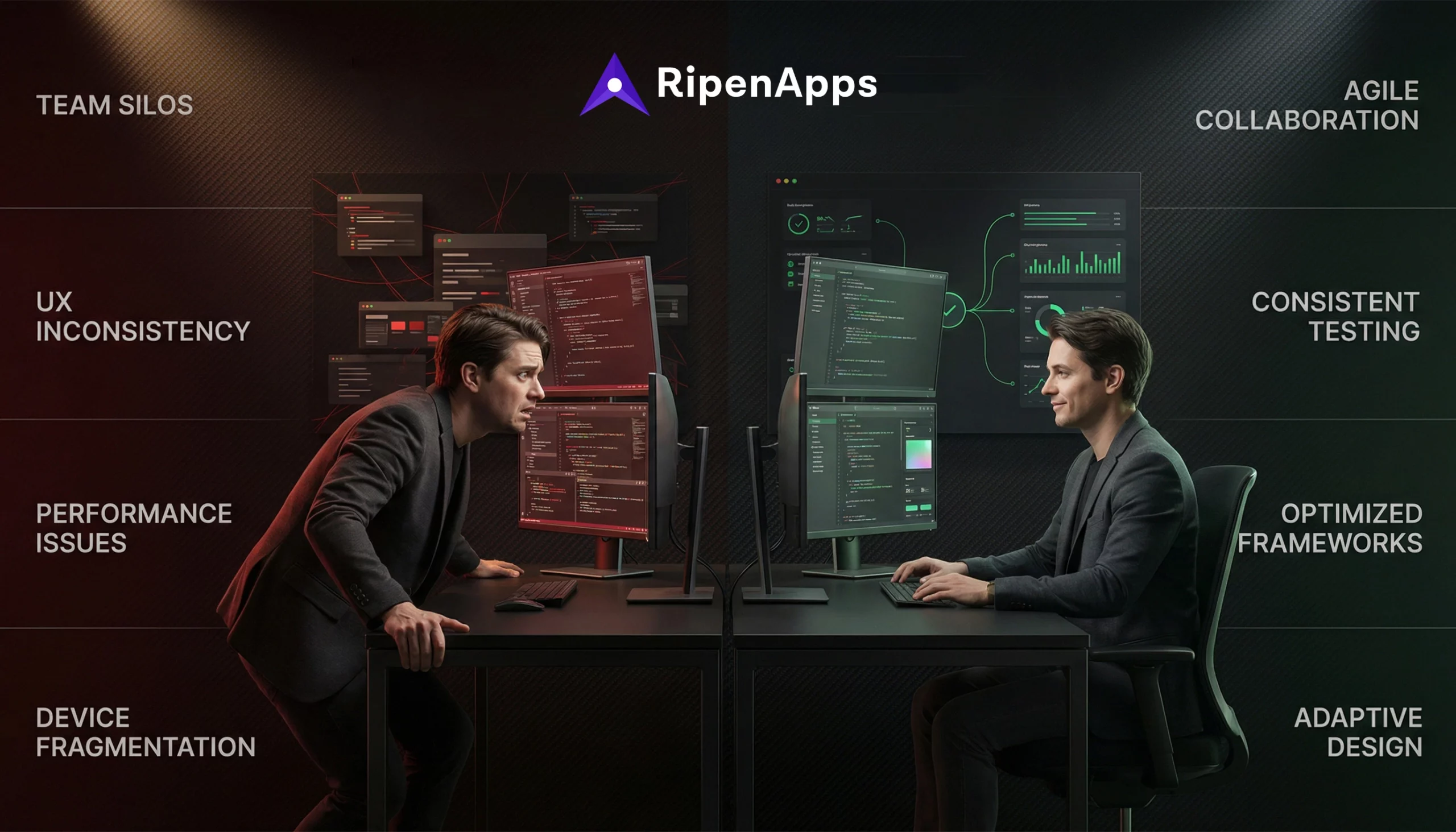

Cross-platform app development continues to evolve as businesses push for faster launches, wider reach, and long-term cost efficiency. In 2026, the conversation is no longer about whether cross-platform works. The real question focuses on how well it scales, performs, and stays secure across rapidly changing devices and user expectations.
Enterprises, startups, and global brands rely on cross-platform app development to ship consistent experiences across Android, iOS, web, wearables, and foldables. Yet, complexity grows as platforms mature. New architectures, AI-driven workflows, sustainability goals, and hardware-level integrations redefine old challenges.
Below is a future-ready view of the most critical cross-platform app development challenges and how modern teams solve them. So, let’s get started :
Table of Contents
Cross-Platform App Development Challenges And Solutions
This section highlights the most common hurdles in cross-platform mobile application development and the practical strategies to overcome them. Understanding these challenges early helps you make informed technical decisions, reduce long-term risks, and unlock the highest benefits of developing cross-platform apps. We have divided these into two key focus areas:
Core Technical & Structural Challenges
The pointers below focus on the foundational cross platform development problems. These challenges relate to how the app is built, how it performs on various hardware, and how it maintains a consistent feel across different operating systems. Addressing these early through robust architecture and modern framework features is essential for ensuring your app behaves like a high-quality native product.
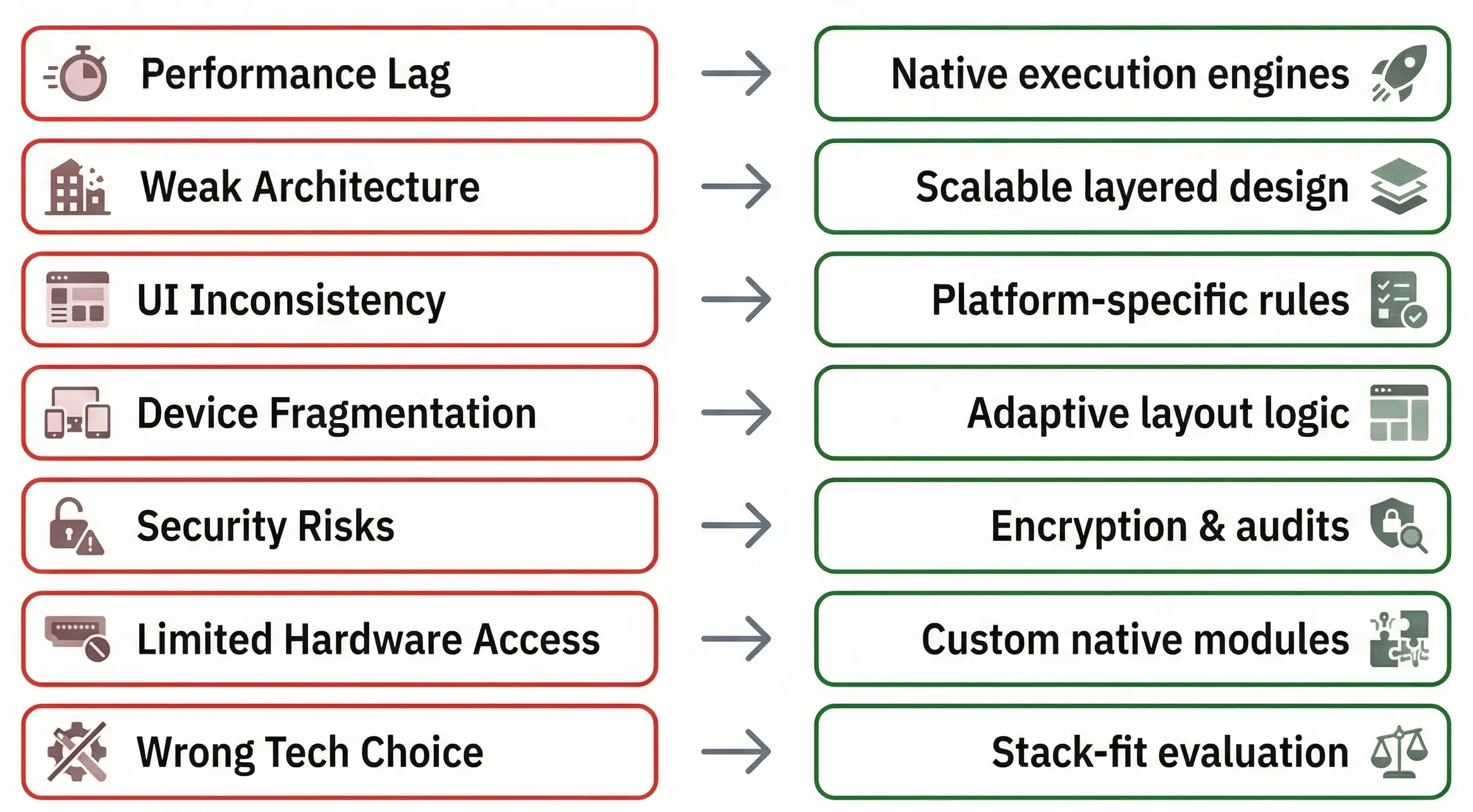
1. Performance Lag That Drives Users Away
Performance issues remain one of the biggest reasons users uninstall apps. Laggy animations, slow startup times, and memory spikes damage trust quickly, especially when apps aim to behave like native products.
Solution
Modern frameworks address this directly. React Native uses JSI and TurboModules to reduce bridge overhead. Flutter relies on the Impeller engine for smoother rendering, while Kotlin Multiplatform enables native execution for business logic. A reliable hybrid app development company applies these technologies strategically to improve runtime performance without sacrificing stability or scalability.
2. Applying Robust Architectural Foundations
Nearly 70% of digital transformation projects fail due to a poorly designed architectural foundation. And, since there are so many teams involved in cross-platform app development, there is a solid requirement for building a strong architectural foundation for your app project.
Solution
Choose modern and scalable architectures to build high performing apps and ensure your project stays flexible and adaptable to future changes. Plan regular reviews and updates for the architectures you utilize in your cross-platform app development project. When you hire mobile app developers for your startup, consult about the scalability of your cross-platform app development architecture.
3. Ensuring Consistent User Experience Across Platforms
Another key challenge of cross platform apps is ensuring a consistent user experience. Of course, you want to build an app that is identical in terms of design, performance, and speaks your brand tone. Nearly 57% of the users do not recommend a business with a poorly designed mobile app. So, how can you ensure that your app stays consistent and has a resemblance to your brand?
Solution
Testing is the best solution while ensuring a consistent user experience. Do check your app on multiple devices as much as you can, even after updating it or introducing any new feature. Gather user feedback and take it seriously. When you apply what users want in your app, your user experience will ultimately improve, fostering a smooth and consistent user experience across devices.
4. Device Fragmentation Keeps Growing
Foldables, tablets, wearables, and multiple screen sizes add complexity. Layouts designed for phones break on larger or flexible displays. Navigation patterns feel inconsistent across devices.
Solution
Adaptive layouts handle varying screen sizes without rewriting logic. Shared business logic powers all devices, while UI layers adjust dynamically. Planning for fragmentation early prevents costly redesigns later in the cross platform mobile application development cycle.
5. Safeguarding Sensitive User Information
Data breaches continue to cost organizations millions in financial loss, regulatory penalties, and brand trust. Cross-platform apps attract a broad user base across Android, iOS, and web environments. Thus, increasing the volume and variety of sensitive data processed daily. With multiple access points and shared codebases, data protection requires a deliberate, security-first approach to prevent exposure and ensure long-term user trust.
Solution
Set the security of your mobile app as a priority, no matter what. Implement robust cyber security solutions like encryption and utilize secure APIs. Further, ask your teams to perform regular security audits and compliance checks to safeguard user data and your business reputation.
6. Accessing Advanced Device Hardware
Features like Face ID, biometrics, sensors, and LiDAR play a key role in modern app experiences. Cross-platform apps often face limitations when hardware access is poorly planned.
Solution
Native modules bridge this gap by enabling direct access to platform APIs without compromising performance. This approach supports advanced hardware capabilities while keeping the shared codebase efficient and maintainable. Experienced teams offering professional IT consultancy services help plan and implement these integrations correctly. Thus, ensuring hardware features work reliably across platforms without adding technical debt.
7. Navigating Technical Challenges
Another major cross-platform development issue is navigating the technical challenges efficiently. Since cross-platform apps target delivering a native-like mobile app experience, there are a bunch of technical aspects involved that might require you to hire mobile app developers for your project. Nearly 48% of the developers cite that they face compatibility issues in cross-platform app development.
Solution
Explore and integrate the most modern and popular cross-platform app development frameworks. Do not go with the old frameworks that are not supported by the most modern APIs. React and Flutter app development technologies can be your best bet here. From bug fixing to releasing new features, everything is smooth when you leverage modern cross platform mobile app development technologies.
Operational & Advanced Challenges
These challenges emerge during the active development lifecycle and long-term management of an app. They focus on team dynamics, rising maintenance costs, and integrating complex modern features like AI or “Super App” functionalities. Solving these operational issues requires collaboration and smart development workflows to ensure the project remains scalable and cost-effective as it grows.
1. Fostering Seamless Collaboration Across Teams
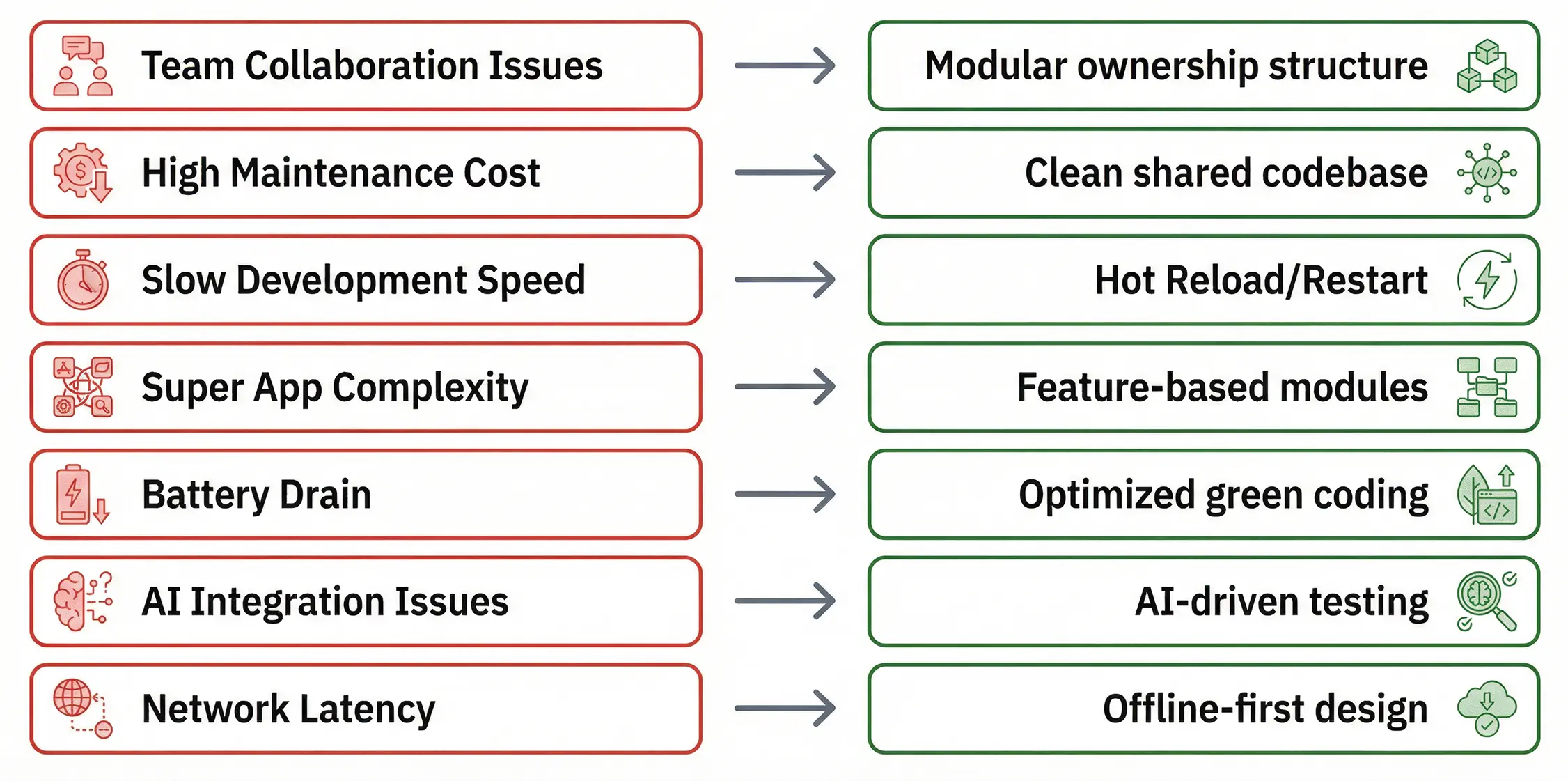
Achieving that seamless collaboration across platforms is not as easy as it sounds. When you plan to develop your cross-platform mobile app, nearly 75% of your project depends on the collaboration between multiple teams, be it Android, iOS, web, or other important teams.
Solution
To bridge the gap in communication between cross-functional teams, you must adopt collaborative tools, agile methodologies, and establish clear communication channels. When you build a culture of effective collaboration and set shared goals with your mobile app development partner, you can establish a clear communication channel.
2. Rising Maintenance Costs Over Time
Initial development savings disappear when shared code becomes messy. Debugging takes longer. Updates break existing features. Maintenance consumes more resources than expected.
Solution
A clean shared codebase is critical. Remove unused code through tree shaking. Enforce coding standards. Keep dependencies updated. Clean structure reduces maintenance effort and improves long-term ROI.
3. Slow Development Cycles
Long feedback loops frustrate teams. Simple UI tweaks take hours. Core changes require full rebuilds. Productivity drops as projects scale.
Solution
Hot Reload speeds up UI iteration by applying changes instantly, while Hot Restart resets the app state when deeper logic changes occur. Used together, they significantly shorten development cycles and reduce rework. Teams that hire dedicated React Native developers benefit the most from these workflows, as experienced engineers optimize speed without compromising app stability.
4. Managing Super App Complexity
Super apps combine multiple services into one ecosystem. As features grow, complexity multiplies. Without structure, performance and maintainability suffer.
Solution
Feature-based modules keep complexity under control. Each service operates independently within the app. This structure supports parallel development, controlled releases, and easier scaling.
5. Battery Drain Hurts User Retention
Heavy frameworks, inefficient rendering, and excessive background tasks drain battery life. Users notice quickly and disengage.
Solution
Optimized and green coding practices reduce resource usage. Lightweight builds, efficient rendering pipelines, and controlled background processes protect battery health and improve sustainability.
6. AI Integration Creates New Challenges
AI in mobile development adds intelligence but increases complexity. Poorly integrated models impact performance, security, and data handling.
Solution
AI-driven testing improves quality coverage. Predictive analytics provide performance insights. Controlled AI integration ensures intelligence without bloating the app.
7. Network Latency Impacts User Experience
Connectivity varies across regions. Network delays break real-time features and frustrate users, especially in data-heavy apps.
Solution
Offline-first design ensures core functionality without constant connectivity. Smart syncing and caching reduce dependency on real-time networks and improve reliability.

Why the Right Cross-Platform Development Partner Matters
Cross platform app development involves far more than choosing a framework. It requires architectural foresight, performance planning, security awareness, and long-term scalability thinking. In a crowded mobile app market, the difference between a stable, future-ready product and a costly rework often comes down to the development partner you choose.
Evaluating real-world deployments, understanding how teams handle shared codebases, and assessing experience across Android and iOS ecosystems helps ensure your app is built with the right technical depth. A proven cross-platform app development company brings clarity to complex decisions and helps you navigate challenges before they impact performance, user experience, or growth.
Wrapping Up
Cross platform mobile app development in 2026 demands more than shared code and faster launches. It requires thoughtful architecture, platform-aware design, performance discipline, and a long-term view of scalability and security. As devices, networks, and user expectations continue to evolve, the real advantage lies in anticipating challenges early and addressing them with the right technical approach. With the right expertise and execution, cross-platform apps deliver native-like experiences, sustainable growth, and measurable ROI. Teams like RipenApps help businesses navigate these complexities with clarity, building future-ready applications that perform consistently across platforms.

FAQs
1. What are the biggest cross-platform app development challenges?
Cross-platform app development comes with several challenges, including maintaining consistent performance while ensuring a uniform user interface and experience on both Android and iOS. Development teams also need to deal with device fragmentation caused by different screen sizes and operating system versions. They may also face difficulties when accessing certain native device features or optimizing apps for high-performance tasks.
2. Which framework is best for cross-platform app development?
Some of the most popular frameworks for cross-platform app development include Flutter, React Native, Xamarin, and Ionic. Among these, Flutter and React Native are widely preferred because they offer strong performance, large developer communities, and the ability to build visually rich and scalable applications. The choice of framework ultimately depends on project requirements, development expertise, and the level of native functionality needed.
3. Is cross-platform app development cheaper than native development?
Yes, cross-platform app development is generally more cost-effective than native development because development teams can build a single codebase that works across multiple platforms like Android and iOS. This significantly reduces development time, minimizes resource requirements, and lowers overall project costs.
4. Can cross-platform apps access native device features?
Yes, cross-platform apps can access native device features such as the camera, GPS, microphone, push notifications, and biometric authentication. Modern frameworks provide built-in APIs, plugins, and native bridges that allow developers to interact with device hardware and operating system capabilities while still using a shared codebase.
5. How can developers ensure good performance in cross-platform apps?
Developers can ensure good performance in cross-platform apps by choosing high-performance frameworks, writing optimized and clean code, and using native modules for performance-critical functionalities. Reducing unnecessary communication between the cross-platform layer and native components, optimizing UI rendering, and thoroughly testing the application on different devices and operating systems can also help maintain smooth performance.
6. Which tools help solve cross-platform development challenges?
Several tools and technologies help address cross-platform development challenges, including frameworks like Flutter and React Native for efficient UI development and code sharing. Additionally, tools such as Kotlin Multiplatform, testing frameworks, and CI/CD pipelines help developers maintain code quality, ensure compatibility across devices, and streamline the development and deployment process.Â

SHARE
WRITTEN BY

Prankur Haldiya
Chief Technical Officer
A tech innovator and engineering leader, Prankur Haldiya drives RipenApps’ product development strategy and oversees cutting-edge solutions in mobility, AI, and cloud ecosystems. He is passionate about building high-performance teams and helping brands launch secure, scalable, and user-centric digital products.
View All Articles






 India
India USA
USA Australia
 Canada
 UK
UK UAE
UAE