

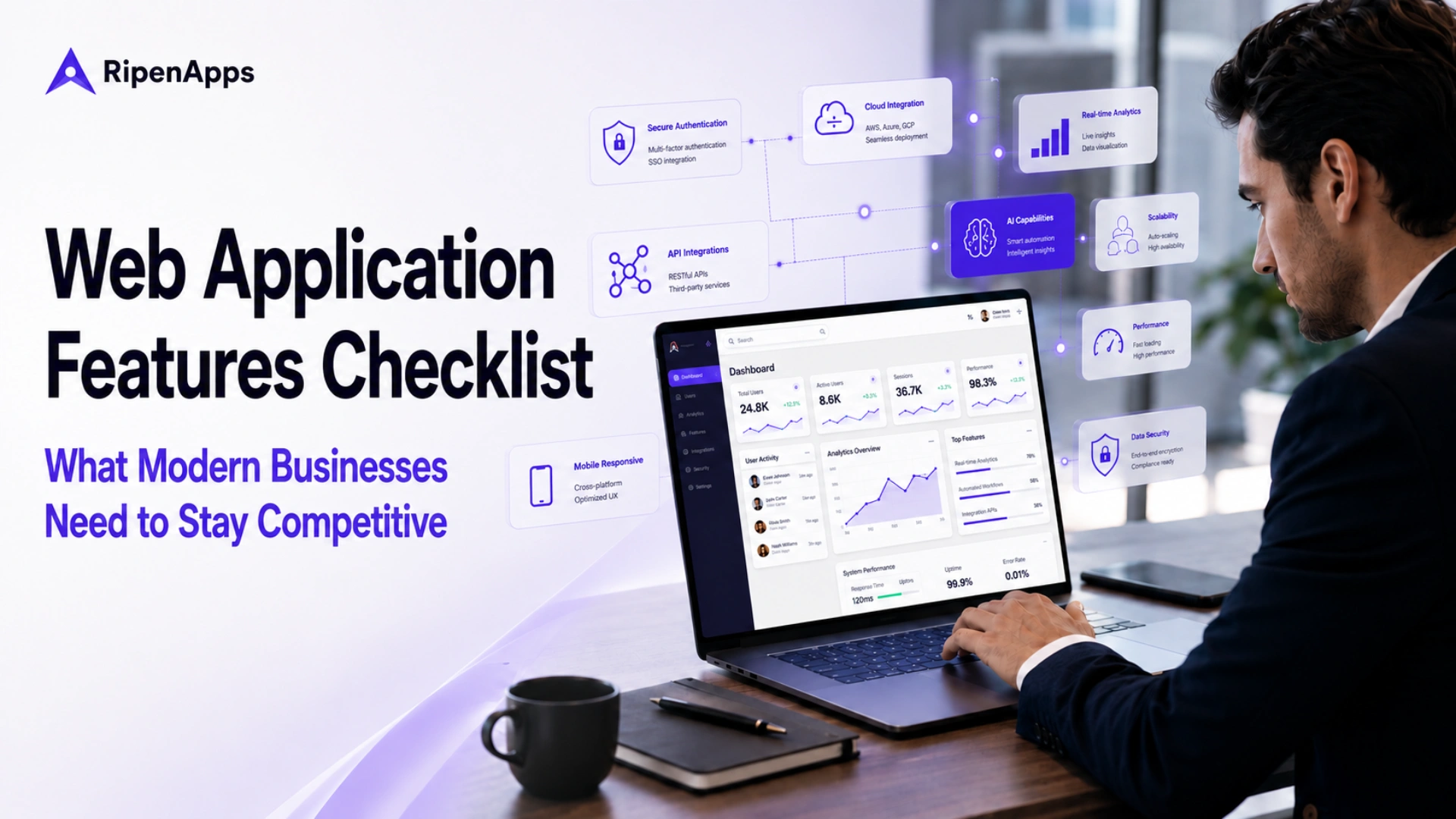

Key Takeaways
Before diving deeper, here are the most critical insights business leaders should understand:
- Web applications are now core revenue-driving assets, not just support tools
- Security, scalability, and API-first design define modern enterprise success
- Performance optimization directly impacts conversion rates and user retention
- MVP planning prevents overengineering and reduces time-to-market risk
- AI and automation are becoming standard in enterprise-grade applications
- UX and accessibility compliance are critical for global user adoption
Modern enterprises are operating in an environment where digital speed, scalability, and resilience directly define market leadership. Web applications are no longer just operational tools; they are core business platforms that influence customer experience, revenue efficiency, and competitive differentiation. From SaaS startups to Fortune 500 companies, the ability to design the right web application features checklist is now a strategic priority rather than a technical exercise.
Today’s digital-first economy demands that organizations continuously evolve their platforms to match rising user expectations. Leaders evaluating modern business web app features are no longer focused only on functionality; they are prioritizing performance, security, interoperability, and long-term scalability. This shift is driving businesses to rethink how they approach product architecture and user experience design at scale.
With increasing complexity in enterprise ecosystems, aligning with a structured enterprise web application checklist ensures that digital products remain secure, scalable, and future-ready. Organizations investing in expert-led solutions from a web application development company to gain a competitive advantage by building systems that support automation, AI integration, and rapid innovation cycles.
Table of Contents
Core Advantages of Modern Web Applications
Scalable digital platforms now directly shape enterprise efficiency, customer experience, and competitive agility, making platform architecture a board-level priority. A structured web application features checklist helps businesses prioritize the right capabilities for long-term growth and competitive advantage.
- The advantages of web apps include faster deployment, lower maintenance costs, cross-platform accessibility, and scalable cloud-native infrastructure.
- Key features of web apps focus on performance, API-first architecture, and enterprise-grade security
- Must-have web app features include mobile-first UX, and real-time functionality
- Modern business web app features increasingly rely on AI-driven automation and intelligent workflows
- A strong enterprise web application checklist ensures scalability, compliance, and seamless user experiences
Search Intent Alignment: What Business Leaders Are Really Looking For
When executives search for a must-have web app functionality framework, their intent is strategic. They are evaluating whether their digital infrastructure can support growth, handle enterprise workloads, and deliver seamless user experiences at scale.
According to the Salesforce State of the Connected Customer Report, 88% of customers now consider customer experience as important as products and services, reinforcing the growing importance of performance, usability, and digital engagement in enterprise platforms
This confirms that applications and features are now directly tied to business competitiveness, customer retention, and operational efficiency.
Core Web Application Features Checklist for Modern Businesses to Stay Competitive
A strong digital platform is built on foundational capabilities that ensure usability, performance, and security. Below is the structured breakdown of essential components that define modern web applications.
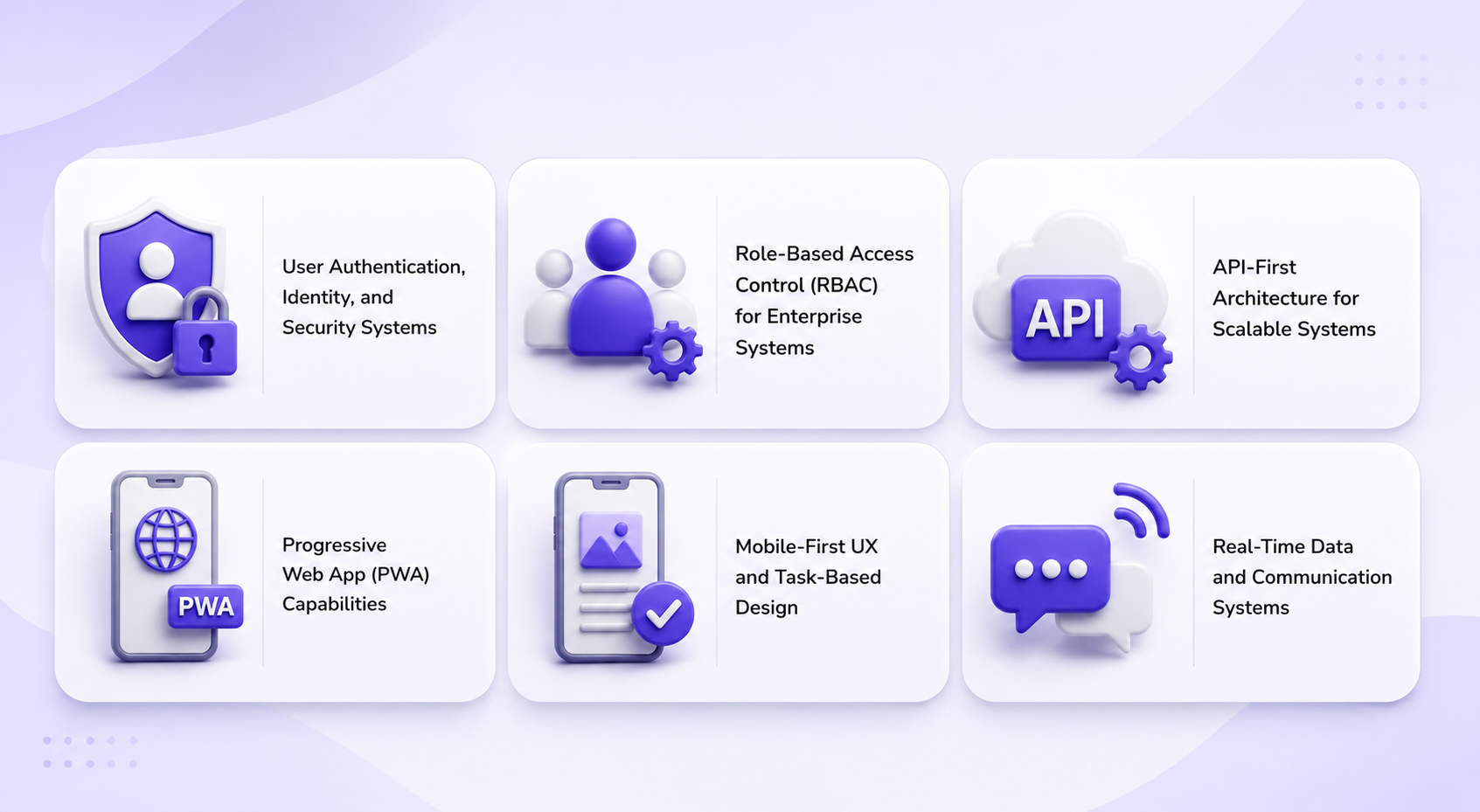
User Authentication, Identity, and Security Systems
Security is the foundation of every enterprise application. Without strong identity management, scalability and trust collapse. Enterprise applications rely on MFA, OAuth 2.0/JWT authentication, and RBAC frameworks to strengthen identity protection and access governance.
Modern systems include:
- Multi-Factor Authentication (MFA)
- OAuth 2.0 and JWT-based authentication
- Secure session management
- Encrypted password recovery workflows
According to IBM’s Data Breach Report, the average cost of a data breach reached $4.45 million in 2025.
Enterprise security failures often stem from weak access governance and outdated authentication systems rather than infrastructure limitations alone.
This reinforces why essential security features for modern web apps are no longer optional but mandatory for enterprise survival.
Role-Based Access Control (RBAC) for Enterprise Systems
RBAC ensures structured access control across users, teams, and enterprise roles. It is critical for organizations handling sensitive data or multi-tenant systems.
Benefits include:
- Reduced internal security risks
- Controlled data visibility
- Simplified governance at scale
This aligns with enterprise expectations for a robust enterprise web application checklist.
API-First Architecture for Scalable Systems
API-first architecture has become the backbone of modern digital ecosystems.
Key advantages:
- Faster integration across platforms
- Better scalability for distributed systems
- Seamless third-party connectivity
These advantages make API-first design a non-negotiable component of any web application features checklist. Businesses building highly interactive enterprise platforms often leverage React JS development services to create scalable, component-driven frontend architectures that integrate seamlessly with API-first ecosystems.
Progressive Web App (PWA) Capabilities
PWAs enhance engagement by delivering app-like experiences through the browser.
Key capabilities include:
- Offline access
- Push notifications
- Fast loading experience
- Mobile installation support
This improves engagement metrics and strengthens user retention across digital platforms.
Mobile-First UX and Task-Based Design
Modern enterprise users expect frictionless, intuitive experiences across devices.
Key design principles:
- Mobile-first responsiveness
- Task-based UX flows
- Minimal navigation complexity
- Accessibility-first interfaces
Meeting WCAG and ADA standards is now a baseline expectation for enterprise platforms serving global audiences.
Real-Time Data and Communication Systems
Modern applications increasingly rely on real-time interactions.
Examples include:
- Live dashboards
- Collaboration tools
- Messaging systems
- Real-time analytics
Real-time capabilities, from live dashboards to collaborative tools, improve both operational responsiveness and user engagement at scale.
Businesses building scalable real-time platforms often collaborate with a node js development company to support event-driven architectures, live communication systems, and high-concurrency applications.
Advanced Enterprise Features for Competitive Advantage
Beyond foundational capabilities, enterprises require advanced features to stay competitive in digital ecosystems.
OWASP Top 10 Compliance and Security Frameworks
Security vulnerabilities are evolving rapidly. OWASP compliance ensures structured protection against common threats.
Security is now a board-level priority. Organizations focus on:
- Secure coding standards
- API encryption
- Continuous vulnerability scanning
Cloud-Native Scalability and Infrastructure
Cloud adoption has become universal across enterprises. Businesses building scalable enterprise ecosystems increasingly evaluate the latest full-stack web development technologies that support microservices architecture, distributed infrastructure, and long-term scalability.
Cloud adoption has become universal across enterprises. Cloud-native systems enable:
- Auto-scaling
- Load balancing
- Microservices architecture
- High availability systems
This directly supports how to scale a business web application efficiently. In enterprise environments, scalability challenges often emerge not during launch, but during rapid user adoption phases where poorly structured APIs and infrastructure create performance bottlenecks.
Understanding how to scale a business web application requires cloud-native systems, distributed infrastructure, and modular API architecture.
Performance Optimization Features Every Modern Web Application Needs
Performance directly impacts user experience, retention, and conversions. Modern enterprise applications rely on optimization features such as intelligent caching, lazy loading, CDN delivery, database query optimization, and asset compression to improve speed and scalability.
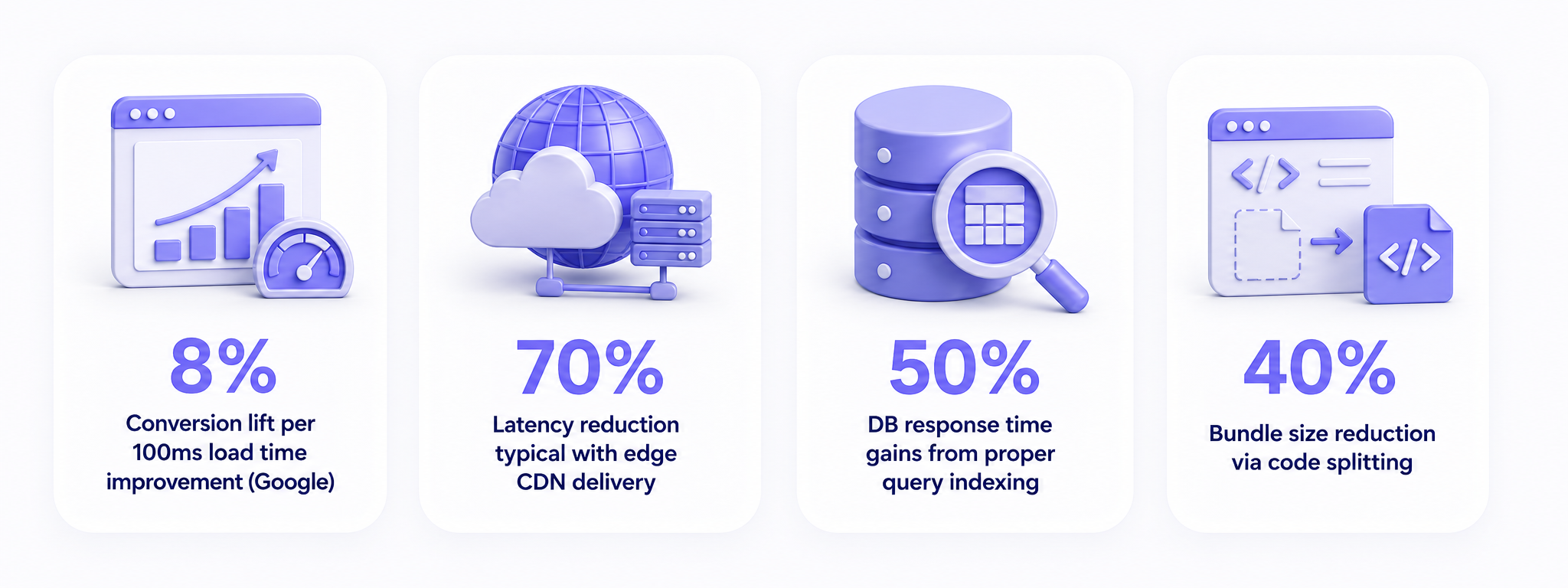
These capabilities help businesses reduce latency, improve Core Web Vitals, optimize server performance, and support high-traffic environments more efficiently. Performance optimization also plays a critical role in how to scale a business web application without compromising user experience or operational stability.
Many enterprises also prefer React for web application development because of its component-based architecture, fast rendering capabilities, and scalability for dynamic user interfaces.
- 8% Conversion lift per 100ms load time improvement (Google)
- 70% Latency reduction is typical with edge CDN delivery
- 50% DB response time gains from proper query indexing
- 40% Bundle size reduction via code splitting
AI Features for Custom Business Software
AI is transforming enterprise software capabilities.
AI enables:
- Predictive analytics
- Automation workflows
- Intelligent recommendations
- Operational optimization
This is rapidly becoming a standard expectation in AI features for custom business software. Businesses investing in AI-enabled web platforms are gaining measurable advantages in automation, operational productivity, and customer personalization.
The growing role of AI-driven automation, personalization, and predictive systems is reshaping enterprise platforms, with AI in web development becoming a major driver of operational efficiency and intelligent user experiences.
Monitoring and Analytics for Enterprise Applications
Modern enterprise applications require continuous monitoring to maintain performance, reliability, and operational efficiency at scale. Businesses increasingly rely on observability systems and analytics frameworks to identify bottlenecks, improve infrastructure stability, and optimize user experiences.
Key focus areas include:
- Real-time application monitoring for system health and issue detection
- Behavioral analytics to understand user engagement and usage patterns
- Uptime tracking to ensure platform reliability and service continuity
- Observability frameworks for infrastructure visibility and faster troubleshooting
- Performance insights that support optimization, scalability, and long-term lifecycle management
Advanced monitoring frameworks combined with cloud optimization services help businesses improve resource utilization, infrastructure visibility, and long-term operational efficiency.
CI/CD and DevOps Automation
Modern delivery pipelines ensure faster and safer deployments.
Benefits:
- Faster release cycles
- Reduced production risks
- Improved system reliability
This supports continuous innovation in enterprise platforms.
Web Application Examples Defining Modern Enterprise Standards
Real-world applications make a web application features checklist practical by showing how scalable, secure, and high-performance systems are built in production. Modern enterprises succeed not by adding isolated features, but by engineering platforms that support global traffic, real-time processing, AI-driven personalization, and enterprise-grade security.
Google Search: Global-Scale Intelligent Web System
Google Search processes billions of queries daily and represents one of the most advanced distributed web systems.
Key highlights:
- Billions of daily searches
- ~18%+ global web traffic share
- AI-driven ranking and indexing
- 99.999%+ uptime SLA, processing over 8.5 billion queries per day with sub-200ms average response time”
It demonstrates API-first design, scalability, and performance optimization at a global scale.
YouTube: Large-Scale Video Streaming Platform
YouTube is a global content platform built for 500 hours of video uploaded every minute, with adaptive bitrate streaming reducing buffering events by over 80% compared to fixed-rate delivery.
Key highlights:
- 2.5B+ monthly users
- ~51 minutes average daily watch time
- ~6%+ global internet traffic
- AI-driven recommendations
Core capabilities include adaptive streaming, CDN delivery, and personalization systems that define modern web applications.
WhatsApp: Secure Real-Time Communication App
WhatsApp is a globally dominant messaging platform built for secure, real-time communication.
Key highlights:
- ~3B monthly active users
- Billions of encrypted messages daily
- End-to-end encryption
- 100 billion messages delivered daily with end-to-end encryption, maintaining sub-second delivery latency across 180+ countries
It showcases essential security features for modern web apps, including encryption and lightweight architecture.
Hungama: AI-Powered Streaming Platform
Hungama is a large-scale entertainment platform designed for music and video streaming at scale. 50M+ monthly active users served with AI-driven recommendations, reducing content abandonment rates by approximately 35%
Key highlights:
- 50M+ monthly users
- 30M+ content library
- AI-based recommendations
- Adaptive streaming system
It demonstrates must-have web app functionalities like personalization, scalability, and high-performance delivery.
eGurukul: Scalable EdTech Learning Platform
eGurukul is a medical learning platform built for structured education delivery at scale.
Key highlights:
- 500,000+ learners
- Real-time progress tracking
It reflects a strong enterprise web application checklist implementation for scalable learning systems.
Al Muzaini: Secure FinTech Platform
Al Muzaini is a FinTech platform enabling secure global financial transactions.
Key highlights:
- 100,000+ users
- AI-based KYC verification
- Biometric authentication
It highlights essential security features for modern web apps, AI-based KYC verification processing over 100,000 user verifications with biometric authentication, reducing onboarding friction by 60%.
Strategic Insight
Across global platforms and RipenApps-built solutions, the pattern is clear: modern web applications are defined by scalability, AI integration, security, and architecture, not just features. These examples reinforce the importance of a structured web application features checklist for building future-ready digital products.

MVP Strategy and Feature Prioritization Framework
Many digital products fail due to poor prioritization. A structured custom web app feature map helps businesses align technical priorities with long-term product and growth objectives:
- Identify core MVP features
- Delay non-essential enhancements
- Reduce time-to-market risks
This ensures efficient investment and faster validation cycles. Many organizations underestimate the long-term cost of rebuilding applications that were not designed with scalability, modular architecture, and integration readiness from the beginning.
Businesses evaluating long-term digital investments often rely on a structured web application development guide to align architecture decisions, scalability planning, and ROI expectations before development begins.
UX, Accessibility, and Compliance Standards
Modern applications must be inclusive and compliant.
Focus areas include:
- WCAG accessibility compliance
- ADA standards alignment
- Mobile-first UX design
These ensure broader adoption and regulatory safety across global markets. A web app accessibility compliance checklist helps businesses ensure WCAG and ADA alignment for broader digital accessibility.
Why Many Enterprise Web Applications Fail at Scale
Many enterprise web applications fail not because of poor ideas, but because of weak architectural decisions made early in development. Scalability, security, and performance issues often appear during rapid growth phases when systems are under real operational pressure.
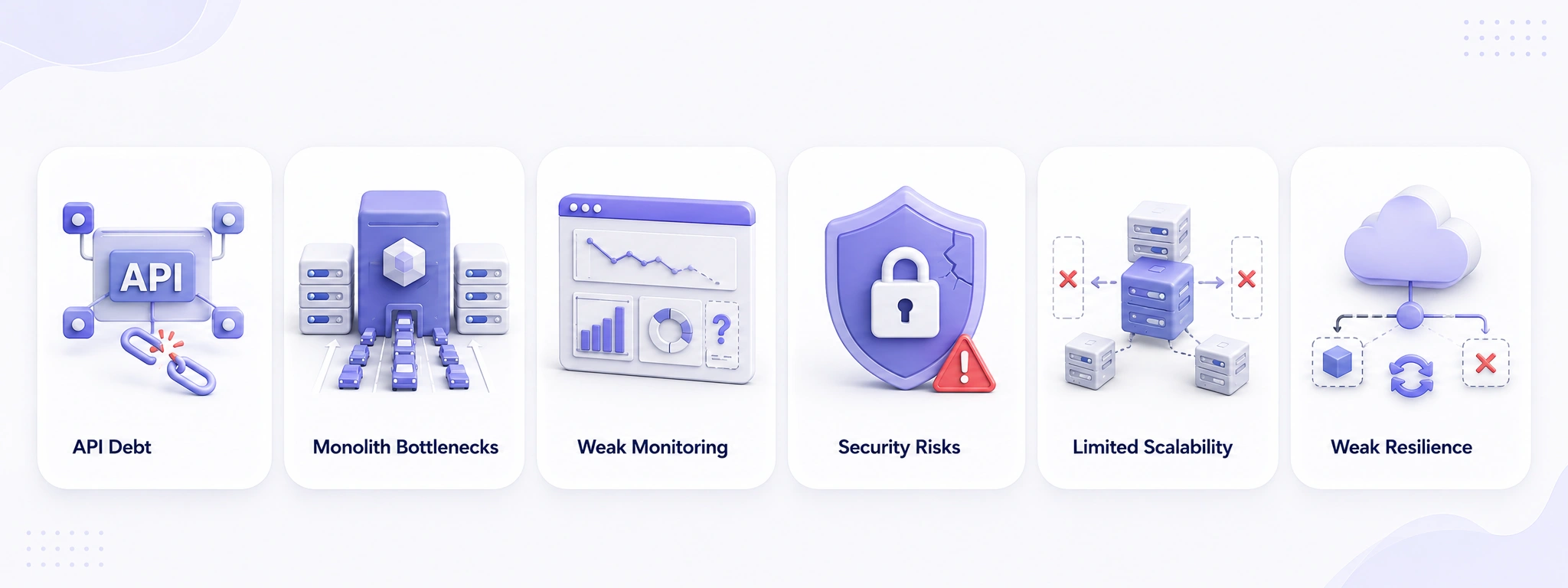
Common failure factors include:
- Weak API architecture and integration debt
- Monolithic infrastructure bottlenecks
- Poor monitoring and observability
- Accumulated security vulnerabilities
- Lack of horizontal scalability
- Insufficient resilience and failover systems
Applications without modular architecture, real-time monitoring, and scalable cloud infrastructure often struggle with downtime, slow performance, and rising operational complexity as user demand grows.
Recognizing these failure patterns before architecture decisions are finalized is the most cost-effective form of enterprise risk management. Rebuilding a platform after reaching a scalability ceiling costs 3–8x more than designing for scale from the outset.
Web Application Features Checklist Summary
Modern web applications require more than just functionality. Businesses need secure, scalable, high-performing, and intelligent platforms that support long-term growth, operational efficiency, and seamless user experiences. The checklist below highlights the essential features every modern web application should include.
| Category | Core Elements |
| Security | MFA, RBAC, encryption, OWASP compliance |
| Architecture | API-first, microservices, integration-ready |
| Performance | TTI optimization, caching, CDN |
| UX | Mobile-first, task-based UX |
| Scalability | Cloud-native infrastructure |
| Intelligence | AI-driven automation and insights |
This forms the backbone of a modern web application features checklist for enterprise success.

Final Thoughts
Building a high-performing digital product requires a balance of architecture, user experience, security, and scalability. A structured web application features checklist ensures that businesses do not just build applications but build systems capable of evolving with market demands, customer expectations, and technological disruption. Understanding how to scale a business web application requires aligning architecture with a structured web application features checklist and a clear custom web app feature map.
Businesses evaluating scalable digital platforms should assess whether their current architecture can support AI integration, cloud scalability, advanced security frameworks, and long-term operational growth. RipenApps helps startups and enterprises through full-stack development services and other web development services designed to build future-ready web applications aligned with modern enterprise web application checklist standards, enabling faster innovation, stronger security, and measurable business scalability.
FAQs
1. What are the most important features of a web application?
The most important features of a web application include secure authentication systems, Role-Based Access Control (RBAC), API-first architecture, performance optimization, and real-time functionality. These elements form the foundation of any modern web application features checklist and ensure the application can support enterprise-level workloads, user growth, and long-term digital transformation goals.
2. What should be included in a web application checklist?
A complete web application features checklist should include security features (MFA, encryption, OAuth 2.0), scalable architecture (cloud-native and microservices), API-first design, UX optimization, performance improvements (TTI and load time optimization), and compliance standards like OWASP and WCAG. Modern checklists also include AI integration and automation to support evolving modern business web app features.
3. What makes a web application scalable?
A scalable web application is built using cloud-native infrastructure, load balancing, microservices architecture, and efficient database design. API-first systems also play a major role in scalability by enabling modular integration across services. These elements are essential in any enterprise web application checklist designed for long-term growth and high user traffic handling.
4. Why is security important in web applications?
Security is critical because web applications handle sensitive business and customer data. Without proper protection, systems are vulnerable to breaches, financial loss, and reputational damage. Essential security features include MFA, encryption, secure APIs, and OWASP Top 10 compliance. These are core components of essential security features for modern web apps and are non-negotiable in enterprise environments.
5. What is API-first architecture in web applications?
API-first architecture is a development approach where APIs are designed before building the application itself. This ensures that systems are modular, scalable, and easily integrable with third-party services, mobile apps, and enterprise systems. It is a key part of modern business web app features and is widely adopted in enterprise digital transformation strategies.
6. How do modern web applications improve user experience?
Modern web applications improve user experience through mobile-first design, fast load times, task-based UX flows, accessibility compliance, and real-time interactions. Performance optimization and intuitive navigation also play a major role in improving engagement and retention, making UX a core pillar of any web application features checklist.
7. What is the role of AI in web applications today?
AI plays a major role in personalization, automation, predictive analytics, and decision-making within web applications. It powers recommendation engines, fraud detection systems, and intelligent workflows. AI has become a standard component of must-have web app functionalities, helping businesses improve efficiency and user engagement at scale.
8. How do enterprises ensure web application performance?
Enterprises ensure performance by optimizing Time-to-Interactive (TTI), using CDNs, implementing caching strategies, minimizing code complexity, and optimizing backend queries. Performance is directly linked to conversion rates and user retention, making it a critical part of any modern business’s web app features strategy.

SHARE
WRITTEN BY

Ishan Gupta
CEO & Founder
Ishan Gupta is a seasoned entrepreneur and CEO with extensive 8+ years of experience in business and mobile app development landscape. He believes that the right digital product allows companies to focus on what they do best, while technology handles the rest. With deep exposure to global markets, he understands what makes an app succeed. His approach translates business needs into clear product strategies, ensuring that every feature contributes to measurable ROI.
View All Articles



 India
India USA
USA Australia
 Canada
 UK
UK UAE
UAE