

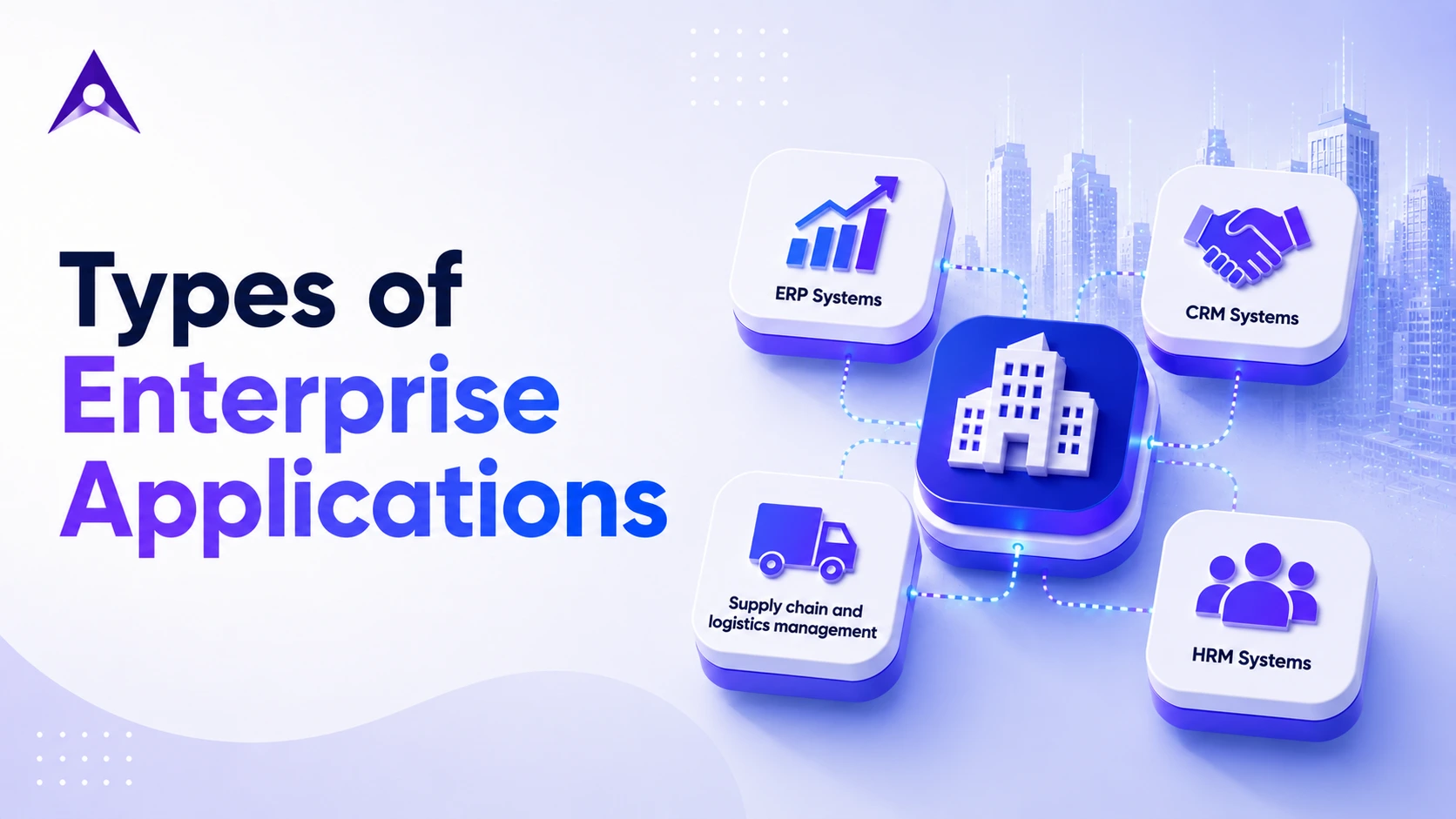

Enterprise growth rarely slows down because businesses lack ideas. It slows down because operations become fragmented. Teams work on disconnected systems, data stays trapped across departments, and workflows become difficult to manage at scale. This is exactly why enterprise applications have become essential for modern businesses building toward operational efficiency and long-term scalability.
The most common types of enterprise applications include ERP systems, CRM platforms, supply chain management software, HRM systems, enterprise mobile applications, enterprise communication platforms, and business intelligence tools. Each system solves a different operational challenge, and choosing the right combination directly impacts productivity, visibility, collaboration, and business performance.
Most companies don’t fail due to a lack of software. They fail because they are using the wrong type of enterprise application for the way their business actually operates. A CRM alone cannot solve workflow inefficiencies. An ERP alone cannot improve customer engagement. Businesses need connected enterprise systems that support integrations, scalability, automation, and real-time decision-making across departments.
The challenge in 2026 is no longer whether businesses should invest in enterprise applications. The real challenge is understanding which enterprise application categories align with specific business goals, workflows, and infrastructure maturity. Choosing the wrong system creates operational bottlenecks, rising costs, poor scalability, and low adoption across teams.
This guide breaks down the most important types of enterprise applications businesses are using today, their real-world use cases, architecture considerations, operational benefits, and how modern organizations evaluate enterprise-grade systems before investing. Whether you are planning enterprise application modernization, scaling operations, or working with a recognized enterprise mobile app development company, this blog will help you make more informed decisions.
Key Takeaways
- Different types of enterprise applications solve different operational challenges across departments and workflows.
- Choosing the wrong enterprise application software creates long-term inefficiencies and scalability limitations.
- Modern businesses are investing in integrated and scalable enterprise systems instead of isolated tools.
- Enterprise mobile applications are becoming essential for real-time access, remote operations, and workforce productivity.
- The right enterprise application strategy improves operational efficiency, decision-making, and long-term business growth.
Table of Contents
What Enterprise Applications Actually Mean for Modern Businesses
Enterprise applications are large-scale software systems designed to manage business operations, workflows, data, and communication across organizations. Unlike basic business tools, enterprise applications are built to support multiple departments, large user bases, complex workflows, and high-volume data processing.
These systems help businesses centralize operations instead of relying on disconnected tools and manual processes. From customer management and finance to supply chain operations and internal communication, enterprise applications become the operational backbone of modern companies.
In 2026, businesses will no longer build enterprise applications only for automation. They are building scalable enterprise systems that improve visibility, reduce operational delays, and support faster decision-making.
The biggest misconception is that enterprise applications are only for large corporations. That is no longer true. Startups, mid-sized businesses, and growing digital platforms are now investing in enterprise application development much earlier because fragmented operations become expensive as scale increases.
Enterprise applications are no longer optional infrastructure. They are growth systems.
Why Businesses Invest in Enterprise Applications Earlier Than Before
Most businesses delay enterprise application adoption until operational inefficiencies begin affecting growth. By that stage, workflows become fragmented, reporting slows down, and teams rely heavily on manual coordination.
The biggest problem is that operational complexity grows faster than disconnected systems can handle.
Businesses are now investing in enterprise applications earlier to:
- Improve cross-department operational efficiency
- Centralize business data and reporting
- Reduce manual workflows and repetitive tasks
- Support larger operational volumes
- Improve collaboration across distributed teams
- Deliver faster customer experiences through connected systems
We’ve seen businesses rebuild internal systems within 18–24 months because their original tools were optimized for short-term operations, not scalability.
Enterprise application development is no longer only about digitization. It is about building scalable operational infrastructure before growth creates bottlenecks.
Why Legacy Enterprise Systems Fail at Scale
Many businesses continue operating on legacy systems built for smaller teams, limited workflows, and lower operational complexity. These systems may work initially, but they struggle as operations expand across departments, locations, and digital channels.
The biggest problem with legacy enterprise infrastructure is that it was never designed for scalability, real-time processing, or modern integrations. As businesses grow, these systems create operational bottlenecks instead of supporting efficiency.
Common scalability issues businesses face with legacy systems:
- Tightly coupled architecture that slows updates and feature expansion
- Limited API capabilities that prevent seamless integrations
- High infrastructure maintenance costs
- Poor observability across workflows and systems
- Slow data processing during high-volume operations
- Increased downtime risks and performance instability
We’ve seen businesses rebuild enterprise systems within a few years because the original architecture was optimized only for launch speed, not long-term operational scale.
Enterprise application modernization is no longer optional. Modern businesses are increasingly investing in application modernization solutions to improve scalability, automate workflows, strengthen operational resilience, and support long-term infrastructure growth from the beginning.
Understanding the Core Types of Enterprise Applications Businesses Use Today
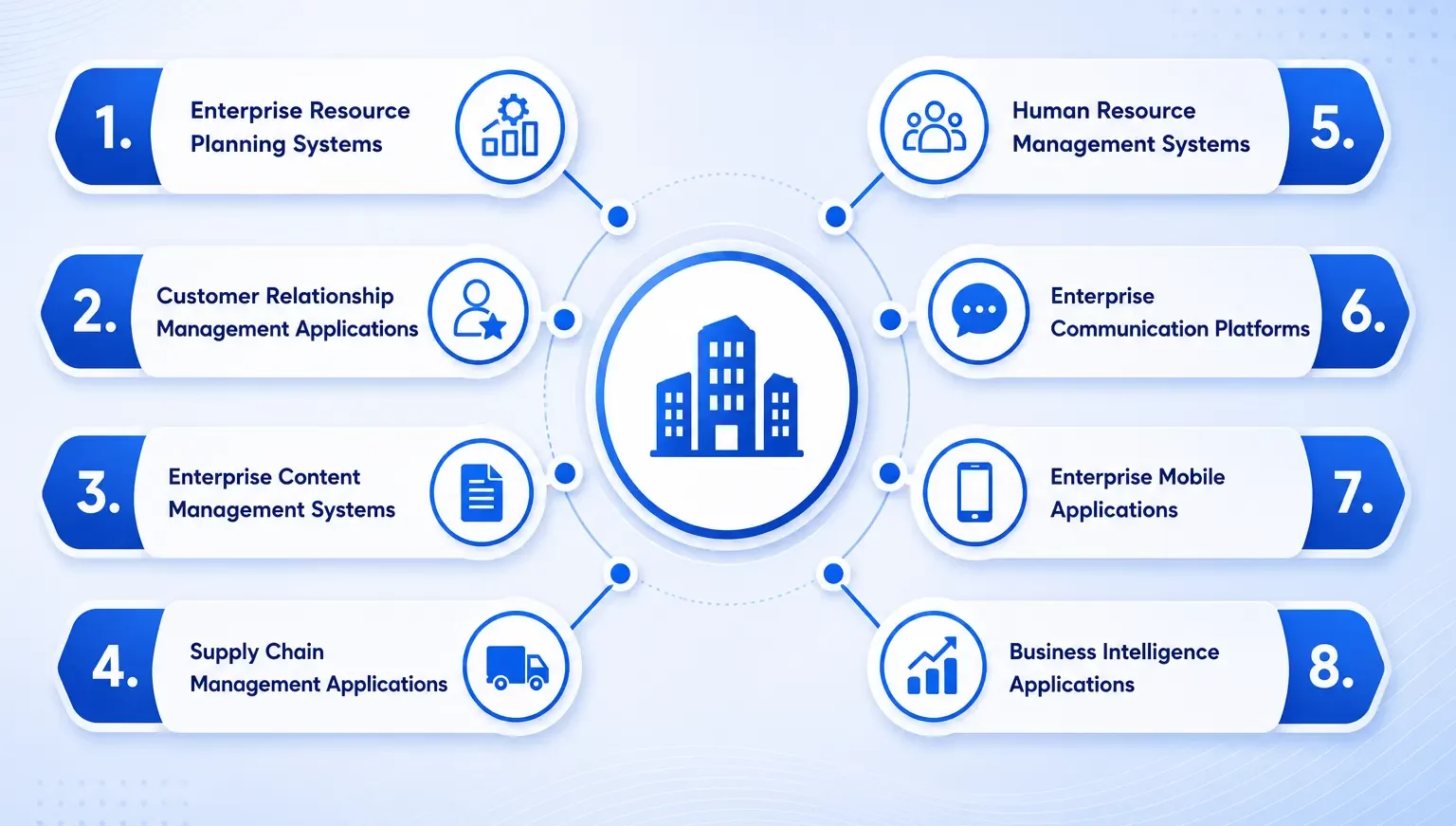
Not every enterprise application solves the same problem. Different systems are designed for different operational requirements. Understanding these enterprise application categories helps businesses choose systems based on actual workflows instead of trends.
Below are the most common types of enterprise applications modern businesses rely on.
1. Enterprise Resource Planning Systems That Centralize Business Operations
Enterprise Resource Planning systems, commonly known as ERP systems, are among the most widely used types of enterprise application software. Businesses investing in modern ERP development use these systems to connect multiple operational functions into one centralized platform.
ERP systems typically manage:
- Finance and accounting
- Procurement and inventory
- Human resources
- Manufacturing operations
- Supply chain workflows
- Reporting and analytics
The biggest advantage of ERP systems is operational visibility. Instead of departments working separately, businesses get a unified view of operations.
For example, when inventory updates automatically reflect in finance, logistics, and procurement systems, decision-making becomes faster and more accurate.
Modern ERP development increasingly focuses on cloud-first architecture, API-driven integrations, automation workflows, and real-time reporting capabilities. This allows businesses to integrate third-party platforms more efficiently while improving operational scalability.
Businesses outgrow spreadsheets much faster than they realize. ERP systems solve that fragmentation before operational complexity begins slowing growth.
2. Customer Relationship Management Applications That Improve Customer Retention
CRM systems are designed to manage customer interactions, sales pipelines, support workflows, and engagement data.
These enterprise applications help businesses:
- Track customer interactions
- Manage leads and sales funnels
- Automate customer communication
- Improve support workflows
- Analyze customer behavior
- Increase retention and repeat engagement
The reason CRM systems have become critical is simple. Customer expectations are increasing faster than manual systems can handle. Businesses that rely on disconnected communication tools often struggle with inconsistent customer experiences.
Modern CRM systems now integrate AI-driven analytics, workflow automation, and omnichannel communication to improve customer management. CRM platforms are no longer sales tools. They are customer intelligence systems.
3. Enterprise Content Management Systems That Organize Business Information
One of the fastest-growing enterprise application software categories is content and document management systems.
Businesses generate massive amounts of internal documentation, contracts, reports, media files, operational records, and compliance data. Without centralized systems, information becomes difficult to access and manage.
Enterprise content management systems help businesses:
- Store and organize digital documents
- Control access permissions
- Improve document collaboration
- Maintain compliance records
- Automate approval workflows
- Reduce document duplication
These systems become especially important for industries dealing with compliance-heavy operations such as healthcare, finance, and enterprise administration. Poor document management slows operations more than most businesses realize.
4. Supply Chain Management Applications That Improve Operational Efficiency
Supply chain management systems help businesses manage procurement, logistics, warehouse operations, inventory tracking, and distribution workflows.
These enterprise applications are heavily used in:
- Manufacturing
- Ecommerce
- Logistics
- Retail
- Distribution businesses
Modern supply chain applications rely on:
- Real-time tracking systems
- Predictive analytics
- Automated procurement workflows
- Inventory forecasting
- Event-driven architecture
- Integration with ERP systems
The goal is not only operational visibility. It is operational predictability.
Businesses using disconnected supply chain tools often face inventory delays, shipment inefficiencies, and forecasting issues. Supply chain systems become critical the moment operational complexity increases.
Read Also: Role of Technology in Supply Chain: How Technology is Revolutionizing the Logistics Industry
5. Human Resource Management Systems That Support Workforce Operations
Human Resource Management Systems help businesses manage employees, payroll, recruitment, attendance, onboarding, and workforce analytics.
As organizations scale, HR operations become increasingly difficult to manage manually.
HR enterprise applications help businesses:
- Automate employee onboarding
- Manage payroll and benefits
- Track attendance and performance
- Improve recruitment workflows
- Support remote workforce management
- Centralize employee records
Modern HR systems also include workforce analytics, AI-powered recruitment workflows, and employee engagement dashboards. Workforce management becomes significantly harder without centralized HR systems.
6. Enterprise Communication Platforms That Improve Collaboration
Internal communication delays create operational inefficiencies across organizations.
This is why communication and collaboration systems have become one of the most important types of enterprise software applications.
These platforms support:
- Team communication
- Video conferencing
- File sharing
- Task coordination
- Workflow collaboration
- Cross-functional visibility
Remote and distributed workforces have accelerated demand for enterprise collaboration systems.
Modern communication applications also integrate with project management systems, CRMs, and internal workflow platforms. Communication gaps often become productivity gaps.
7. Enterprise Mobile Applications That Enable Real-Time Business Access
Enterprise mobile apps are becoming essential for businesses that operate beyond traditional office environments.
Field teams, logistics operations, healthcare professionals, sales teams, and enterprise managers now require access to systems in real time.
Enterprise mobile application development helps businesses:
- Improve remote workforce productivity
- Access systems on the go
- Enable real-time reporting
- Improve field operations
- Reduce operational delays
- Support mobile-first workflows
Modern businesses increasingly work with a leading enterprise mobile app development company to build secure and scalable enterprise mobile apps that integrate directly with backend enterprise systems.
The shift toward mobile enterprise applications is no longer about convenience. It is about operational speed. Businesses without mobile enterprise systems often struggle with execution delays and workflow inefficiencies.
8. Business Intelligence Applications That Improve Decision-Making
Data without visibility creates confusion instead of clarity.
Business intelligence systems help organizations analyze operational, financial, and customer data through centralized dashboards and reporting systems.
These enterprise applications provide:
- Real-time reporting
- Predictive analytics
- Performance dashboards
- Operational visibility
- Data-driven forecasting
- KPI tracking systems
Modern enterprise applications increasingly rely on AI-powered analytics and observability systems to improve operational decision-making. Businesses grow faster when decisions are based on real-time operational data.
Comparison of Enterprise Application Types
| Enterprise Application Type | Primary Use | Common Industries | Business Impact |
| Enterprise Resource Planning (ERP) Systems | Centralize finance, inventory, procurement, and operational workflows | Manufacturing, Retail, Logistics, Healthcare | Improves operational efficiency, visibility, and cross-department coordination |
| Customer Relationship Management (CRM) Applications | Manage customer interactions, sales pipelines, and service operations | SaaS, Banking, Ecommerce, Real Estate | Enhances customer retention, sales performance, and relationship management |
| Enterprise Content Management (ECM) Systems | Store, organize, and manage enterprise documents and digital assets | Healthcare, Legal, Enterprises, Education | Improves document accessibility, compliance, and workflow management |
| Supply Chain Management (SCM) Applications | Track inventory, procurement, logistics, and distribution workflows | Manufacturing, Logistics, Ecommerce | Reduces operational delays, improves inventory visibility, and streamlines supply chain operations |
| Human Resource Management (HRM) Systems | Manage payroll, hiring, employee records, and workforce operations | IT, Enterprises, Healthcare, Retail | Automates HR operations and improves workforce productivity |
| Enterprise Communication Platforms | Enable team collaboration, messaging, meetings, and workflow coordination | Remote Teams, Enterprises, Education | Improves internal communication and operational alignment across teams |
| Enterprise Mobile Applications | Provide mobile access to enterprise systems, workflows, and real-time operations | Logistics, Healthcare, Retail, Field Services | Enhances workforce mobility, operational speed, and remote accessibility |
| Business Intelligence (BI) Applications | Analyze business data through dashboards, reporting, and analytics | Finance, SaaS, Retail, Enterprise Operations | Supports faster decision-making through real-time business insights |
Four Major Types of Enterprise Applications Businesses Commonly Use
Businesses often ask what are the four major types of enterprise applications. While enterprise systems continue evolving, the four most common enterprise application categories include:
| Enterprise Application Type | Primary Business Function |
| ERP Systems | Centralized operational management |
| CRM Systems | Customer relationship management |
| SCM Systems | Supply chain and logistics management |
| HRM Systems | Workforce and employee management |
These systems form the operational foundation for most scalable businesses.
However, modern organizations increasingly combine multiple enterprise application software categories to create integrated enterprise ecosystems.
Types of Enterprise Application Integration Businesses Use Today
Building enterprise applications is only one part of the challenge. Integration is equally important. Disconnected systems create fragmented workflows and duplicated data.
Modern businesses rely on different types of enterprise application integration to connect systems efficiently.
Common integration approaches include:
- API-based integrations
- Cloud integrations
- Middleware integrations
- Event-driven integrations
- Real-time synchronization systems
API-first architecture has become especially important because businesses now operate across multiple tools and platforms.
Without proper integration strategies, enterprise systems become operational silos instead of connected ecosystems. Enterprise systems create value when they communicate with each other efficiently.
How Businesses Decide Which Enterprise Application They Actually Need
Many businesses make the mistake of investing in enterprise software before evaluating operational requirements.
The right enterprise application depends on:
- Operational complexity
- Workflow inefficiencies
- Team size and structure
- Customer management requirements
- Scalability goals
- Integration requirements
- Reporting and analytics needs
Businesses should not choose enterprise systems based on trends. They should choose systems based on operational bottlenecks.
For example:
- If customer management is fragmented, CRM systems become critical
- If operational visibility is poor, ERP systems create more impact
- If logistics workflows are slowing operations, SCM systems become necessary
- If workforce operations are difficult to manage, HRM systems should be prioritized
Enterprise application strategy should always follow operational priorities.
Why Many Enterprise Applications Fail After Implementation
Most enterprise applications do not fail because of bad technology. They fail because businesses implement systems without operational clarity.
Common reasons enterprise applications fail include:
- Poor requirement planning
- Low employee adoption
- Weak integration strategy
- Overcomplicated workflows
- Lack of scalability planning
- Choosing software based only on cost
- No post-deployment optimization
We have seen businesses invest heavily in enterprise systems only to rebuild workflows later because the original implementation was designed for short-term execution instead of long-term scalability.
Modern enterprise systems require:
- Scalable architecture
- Fault-tolerant systems
- Workflow optimization
- Distributed infrastructure
- Observability and monitoring systems
- Real-time synchronization
Enterprise applications fail when businesses treat them as software purchases instead of operational systems.
Enterprise Applications Are Rapidly Evolving in 2026
Enterprise application development is changing significantly. Businesses are no longer investing only in automation. They are investing in intelligent operational systems.
Key trends shaping enterprise applications in 2026 include:
1. AI-Driven Enterprise Workflows
Businesses are integrating AI into enterprise applications for:
- Predictive analytics
- Workflow automation
- Customer intelligence
- Automated reporting
- Intelligent process optimization
AI is reducing operational friction, but businesses still need scalable systems underneath.
2. Cloud-Native Enterprise Systems
Modern enterprise systems are increasingly built on cloud-first infrastructure. Businesses are also investing in cloud app development to build scalable, secure, and high-performance enterprise solutions across platforms.
This allows businesses to:
- Scale faster
- Reduce infrastructure overhead
- Improve deployment flexibility
- Support distributed operations
- Enable remote workforce access
3. Enterprise Application Modernization
Many businesses are replacing outdated legacy systems with modern enterprise platforms.
Application modernization solutions are becoming critical because older systems struggle with:
- Scalability limitations
- Integration challenges
- Poor user experiences
- Security vulnerabilities
- Operational inefficiencies
Businesses are now prioritizing modern architecture over temporary fixes. Legacy systems often become growth limitations instead of operational assets.
4. Mobile-First Enterprise Operations
Enterprise mobile apps are becoming standard operational infrastructure. Businesses increasingly rely on top-rated mobile application development services to build systems that support:
- Field operations
- Remote workforce management
- Real-time communication
- Operational tracking
- Mobile reporting systems
The shift toward enterprise mobility is accelerating across industries.
How Businesses Choose Between ERP, CRM, and Custom Enterprise Applications
One of the biggest mistakes businesses make is assuming every operational problem requires the same type of enterprise software. In reality, ERP systems, CRM platforms, and custom enterprise applications solve completely different business challenges.
The right decision depends on:
- operational complexity
- workflow structure
- scalability goals
- integration requirements
- level of customization needed
Businesses that choose the wrong system often face fragmented operations, rising software costs, and scalability limitations within a few years.
ERP vs CRM vs Custom Enterprise Applications
| Factor | ERP Systems | CRM Applications | Custom Enterprise Applications |
| Primary Focus | Internal operations | Customer management | Business-specific workflows |
| Flexibility | Moderate | Moderate | High |
| Scalability | High | High | Very High |
| Customization | Limited | Limited | Fully customizable |
| Integration Capability | Moderate | Moderate | Advanced |
| Long-Term Ownership | Vendor dependent | Vendor dependent | Full ownership |
| Best For | Operational management | Sales & engagement | Enterprise scalability |
Monolithic vs Modular Enterprise Architecture for Scalable Business Systems
The architecture behind an enterprise application directly impacts scalability, flexibility, and operational performance. Many businesses fail to evaluate architecture decisions early, which creates limitations as workflows and integrations grow.
Most enterprise systems are built using either monolithic or modular architecture approaches.
Monolithic Architecture
In monolithic systems, all components operate within a single codebase and infrastructure layer.
This approach works for:
- Smaller operational systems
- Limited integrations
- Early-stage internal platforms
However, monolithic systems often become difficult to scale as enterprise operations expand. A small change in one module can impact the entire system.
Modular or Microservices-Based Architecture
Modern enterprise-grade applications increasingly rely on modular systems or microservices architecture.
This approach separates functionalities into independent services such as:
- User management
- Inventory systems
- Reporting dashboards
- Billing workflows
- Notification engines
Benefits of modular enterprise architecture:
- Better horizontal scalability
- Faster deployment cycles
- Improved fault tolerance
- Easier third-party integrations
- Higher infrastructure flexibility
Modern enterprise application development increasingly prioritizes modular architecture because businesses need systems that evolve without disrupting operations.
The Role of APIs in Modern Enterprise Ecosystems
Enterprise applications no longer operate as isolated systems. Modern businesses rely on connected digital ecosystems where multiple platforms exchange data in real time.
This is where APIs become critical.
APIs allow enterprise systems to communicate securely across:
- ERP platforms
- CRM systems
- Payment gateways
- Logistics systems
- Analytics platforms
- Third-party enterprise tools
Without strong API architecture, businesses face disconnected workflows, duplicate data, and operational delays.
Modern enterprise ecosystems increasingly rely on:
- API-first architecture
- Event-driven systems
- Asynchronous workflows
- Real-time data synchronization
These approaches improve system interoperability and operational efficiency at scale.
Businesses investing in enterprise application integration should focus on APIs early, not as an afterthought. Poor integration architecture becomes significantly more expensive to fix later.
Why Cloud-Native Infrastructure Matters for Enterprise Applications
Enterprise applications today handle large-scale workflows, distributed teams, real-time operations, and growing data loads. Traditional infrastructure models struggle to support these demands efficiently.
Cloud-native infrastructure has become the foundation of scalable enterprise systems because it improves flexibility, resilience, and infrastructure efficiency.
Modern enterprise applications increasingly use:
- Container orchestration platforms
- Distributed cloud infrastructure
- Auto-scaling environments
- Load balancing systems
- Serverless computing models
These systems help businesses:
- Improve application uptime
- Reduce infrastructure bottlenecks
- Scale operations dynamically
- Optimize operational costs
- Improve deployment reliability
Cloud-native enterprise systems are also better equipped for resilience engineering and fault tolerance, which are essential for maintaining operational continuity during traffic spikes or infrastructure failures.
Enterprise scalability is no longer only about software features. Infrastructure maturity now plays an equally important role.
Real-World Enterprise Application Examples That Drive Business Scale
The best way to understand enterprise applications is to see how they solve operational problems in the real world. Successful enterprise systems are not built around features alone. They are built around workflows, scalability, and operational efficiency.
What separates high-performing enterprise applications from average systems is their ability to handle growth without slowing operations, breaking integrations, or increasing manual dependency.
Here’s how modern businesses are using enterprise-grade applications to scale faster and operate more efficiently.
1. Motion Learning scaled digital education operations through a high-performance enterprise platform
As digital education platforms grow, they face increasing pressure around concurrent users, content delivery, performance optimization, and real-time engagement.
RipenApps developed Motion Learning as a scalable educational platform designed to support students preparing for competitive exams. The business challenge was managing high-volume user activity while ensuring smooth learning experiences across devices without performance breakdowns during peak usage hours.
To solve this, the platform included:
- Live class streaming infrastructure
- Real-time test and assessment systems
- Scalable content delivery architecture
- Student performance tracking dashboards
- Real-time notifications and engagement systems
- Concurrent user optimization for large-scale traffic
The result was a platform capable of handling massive engagement volumes while maintaining system stability and performance. Motion Learning achieved over 500K downloads and 100K+ daily active users while supporting large-scale concurrent access.
What makes this a strong enterprise application example is not just user growth. It is the backend engineering and scalability architecture required to maintain operational performance at scale.
Enterprise applications fail when systems are optimized only for launch speed instead of long-term scalability.
2. Stoklo improved inventory visibility and operational coordination through centralized enterprise workflows
Inventory and stock management systems often become operational bottlenecks when businesses rely on disconnected spreadsheets, manual reporting, and fragmented workflows.
RipenApps developed Stoklo as an enterprise inventory and stock management platform focused on improving operational visibility, workflow automation, and centralized coordination across inventory operations.
The platform addressed major operational challenges, such as:
- Lack of real-time stock visibility
- Delayed reporting workflows
- Manual inventory coordination
- Inefficient stock tracking across operations
- Poor operational synchronization between teams
To solve these issues, the platform included:
- Centralized stock tracking dashboards
- Real-time inventory visibility systems
- Workflow automation modules
- Operational reporting and analytics
- Multi-user coordination systems
- Smart inventory management workflows
The platform helped improve operational efficiency while reducing manual dependency across inventory processes. As operations scaled, Stoklo achieved a 45% business growth rate and crossed 10K+ monthly active users.
This reflects how enterprise applications create measurable business impact when systems are designed around operational workflows instead of isolated functionalities.
Enterprise systems should simplify operational complexity, not add to it.
3. Cilio expanded global digital operations through a scalable enterprise communication platform
Modern communication platforms require far more than messaging functionality. They need scalable infrastructure, real-time synchronization, performance stability, and seamless user experiences across regions.
RipenApps developed Cilio as a scalable communication and social interaction platform designed to support global digital engagement and real-time connectivity across users. The challenge was building a system capable of supporting growing user activity, uninterrupted communication workflows, and scalable engagement infrastructure across international markets.
To support this, the platform included:
- Real-time communication infrastructure
- Scalable cloud-native backend systems
- User engagement and interaction modules
- Multi-region accessibility optimization
- High-performance synchronization systems
- Secure and scalable user management architecture
The platform supported large-scale user engagement while maintaining operational stability and performance across growing traffic volumes.
This is where enterprise-grade application development becomes critical. As platforms expand across markets and user bases, scalability engineering, low-latency systems, and fault-tolerant architecture become operational necessities instead of technical upgrades.
Businesses outgrow lightweight systems faster than expected when user activity and operational complexity increase simultaneously.
How RipenApps Builds Enterprise Applications That Scale With Business Growth
At RipenApps, enterprise application development focuses on operational scalability instead of feature overload. Most businesses do not need more software. They need systems that reduce friction across workflows, departments, and operations.
This is why the focus stays on:
- Scalable enterprise architecture
- Workflow-first development
- Enterprise mobile integration
- Real-time operational visibility
- Secure and fault-tolerant systems
- Long-term scalability planning
Whether businesses need enterprise mobile application development services, enterprise modernization, enterprise platforms, or want to invest in custom software development, the goal remains the same. Build enterprise solutions that continue performing as operations grow.
The real challenge is not building enterprise applications. It is building systems that businesses do not outgrow.
Conclusion
Different types of enterprise applications solve different operational problems. ERP systems improve visibility, CRM platforms improve customer management, SCM systems optimize logistics, and enterprise mobile applications improve execution speed. The key is understanding which systems align perfectly with your business workflows, scalability goals, and operational challenges.
Modern businesses are no longer investing in enterprise applications only for automation. They are investing in scalable operational infrastructure that supports growth, decision-making, and long-term efficiency. At RipenApps, the focus remains on building enterprise-grade systems that align technology with real business outcomes. Whether you are planning enterprise application modernization or building a scalable platform from scratch, the right enterprise application strategy will define how efficiently your business grows.
FAQs
Q1. What are the types of enterprise applications?
The most common types of enterprise applications include ERP systems, CRM platforms, supply chain management systems, HR management systems, enterprise content management systems, and enterprise mobile applications.
Q2. What are the four major types of enterprise applications?
The four major types of enterprise applications are ERP systems, CRM systems, SCM systems, and HRM systems. These systems help businesses manage operations, customers, supply chains, and workforce processes.
Q3. Why are enterprise applications important for businesses?
Enterprise applications improve operational efficiency, centralize business workflows, automate processes, and help organizations scale more efficiently.
Q4. What is enterprise mobile application development?
Enterprise mobile application development focuses on building mobile apps that help businesses manage operations, workflows, communication, and reporting through mobile devices.
Q5. How do businesses choose the right enterprise application?
Businesses should evaluate operational bottlenecks, scalability requirements, integrations, workflow complexity, and long-term business goals before selecting enterprise applications.
Q6. What causes enterprise applications to fail?
Enterprise applications commonly fail due to poor planning, weak integrations, low user adoption, lack of scalability, and choosing systems that do not align with business workflows.
Q7. What industries use enterprise applications the most?
Healthcare, finance, logistics, ecommerce, manufacturing, SaaS, and enterprise operations are among the industries investing heavily in enterprise applications.
Q8. What is enterprise application modernization?
Enterprise application modernization involves upgrading outdated legacy systems with scalable, cloud-native, and modern enterprise platforms that improve efficiency and scalability.

SHARE
WRITTEN BY

Ishan Gupta
CEO & Founder
Ishan Gupta is a seasoned entrepreneur and CEO with extensive 8+ years of experience in business and mobile app development landscape. He believes that the right digital product allows companies to focus on what they do best, while technology handles the rest. With deep exposure to global markets, he understands what makes an app succeed. His approach translates business needs into clear product strategies, ensuring that every feature contributes to measurable ROI.
View All Articles


 India
India USA
USA Australia
 Canada
 UK
UK UAE
UAE