


Key Takeaways
- Web applications help businesses increase revenue, improve customer experiences, and streamline operations through scalable digital solutions.
- Industries from healthcare and fintech to logistics and SaaS leverage web applications to drive measurable business growth.
- Custom web applications provide greater flexibility, integration capabilities, and competitive advantages compared to generic software solutions.
- Emerging technologies like AI, PWAs, edge computing, and serverless architecture are shaping the future of web applications.
- Choosing the right web application starts with identifying business goals, user needs, integrations, and success metrics.
Businesses that invest in web applications gain more than a digital presence; they create scalable systems that improve operations, increase revenue, and deliver better customer experiences. From eCommerce platforms and healthcare portals to AI-powered business tools, modern web applications have become essential growth engines for organizations across industries.
The demand for web applications continues to accelerate alongside digital transformation initiatives. According to industry projections, the global web design and development market is expected to reach approximately $123.2 billion by 2032, reflecting the growing reliance on digital platforms to streamline operations and drive business growth. As competition intensifies, organizations are looking beyond traditional websites and investing in interactive digital solutions that deliver measurable business outcomes.
A web application differs from a static website because it allows users to interact with data, perform tasks, and access personalized experiences in real time. While websites primarily provide information, web applications function as dynamic software platforms accessible through a browser.
In this guide, you’ll discover real-world web application examples for business, explore how companies are achieving growth through digital solutions, and learn how to evaluate the right approach for your organization. Whether you’re considering custom web application development, evaluating a web application development company, or exploring engineering capabilities, these examples provide practical insights for modern businesses.
Table of Contents
What Is a Web Application?
A web application is browser-based software that enables users to interact with data, complete actions, and access dynamic functionality in real time. Unlike traditional websites that primarily display information, web applications provide personalized experiences, process user inputs, connect with databases, and support complex business workflows.
For many organizations, understanding the difference between a website and a web application is the first step toward identifying opportunities for digital innovation. Modern businesses increasingly rely on web-based software to automate processes, improve customer engagement, and scale operations efficiently.
Organizations exploring digital transformation often start by understanding web development features and how it fits into their technology strategy.
Website vs. Web Application Comparison
Understanding the difference between a website and a web application helps businesses choose the right digital solution for their goals, functionality requirements, and user interactions.
Here is the table for quick comparison:
| Website | Feature | Web Application |
| Information sharing | Primary Purpose | User interaction and task completion |
| Limited | User Input | Extensive |
| Minimal | Database Connectivity | Extensive |
| Low | Personalization | High |
| Basic | Dynamic Content | Real-time |
| Rarely supported | Business Processes | Core functionality |
| Moderate | Scalability | High |
Key Characteristics That Define a Business Web Application
Modern business web applications are designed to deliver interactive, scalable, and data-driven experiences that support operational efficiency, customer engagement, and business growth.
- User Authentication and Personalized Sessions: Users can create accounts, log in securely, and access personalized dashboards tailored to their needs.
- Database Interaction in Real Time: Web applications connect directly with databases, allowing users to retrieve, update, and manage information instantly.
- Dynamic Content Rendering: Content adapts based on user actions, preferences, roles, and business logic.
- Scalable Architecture: Modern web applications are designed to support increasing users, transactions, and integrations without sacrificing performance.
These capabilities make web applications a strategic asset rather than simply a digital presence.
What Are the Different Types of Web Applications Businesses Use?
Web applications come in various forms, each designed to solve specific business challenges, improve operational efficiency, and enhance user experiences. From customer-facing platforms and enterprise systems to AI-powered solutions, understanding the different types of web applications can help organizations choose the right technology to support growth and digital transformation.
Here is a table for your convenience:
| Web Application Type | Primary Purpose |
| E-Commerce Applications | Online buying and selling |
| SaaS Applications | Deliver software through the browser |
| Enterprise Applications | Manage internal business operations |
| Customer Portals | Self-service access for customers |
| Healthcare Applications | Patient and provider interactions |
| Fintech Applications | Digital financial services |
| Educational Applications | Online learning and assessments |
| Logistics and Supply Chain Applications | Manage deliveries and operations |
| Marketplace Applications | Connect buyers and sellers |
| Single Page Applications (SPAs) | Deliver fast, app-like experiences |
| Progressive Web Applications (PWAs) | Combine web and mobile app capabilities |
| AI-Powered Applications | Automate tasks and generate insights |
Why Are Companies Investing in Web Applications?
Businesses invest in web applications because they improve efficiency, enhance customer experiences, accelerate innovation, and create scalable digital revenue opportunities. As organizations continue their digital transformation journeys, web applications have become essential tools for driving growth, increasing agility, and maintaining a competitive edge.
The business case for web applications is stronger than ever. According to Grand View Research, the global digital transformation market was valued at approximately $1.3 trillion in 2025 and is projected to grow at a CAGR of 19.4% through 2033. The report highlights that businesses are increasingly investing in cloud technologies, AI, analytics, and digital platforms to improve operational efficiency and customer experiences.
For startup founders, CEOs, CTOs, and business decision-makers, web applications are no longer viewed as standalone technology projects.
They are strategic business assets that help organizations:
- Improve customer acquisition and retention
- Streamline workflows through automation
- Enable faster, data-driven decision-making
- Increase operational efficiency and productivity
- Scale products and services more effectively
- Support long-term digital transformation goals
Many organizations also accelerate outcomes by adopting legacy application modernization services to improve system efficiency.
What Measurable Outcomes Do Businesses Report?
Organizations that invest in web applications often see measurable improvements across revenue, operational efficiency, customer satisfaction, and business scalability. By automating workflows, enhancing user experiences, and enabling data-driven decision-making, web applications deliver tangible outcomes that directly support long-term business growth and competitive advantage.
- Revenue Growth: Digital channels create new revenue streams while expanding market reach.
- Customer Retention Improvements: Personalized experiences encourage repeat engagement and stronger loyalty.
- Operational Cost Reduction: Automation minimizes manual effort and reduces administrative overhead.
- Faster Time-to-Market: Web applications enable rapid deployment of products, services, and updates.
- Improved Customer Experience Scores: Enhanced usability and accessibility improve satisfaction and brand perception.
For many businesses, web applications have evolved from optional technology investments into essential growth infrastructure.
What does the Data Say About Web Application ROI Across Industries?
Industry research confirms that ROI from web applications varies by vertical, but measurable returns are consistent across sectors.
- Healthcare: Organizations adopting patient portal web applications report administrative cost reductions of 20–30%, driven by automated scheduling, digital intake, and reduced call volumes.
- Retail and eCommerce: Businesses that personalize digital experiences through web applications report revenue increases of 10–15%, with conversion rate improvements of up to 8% compared to static digital storefronts.
- Financial Services: Fintech platforms leveraging automation and digital workflows reduce operational costs by 25–40% while improving transaction processing speed and compliance accuracy.
- SaaS and B2B Platforms: Companies migrating from legacy systems to modern web application architectures report productivity gains of 30–50% within the first year of deployment.
- Logistics and Supply Chain: Web-based operations platforms reduce manual coordination effort by up to 35%, improving delivery accuracy and reducing overhead costs.
For most organizations, web application investments begin delivering measurable ROI within 12–24 months, with long-term compounding value through customer retention, operational efficiency, and scalability gains.
What Are the Best Real-World Web Application Examples Across Industries?
The most successful web applications don’t just solve problems; they create entirely new ways for businesses to grow, engage customers, and scale operations. From global eCommerce leaders and healthcare innovators to fintech disruptors and education platforms, modern web applications are reshaping industries through automation, personalization, and data-driven experiences.
The following real-world web application development examples showcase how businesses are using digital solutions to improve efficiency, enhance customer experiences, and generate measurable business outcomes.
These platforms are often engineered using modern practices such as API development services and cloud-native development approaches to ensure scalability and a seamless user experience.
These real-world platforms represent some of the top webapps driving innovation across industries today:
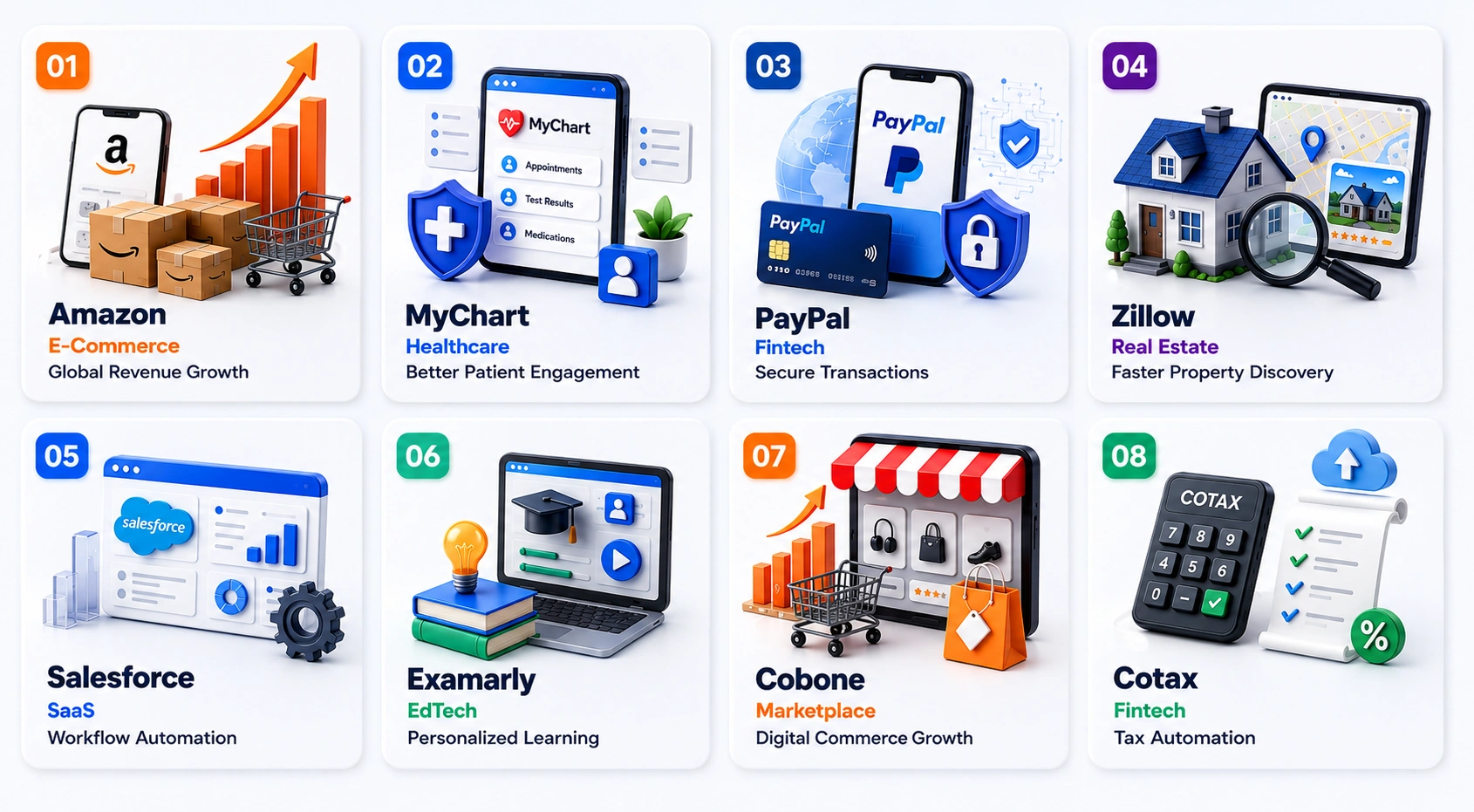
1) Amazon: Transforming E-Commerce Into a Global Revenue Engine
Amazon’s ecosystem-level scalability is supported by strong API-first architecture and engineering practices similar to those delivered through API development services and modern cloud engineering approaches.
Business Challenge
Traditional retailers often struggle with:
- Inventory management across multiple locations
- Limited geographic reach
- Inconsistent customer experiences
- Cart abandonment and conversion challenges
Web Application Features Driving Success
Amazon’s web application leverages:
- Real-time inventory synchronization
- AI-powered product recommendations
- One-click purchasing experiences
- Personalized search results
- Secure payment processing
- Mobile-first and PWA-inspired experiences
Business Impact
Amazon’s recommendation engine is estimated to influence more than 35% of purchases, highlighting the value of personalization in eCommerce.
Key outcomes include:
- Higher customer retention rates
- Increased average order values
- Reduced purchasing friction
- Continuous 24/7 revenue generation
- Global market accessibility
2) MyChart: Revolutionizing Digital Healthcare Experiences
MyChart demonstrates how healthcare web applications can simplify patient interactions while improving operational efficiency for healthcare providers.
Business Challenge
Healthcare organizations frequently encounter:
- Administrative bottlenecks
- Missed appointments
- Limited patient engagement
- Fragmented communication channels
Web Application Features Driving Success
MyChart enables:
- Online appointment scheduling
- Secure patient-provider messaging
- Electronic health record access
- Prescription management
- Telehealth consultations
Business Impact
According to industry reports, telehealth adoption continues to improve healthcare accessibility while reducing operational burdens for providers.
Benefits include:
- Faster appointment management
- Lower administrative costs
- Improved patient satisfaction
- Better healthcare accessibility
- Enhanced care coordination
3) PayPal: Building Trust Through Secure Digital Financial Services
PayPal transformed digital payments by making online transactions secure, simple, and accessible for businesses and consumers worldwide.
Business Challenge
Financial institutions and merchants must balance:
- Transaction security
- Fraud prevention
- Customer convenience
- Regulatory compliance
Web Application Features Driving Success
PayPal’s platform includes:
- Secure payment processing
- Real-time transaction monitoring
- Fraud detection systems
- Digital wallet functionality
- Multi-currency payment support
Business Impact
With more than 400 million active accounts globally, PayPal demonstrates how fintech web applications can scale while maintaining customer trust.
Business advantages include:
- Increased customer confidence
- Faster transactions
- Higher digital adoption rates
- Reduced payment friction
- Stronger customer loyalty
4) Zillow: Enhancing Property Discovery With Interactive Real Estate Experiences
Zillow has transformed how people search, evaluate, and purchase properties through an intuitive and data-rich web application experience.
Business Challenge
Property buyers often face:
- Limited property information
- Time-consuming research processes
- Difficulty comparing options
- Lack of market transparency
Web Application Features Driving Success
Platforms like Zillow rely heavily on responsive and dynamic frontend systems built using modern frameworks similar to Angular development services to deliver fast, interactive user experiences.
Zillow provides:
- Interactive property maps
- Virtual home tours
- Mortgage calculators
- Market trend insights
Business Impact
By combining property data with user-friendly experiences, Zillow has become one of the most visited real estate platforms in the United States.
Key outcomes include:
- Improved user engagement
- Higher lead generation
- Better buyer confidence
- Faster decision-making
- Increased conversion opportunities
5) Salesforce: Powering Business Growth Through Scalable SaaS Solutions
Salesforce is one of the most successful SaaS web apps examples, helping businesses manage customer relationships and automate critical processes.
Business Challenge
Growing organizations often struggle with:
- Disconnected customer data
- Manual sales processes
- Limited visibility into pipelines
- Inefficient workflows
Web Application Features Driving Success
Salesforce offers:
- CRM automation
- Workflow management
- Business analytics dashboards
- Third-party integrations
- AI-powered sales insights
Business Impact
Salesforce pioneered the SaaS model and demonstrated how cloud-based web applications can deliver scalable business value.
Organizations benefit from:
- Increased sales productivity
- Improved forecasting accuracy
- Better customer retention
- Faster decision-making
- Scalable growth infrastructure
Large-scale SaaS platforms like Salesforce often extend functionality through custom SaaS development, enabling deeper integrations with enterprise systems.
6) Perplexity AI: Setting the Standard for AI-Native Web Application Experiences
Perplexity AI represents a new generation of web applications built entirely around artificial intelligence- not as an added feature, but as the core product architecture.
Business Challenge
Traditional search and research tools face increasing limitations:
- Information retrieval is disconnected from synthesis
- Users must manually evaluate and cross-reference sources
- Static interfaces cannot adapt to conversational or contextual queries
Web Application Features Driving Success
Perplexity AI’s platform delivers:
- Real-time AI-powered answer generation with cited sources
- Conversational search experiences that replace static keyword queries
- Multi-turn context retention across research sessions
- Deep research mode for extended, structured analysis
- Seamless integration of web data with LLM reasoning
Business Impact
Launched in 2022 and accelerating significantly post-2024, Perplexity AI crossed 15 million daily active users by early 2025, demonstrating rapid adoption of AI-native web experiences among knowledge workers, researchers, and business professionals.
Key outcomes include:
- Faster information synthesis for enterprise users
- Higher user engagement through conversational UX
- New monetization models through AI Pro subscriptions
- Competitive disruption of legacy search-based workflows
- Demonstrated product-market fit for AI-first web application architecture
7) LogiNext: Optimizing Logistics and Supply Chain Operations Through Intelligent Automation
LogiNext demonstrates how logistics and supply chain web applications help businesses streamline deliveries, improve visibility, and reduce operational costs through real-time tracking and automation.
Business Challenge
Logistics companies and supply chain operators often face:
- Lack of real-time shipment visibility
- Manual route planning
- Delivery delays
- Inefficient fleet utilization
- High operational costs
Web Application Features Driving Success
LogiNext’s platform provides:
- Real-time shipment tracking
- AI-powered route optimization
- Fleet management dashboards
- Delivery performance analytics
- Automated customer notifications
- Multi-location logistics monitoring
Business Impact
Leading logistics providers use platforms like LogiNext to improve operational efficiency and enhance delivery experiences across complex supply chains.
Key outcomes include:
- Reduced delivery times
- Improved fleet utilization
- Lower operational costs
- Enhanced customer satisfaction
- Greater supply chain visibility
8) Microsoft Dynamics 365: Enabling Enterprise-Wide Digital Transformation
Microsoft Dynamics 365 is one of the most widely adopted enterprise web applications, helping organizations unify operations, customer management, finance, and business intelligence within a single cloud-based platform.
Business Challenge
Large enterprises often struggle with:
- Disconnected business systems
- Data silos across departments
- Limited operational visibility
- Manual business processes
- Inefficient decision-making
Web Application Features Driving Success
Dynamics 365 offers:
- Enterprise resource planning (ERP)
- Customer relationship management (CRM)
- Financial management tools
- Supply chain and inventory management
- AI-powered business insights
- Workflow automation and integrations
Business Impact
Enterprises across industries use Dynamics 365 to improve collaboration, automate operations, and gain real-time visibility into business performance.
Organizations benefit from:
- Improved operational efficiency
- Faster decision-making
- Enhanced cross-functional collaboration
- Reduced administrative workload
- Scalable enterprise growth
9) Google Maps: Delivering Seamless Single Page Application Experiences
Google Maps is one of the most recognized single-page web applications, demonstrating how SPAs can deliver highly interactive user experiences without requiring full-page reloads.
Business Challenge
Traditional web applications often face:
- Slow page transitions
- Interrupted user experiences
- High user abandonment rates
- Limited real-time interactions
Web Application Features Driving Success
Google Maps leverages:
- Dynamic content loading
- Real-time map rendering
- Interactive location search
- Live traffic updates
- Route planning and navigation
- Instant user interactions
Business Impact
Google Maps showcases how single-page applications can provide fast, responsive, and highly engaging digital experiences for millions of users worldwide.
Key outcomes include:
- Improved user engagement
- Faster application performance
- Seamless user experiences
- Reduced page load interruptions
- Higher user retention
10) Examarly: Modernizing Online Learning Through Intelligent Education Technology
Examarly showcases how educational web applications can create personalized learning experiences for students preparing for competitive examinations.
Business Challenge
Traditional learning methods often lack:
- Personalization
- Progress visibility
- Performance insights
- Flexible accessibility
Web Application Features Driving Success
The platform includes:
- AI-driven performance analytics
- Mock examinations
- Personalized learning paths
- Progress tracking dashboards
- Interactive study resources
Business Impact
By combining education with data-driven insights, Examarly helps learners improve outcomes while maintaining engagement.
Benefits include:
- Higher learner engagement
- Improved performance tracking
- Personalized education experiences
- Scalable digital learning
- Better exam preparedness
11) Cobone: Driving Digital Commerce Through Marketplace Innovation
Cobone demonstrates how marketplace web applications can connect consumers and businesses while creating sustainable digital revenue opportunities.
Business Challenge
Businesses often struggle with:
- Customer acquisition costs
- Market visibility
- Digital reach limitations
- Promotional effectiveness
Web Application Features Driving Success
Cobone provides:
- Deal discovery platforms
- Merchant dashboards
- Digital payment integration
- Customer review systems
- Personalized offers
Business Impact
Marketplace applications create value for both businesses and consumers by simplifying transactions and expanding reach.
Outcomes include:
- Increased merchant visibility
- Higher customer engagement
- Greater transaction volumes
- Expanded market reach
- Improved customer acquisition
12) Cotax: Simplifying Tax Management With Fintech Automation
Cotax highlights how fintech web applications can simplify complex financial processes through automation and intelligent workflows.
Business Challenge
Tax preparation and compliance often involve:
- Manual documentation
- Time-consuming calculations
- Regulatory complexity
- Human errors
Web Application Features Driving Success
Cotax streamlines financial management through:
- Automated tax calculations
- Digital document management
- Compliance tracking
- Financial reporting tools
- Workflow automation
Business Impact
Automation-driven fintech platforms help businesses save time while improving accuracy and compliance.
Key advantages include:
- Reduced administrative workload
- Faster tax processing
- Improved compliance management
- Enhanced user convenience
- Greater operational efficiency
These examples of apps will provide insights for driving your business goals.
How do SaaS and Custom Web Applications Compare for Business Growth?
Both SaaS and custom web applications help businesses improve efficiency and scale operations, but they differ in flexibility, ownership, and long-term value. While SaaS solutions offer faster deployment and lower upfront costs, custom web applications provide greater customization, competitive differentiation, and scalability tailored to specific business needs.
SaaS vs Custom Web Application Comparison
Here is a quick comparison table:
| Factor | SaaS Application | Custom Web Application |
| Initial Cost | Lower upfront investment | Higher initial development cost |
| Deployment Speed | Fast implementation | Longer development timeline |
| Customization | Limited to vendor capabilities | Fully tailored to business needs |
| Scalability | Depends on vendor roadmap | Built to scale according to requirements |
| Integration Flexibility | May have integration limitations | Can integrate with any required system |
| Ownership | Vendor-owned platform | Complete ownership and control |
| Security Controls | Shared responsibility | Fully customizable security architecture |
| Competitive Advantage | Similar tools available to competitors | Unique features that differentiate the business |
| Maintenance | Managed by vendor | Managed by internal team or development partner |
| Best For | Startups and businesses with standard processes | Organizations with unique workflows and growth requirements |
How Can You Identify the Right Web Application Type for Your Business?
Selecting the right web application begins with understanding your business goals rather than focusing solely on technology.
Organizations exploring the web application development process can use the following framework to guide decision-making.
The 4-Question Web App Selector
Ask the 4 questions for identifying the right web application type for your business:
1) What Core Problem Are You Solving?
Define the specific challenge affecting customers, employees, or operations.
2) Who Are the Primary Users?
Identify whether the application serves:
- Customers
- Employees
- Partners
- Vendors
3) What Integrations Are Required?
Determine connections needed with:
- CRM systems
- ERP platforms
- Payment gateways
- Marketing tools
- Analytics solutions
4) What Does Success Look Like in 12 Months?
Establish measurable KPIs such as:
- Revenue growth
- Cost savings
- Customer retention
- Productivity gains
- Market expansion
This metric-driven approach helps organizations prioritize features and maximize web development ROI.
Which Web Application Trends Will Shape Business Success in 2026?
Several emerging technologies are shaping the future of web applications in 2026. Businesses are increasingly adopting Progressive Web Apps (PWAs), AI-powered functionality, serverless infrastructure, low-code platforms, edge computing, and headless CMS solutions to improve performance, scalability, and user experiences. These innovations are enabling organizations to accelerate digital transformation, streamline operations, and deliver smarter, more engaging digital products.
Selecting the right types of web app technology begins with understanding your business goals rather than focusing solely on technology.
Progressive Web Apps (PWAs)
Progressive Web Apps (PWAs) combine the accessibility of websites with the functionality of mobile apps. They offer fast load times, offline access, and push notifications, helping businesses improve user engagement, reduce bounce rates, and increase conversions without requiring a native app.
AI and Machine Learning Integration
AI and Machine Learning are becoming standard features in modern web applications. Businesses use AI to automate workflows, deliver personalized experiences, power intelligent chatbots, and generate actionable insights, enabling better customer experiences and more efficient operations.
The growing adoption of AI in web development is enabling businesses to enhance automation, improve user experiences, and generate more actionable insights.
Serverless Architecture
Serverless architecture allows businesses to build and scale applications without managing servers. This approach reduces infrastructure costs, improves flexibility, and accelerates deployment, making it ideal for organizations seeking faster innovation and operational efficiency.
Many enterprises also rely on devops development services to automate deployments and maintain system reliability in serverless environments.
Low-Code and No-Code Platforms
Low-code and no-code platforms enable businesses to develop applications faster using visual tools and pre-built components. These solutions help organizations reduce development timelines, improve agility, and quickly respond to changing business needs.
Edge Computing
Edge computing processes data closer to users, reducing latency and improving application performance. It is especially valuable for real-time applications, helping businesses deliver faster, more responsive digital experiences across devices and locations.
Organizations evaluating development trends should also consider a partner company when planning future initiatives.

Conclusion
The most successful businesses no longer view web applications as optional technology projects. They view them as strategic growth assets capable of improving efficiency, creating new revenue streams, strengthening customer relationships, and accelerating digital transformation. Whether you’re launching a new product, modernizing legacy systems, or scaling operations, investing in the right web application can deliver long-term competitive advantages.
As organizations continue adopting AI, automation, cloud technologies, and advanced digital experiences, the demand for scalable web application development services will only grow. Partnering with experienced development teams can help ensure your solution aligns with business goals, supports future growth, and delivers measurable ROI. To get an idea about these facts, a web app development guide will be helpful. At RipenApps, we help startups, enterprises, CEOs, CTOs, and product leaders transform ideas into powerful digital products through strategic custom web application development, innovation-driven engineering, and scalable technology solutions.
FAQs
1. What are examples of web applications used in businesses?
Business web applications include eCommerce platforms, CRM systems, healthcare portals, fintech platforms, learning management systems, logistics dashboards, client portals, and AI-powered customer engagement solutions. These applications help organizations automate workflows, improve customer experiences, and drive growth.
2. How do web applications help businesses grow?
Web applications support business growth by automating processes, improving customer engagement, reducing web development and operational costs, and enabling scalable digital services. They also provide real-time data insights that support faster and more informed decision-making.
3. What is the difference between a website and a web application?
A website primarily delivers information, while a web application allows users to interact with data and perform tasks. Web applications include features such as authentication, personalization, database integration, and dynamic functionality.
4. Which industries benefit most from custom web applications?
Industries that benefit significantly include healthcare, finance, retail, logistics, education, SaaS, manufacturing, and professional services. Organizations with unique workflows or compliance requirements often gain the greatest value.
5. What is the ROI of building a custom web application?
ROI varies by project scope, but many organizations achieve measurable returns through cost savings, productivity improvements, increased revenue, and enhanced customer retention. Studies show many businesses realize ROI within two years of implementation.
6. How long does it take to develop a business web application?
Development timelines typically range from three to twelve months depending on complexity, integrations, compliance requirements, and feature scope.
7. Should a small business build a custom web app or use off-the-shelf software?
Small businesses should consider custom development when unique workflows, scalability requirements, or competitive differentiation are strategic priorities. Off-the-shelf software may be sufficient for standard operational needs.
8. How much does it cost to build a custom web application?
The cost of developing a web application depends on complexity, features, and technology stack. Simple applications may cost between $5,000–$20,000, mid-level applications range from $20,000–$80,000, and enterprise-grade solutions can exceed $100,000 depending on scale and integrations.

SHARE
WRITTEN BY

Ishan Gupta
CEO & Founder
Ishan Gupta is a seasoned entrepreneur and CEO with extensive 8+ years of experience in business and mobile app development landscape. He believes that the right digital product allows companies to focus on what they do best, while technology handles the rest. With deep exposure to global markets, he understands what makes an app succeed. His approach translates business needs into clear product strategies, ensuring that every feature contributes to measurable ROI.
View All Articles




 India
India USA
USA Australia
 Canada
 UK
UK UAE
UAE